Si Collection, Lower Volume
Radical: Dog (quǎn)
Kangxi Strokes: 19
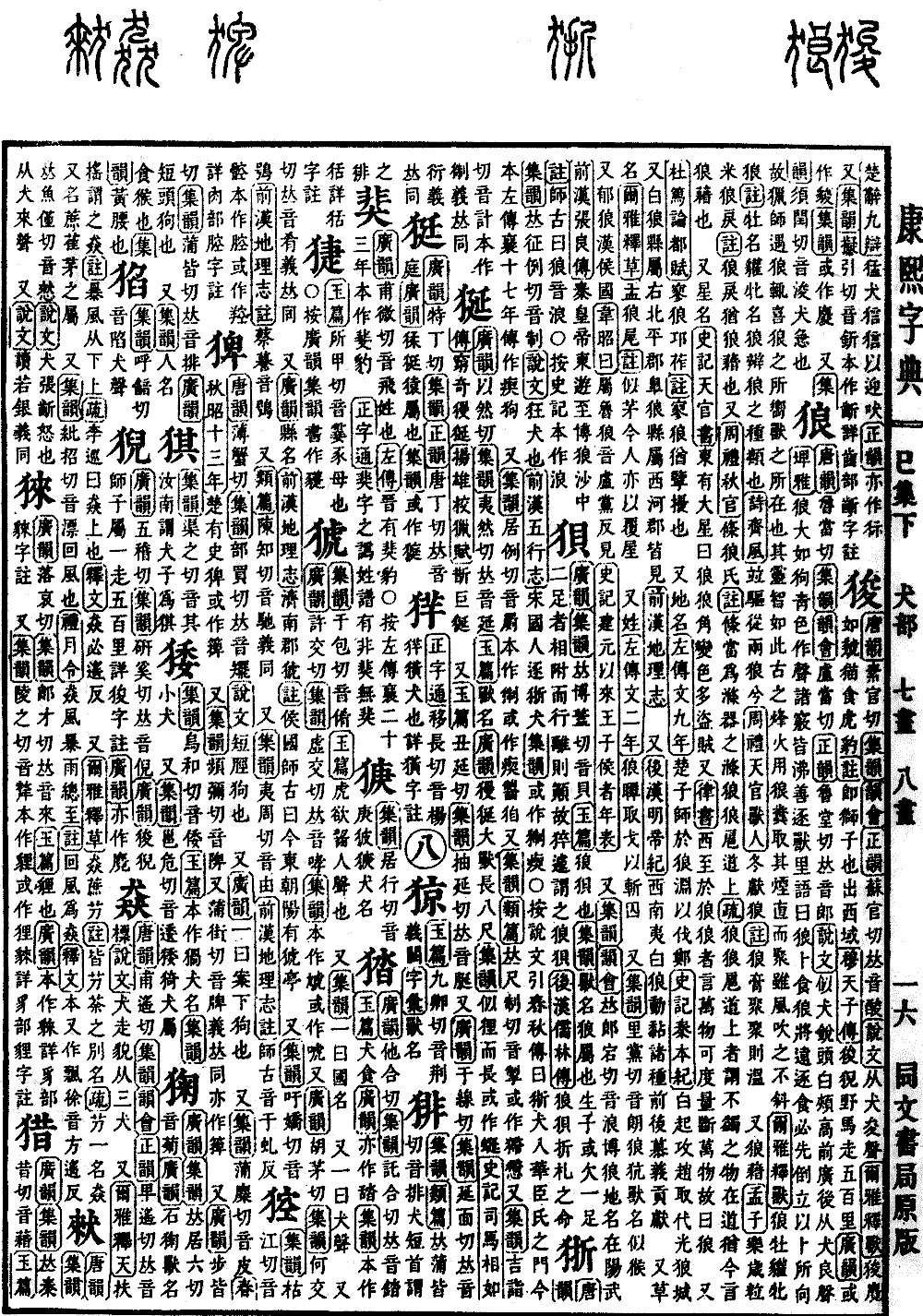
Page 712, Entry 25
Pronounced jie. According to the Jade Chapter (Yupian), the name of a beast. Sometimes written in a variant form (shuo). A beast resembling a bear.
Also, pronounced xi. According to the Classic of Mountains and Seas (Shanhaijing), on the Mountain of Former People, there is a black insect, shaped like a bear, named lie-lie. Guo Pu comments: It is also written in a variant form (shuo), pronounced xi.
Also, pronounced xi. The meaning is the same.
Also, pronounced que. According to the Collected Elegance (Huiya), a fine dog of the Song dynasty. One name is lie-lie. The Collected Rhymes (Jiyun) notes that this is the original form. Sometimes written in a variant form (shuo). See the annotation under that character.
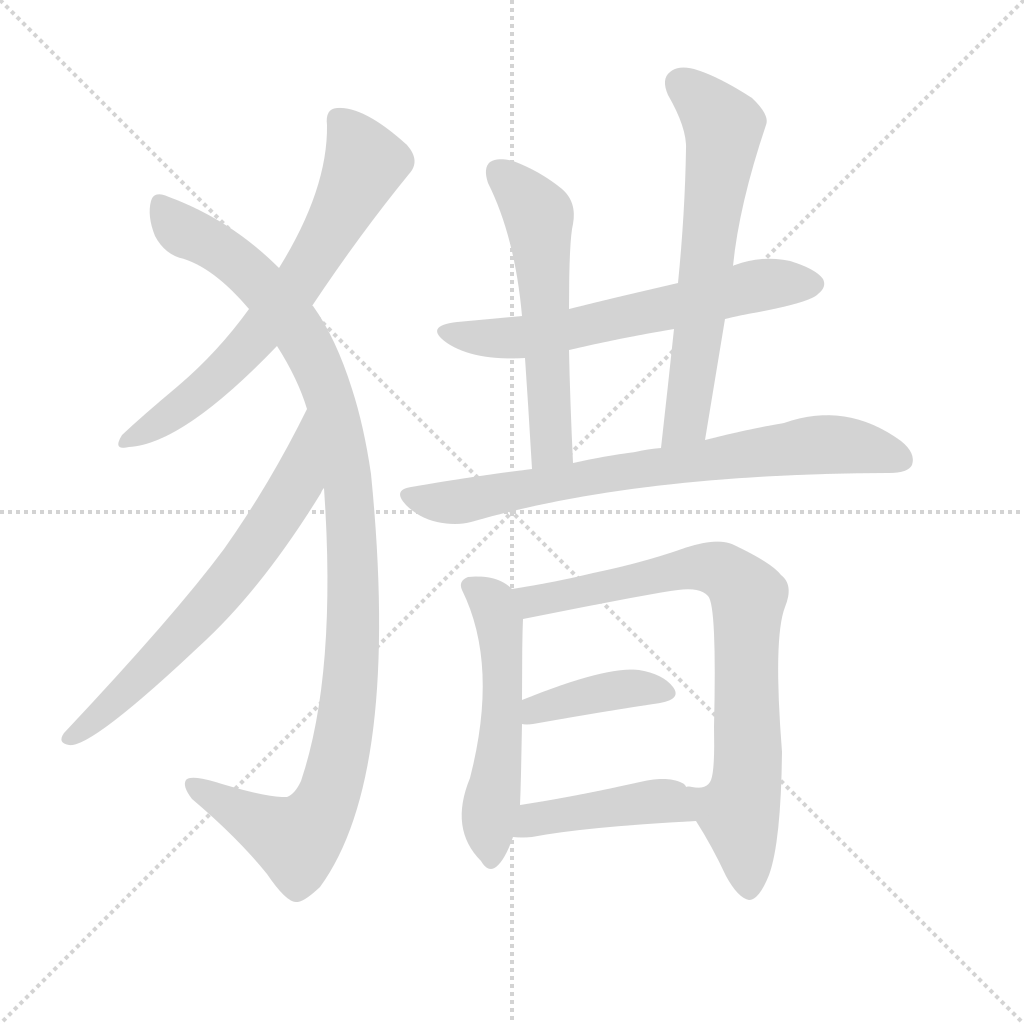
Lie (hunting)
Pronounced lie. According to the Analytical Dictionary of Characters (Shuowen), to hunt, to chase game. According to the Broad Rhymes (Guangyun), to take beasts. The White Tiger Discussions (Baihu Tong) states: The hunting of the four seasons is collectively named lie, meaning to hunt and eliminate pests. The Master Shi (Shizi) states: In the time of Fuxi, the world had many beasts, so he taught the people to hunt. According to the Literary Expositor (Erya), lie means to be cruel. The commentary states: Lie refers to following the game. Because it must be cruel and harmful to things, it is described this way. According to the Literary Expositor (Erya), spring hunting is called sou, summer hunting is called miao, autumn hunting is called mian, and winter hunting is called shou. According to the Book of Odes (Shijing), one does not trap, one does not hunt. According to the Record of Rites (Liji), the jackal offers the beast, and then one goes hunting. According to Cai Yong's Chapters and Sentences on the Monthly Ordinances (Yueling Zhangju), hunting is the name for catching quickly. According to the Correction of Characters (Zhengzitong), hunting is for providing for the sacrificial vessels and practicing for warfare; both are matters of national importance.
Also, to shake. According to the Discourses of Wu (Wuyu), now the grand officer Guozi has raised his masses to attack the troops of the State of Wu. The commentary states: Lie means to shake.
Also, in the Schooling the Hunt Rhapsody (Xiaolie Fu) by Yang Xiong, it is described as expansive and sequential. The commentary by Shi Gu states: Jielie means to alternate and follow in order.
Also, a type of turtle. According to the Literary Expositor (Erya), a turtle with a posterior covering is called lie. According to the Rites of Zhou (Zhouli), the southern turtle is of the lie category.
Also, the name of a mountain. According to the Huainanzi, the Luo River emerges from Lie Mountain.
Also, the name of a vehicle. According to the History of the Former Han (Hanshu), the Grand Coachman used a ling-lie carriage to welcome the great-grandson. The commentary by Wen Ying states: A ling-lie is a small carriage.
Examination of the text: In the History of the Former Han (Hanshu), the text says the Grand Coachman used a ling-lie carriage to welcome the great-grandson; the original text wrongly stated tortoise-grandson, so it has been corrected to great-grandson.