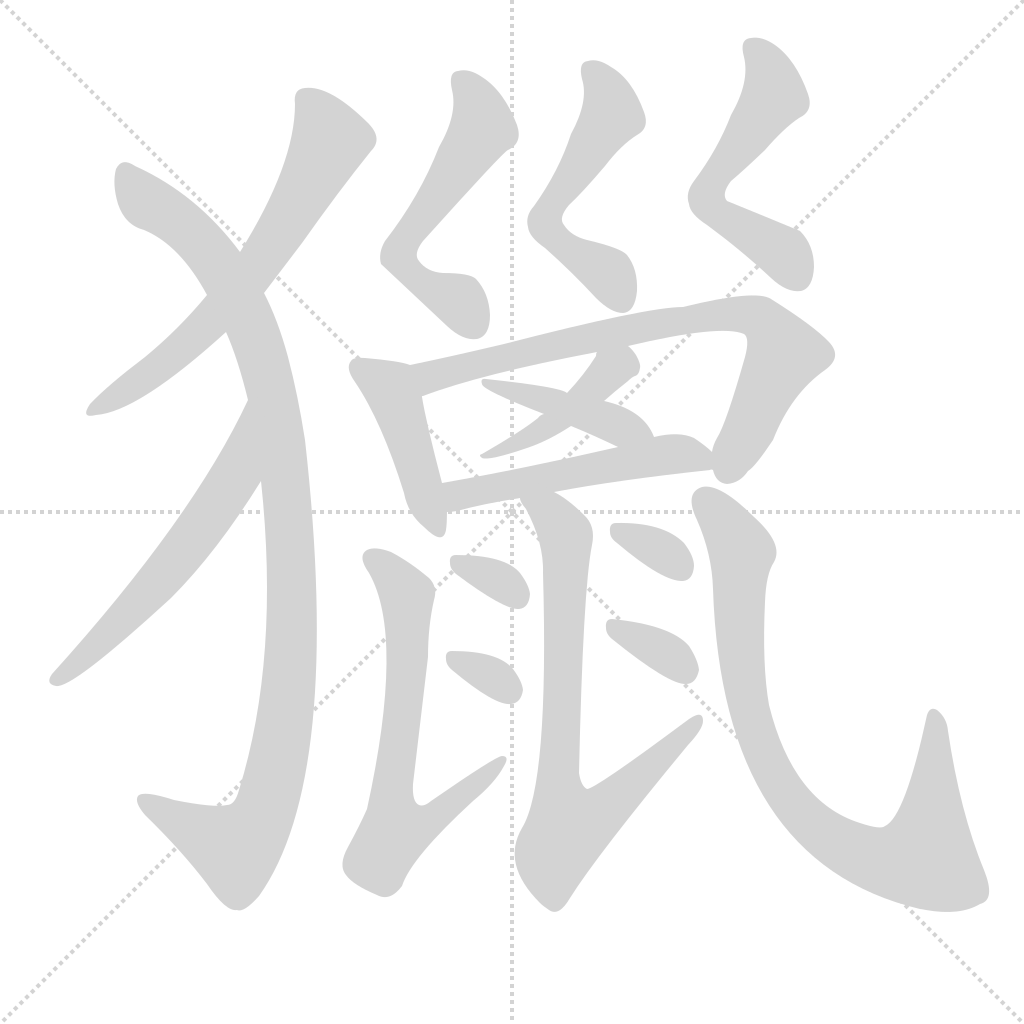
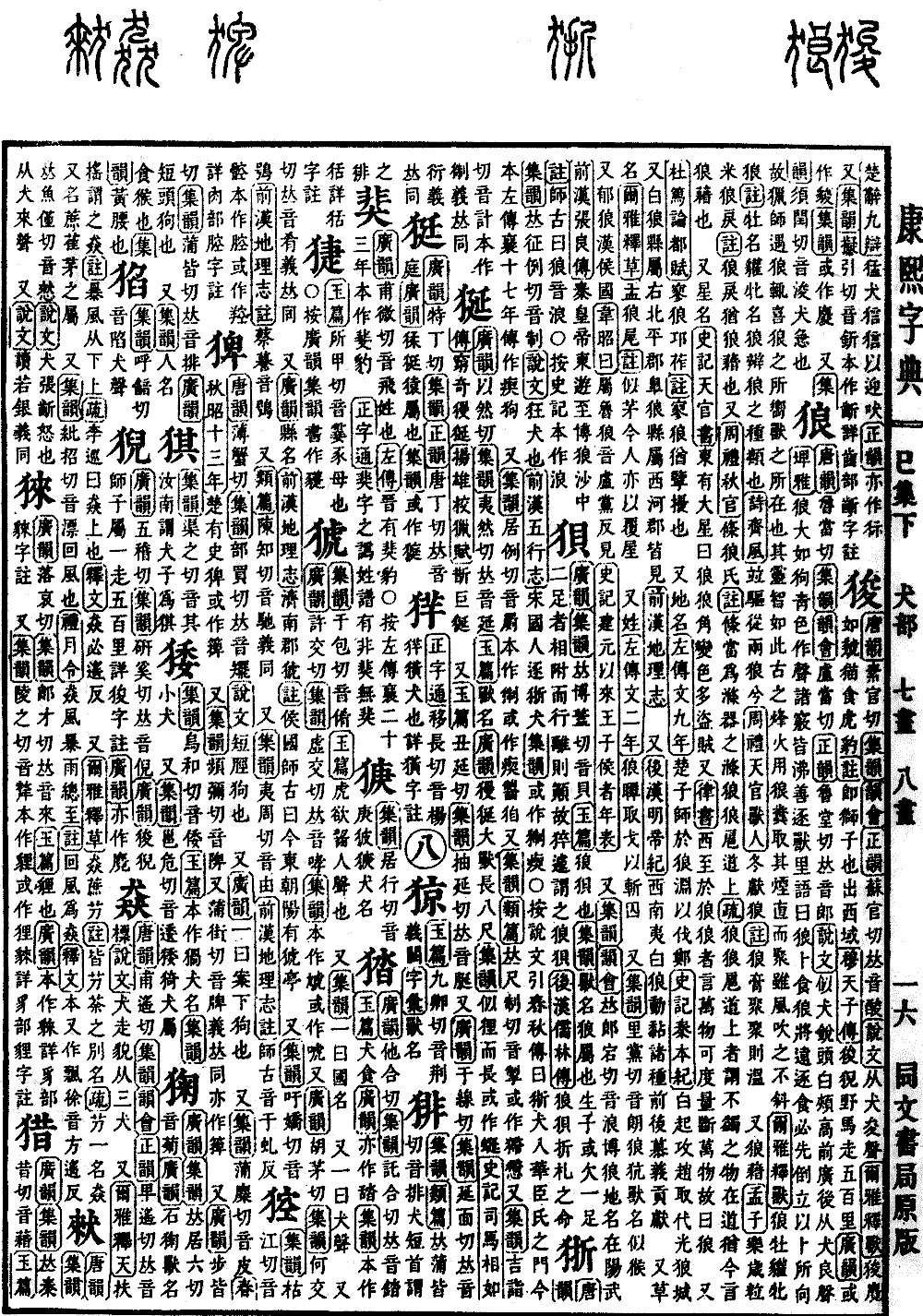
Si Collection, Lower Volume
Radical: Dog (quǎn)
Kangxi Strokes: 19
Page 712, Entry 14
Pronounced liè.
Shuowen Jiezi (Explanation of Simple and Compound Characters): To hunt, to pursue game.
Guangyun (Broad Rhymes of the Guangyun): To capture animals.
White Tiger Hall Discussions (Baihu Tong): Hunting in the four seasons is collectively called hunting, which is to eliminate harm for the fields.
Master Shi (Shizi): In the age of Fuxi, there were many beasts under heaven, so he taught people how to hunt.
Erya (Approaching the Elegant): Hunting is cruelty.
Commentary: Hunting refers to following the game. It must be harmful to living things, hence it is called so.
Erya: Spring hunting is called sou, summer hunting is called miao, autumn hunting is called xian, and winter hunting is called shou.
Book of Odes (Shijing): Neither hunting nor stalking.
Book of Rites (Liji): Only after the jackal sacrifices the prey may one engage in hunting.
Cai Yong, Commentary on Monthly Ordinances (Yueling Zhangju): Hunting is a term for capturing quickly.
Collection of Correct Characters (Zhengzitong): Hunting is used to provide food for sacrifices and to practice military arts; both are matters of national importance.
Also, to shake.
Discourses of the States (Guoyu): Now the Great Officers and the sons of the state have raised their commoners and soldiers to shake the military forces of the State of Wu.
Commentary: Hunting means to shake.
Also, Yang Xiong, Rhapsody on the Great Hunt (Xiaolie Fu): Vast and successive.
Commentary: Shigu says, successive refers to being arranged in sequence.
Also, the name of a turtle.
Erya: A turtle with a covering at the rear is called lie.
Commentary: This refers to when the shell covers the rear, it is called lie.
Rites of Zhou (Zhouli): The southern turtle is of the lie category.
Also, the name of a mountain.
Huainanzi (Masters of Huainan): The Luo River emerges from Lie Mountain.
Also, the name of a carriage.
History of the Former Han (Hanshu), Annals of Emperor Xuan: The Grand Coachman used a small carriage to welcome the great-grandson.
Commentary: Wen Ying says, a carriage name for a small vehicle.
Textual research: In the Annals of Emperor Xuan of the Former Han, it originally stated the turtle-grandson; following the original text, it has been corrected to great-grandson.