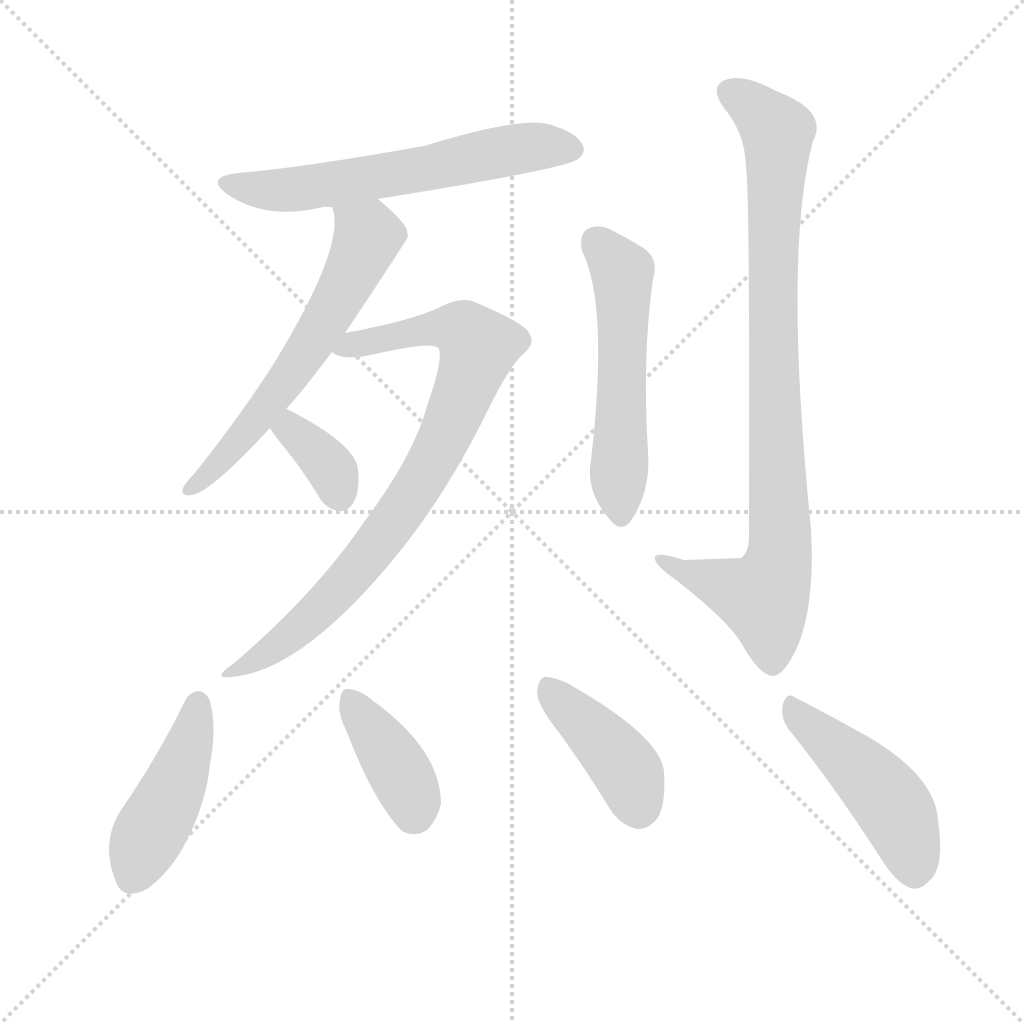
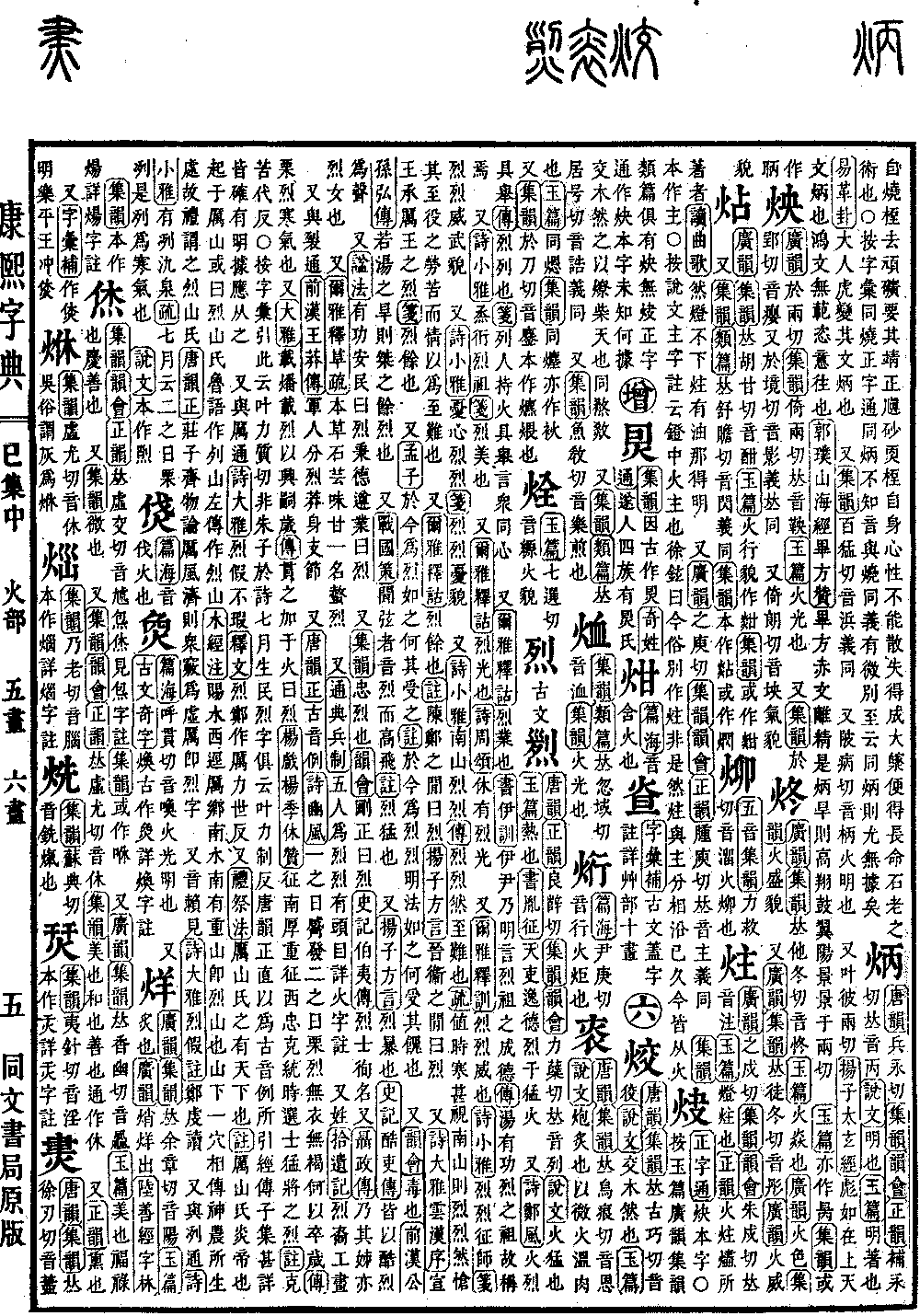
Si Collection, Middle Volume. Radical: Fire (huǒ). Kangxi stroke count: 10. Page 669, Entry 16.
In ancient texts, it is also written in a variant form (liè). Pronounced liè. Pronounced liè. Pronounced liè. Its pronunciation is the same as liè. Explanations in the Explaining Graphs and Analyzing Characters (Shuowen Jiezi) define it as fire burning fiercely. The Dictionary of Standard Characters (Yupian) defines it as blazing heat. As recorded in the Book of Documents (Shangshu), section Investigation of Yin (Yinzheng): The officials of the Son of Heaven have neglected their virtues; it is more severe than a blazing fire. Also, in the Book of Odes (Shijing), section Odes of Zheng (Zhengfeng), there is the phrase: The blazing fires are all raised. The commentary explains "lie" as organized. The sub-commentary explains that the people were arranged in rows, holding torches and raising them together, signifying unity of effort. Furthermore, the Erya: Explaining Ancient Words (Erya Shigu) explains "lie" as merit or achievement. As recorded in the Book of Documents (Shangshu), section Instructions of Yi (Yixun): Yi Yin clearly spoke of the completed virtues of our ancestors of merit. The commentary explains that Shang Tang was an ancestor with meritorious achievements, hence he is so addressed. Also, in the Book of Odes (Shijing), section Lesser Odes of the Kingdom (Xiaoya), there is: To joyfully celebrate the ancestors of merit. The sub-commentary explains "lie" as beautiful. The Erya: Explaining Ancient Words (Erya Shigu) explains "lie" as light or brilliance. In the Book of Odes (Shijing), section Praise Odes of Zhou (Zhousong), there is: Possessing glorious, brilliant light. The Erya: Explaining Words (Erya Shixun) states that "lie lie" denotes martial prowess. In the Book of Odes (Shijing), section Lesser Odes of the Kingdom (Xiaoya), there is: With martial, warlike, and commanding armies. The sub-commentary explains "lie lie" as the appearance of martial vigor. Also, in the Book of Odes (Shijing), section Lesser Odes of the Kingdom (Xiaoya), there is: My worried heart is heavy and distressed. The sub-commentary explains "lie lie" as the appearance of sorrow. Furthermore, in the Book of Odes (Shijing), section Lesser Odes of the Kingdom (Xiaoya), there is: The Southern Mountain is high and steep. The commentary explains "lie lie" as an appearance of extreme difficulty. The sub-commentary explains that at that time the weather was bitterly cold, and seeing the Southern Mountain steep and towering, the speaker lamented the hardships of service, thus feeling it was extremely difficult. The Erya: Explaining Ancient Words (Erya Shigu) explains "lie" as remnant or leftover. The note states that this is the dialect of the Zheng region. The Dialects (Yangzi Fangyan) records that the dialects of the Jin and Wei regions also use "lie". The Book of Odes (Shijing), section Greater Odes of the Kingdom (Daya), preface to the Cloud Han (Yunhan), records: King Xuan inherited the remnants of King Li. The sub-commentary explains "lie" as a remnant disaster. Also, the Mencius contains: Today it is a severe disaster; how can one accept this? The note explains that since the laws are now strict and clear, how could one accept his gift? The Rhyme Collection (Yunhui) defines it as poisonous harm. The History of the Former Han (Qian Hanshu), Biography of Gongsun Hong, records: If it is like the drought of Tang, then it is the remnant harm of Jie. Also, the Strategies of the Warring States (Zhanguo Ce) records: Those who hear the strings, the sound is intense and flies high. The note explains "lie" as fierce or intense. The Dialects (Yangzi Fangyan) explains "lie" as tyrannical. The Records of the Grand Historian (Shiji), Biography of Harsh Officials, records: All were famous for their cruelty and tyranny. The Book of Posthumous Titles (Shifa) states: To have merit and bring peace to the people is called "lie"; to uphold virtue and follow through on achievements is called "lie". The Rhyme Collection (Jiyun) defines it as loyal and heroic. The Rhyme Collection (Yunhui) defines being firm and upright as "lie". The Records of the Grand Historian (Shiji), Biography of Bo Yi, has: The loyal and brave sacrifice themselves for fame. The Biography of Nie Zheng has: She was indeed a heroic woman. The Erya: Explaining Grasses (Erya Shicao) sub-commentary records that in the Materia Medica (Bencao), the taste of stone-rue is sweet, and it is also called "sting-lie". The Comprehensive Institutional History (Tongdian), Military System, records that five men constitute a "lie", and a "lie" has a leader. See the notes on the character Fire for details. It also serves as a surname. The Record of Forgotten Matters (Shiyiji) records a person named Lie Yi who was skilled in painting. It is also used interchangeably with the character for "split" (lie). The History of the Former Han (Qian Hanshu), Biography of Wang Mang, records: The soldiers split Wang Mang's body and limbs. The Corrected Tang Rhymes (Tangyun Zheng) records that the ancient pronunciation was read as li. The Book of Odes (Shijing), section Odes of Bin (Binfeng), has: In the first month, the winds blow; in the second month, the cold is bitter. Without clothes or rough cloth, how can we finish the year? The commentary explains "li lie" as cold air. Also, the Book of Odes (Shijing), section Greater Odes of the Kingdom (Daya), has: They roast and they grill, to continue the years. The commentary explains that skewering meat and placing it over a fire to roast is called "lie". The Eulogies of Yang Xi and Yang Jixiu contains: The General of the South was substantial and heavy, the General of the West was loyal and capable, gathering talents of the era, the prowess of a fierce general. The note says "ke" is pronounced ku and dai. According to the Dictionary of Characters (Zihui), citing this passage: the rhyme is li and zhi. This is incorrect. In his notes on the Book of Odes (Shijing), sections July (Qiyue) and Birth of the People (Shengmin), Zhu Xi gives the phonetic reading for the character "lie" as: the rhyme is li and zhi. The Corrected Tang Rhymes (Tangyun Zheng) directly assumes the ancient pronunciation to be li. The cited materials from the classics and histories are very detailed and have clear grounds; one should follow them. It is also used interchangeably with the character for "severe" (li). The Book of Odes (Shijing), section Greater Odes of the Kingdom (Daya), has: Great and bright, without flaw. The Explanation of the Text (Shiewen) records that in the version of Zheng Xuan, the character "lie" is written as "li", pronounced li and shi. Also, the Book of Rites (Liji), section Sacrificial Rituals (Jifa), records: When the Lishan family possessed the world. The note explains that the Lishan family is the Flame Emperor (Yandi). They arose at Lishan, or were called the Lieshan family. The Discourses of Lu (Luyu) writes it as Lieshan. The Zuo Tradition (Zuo Zhuan) writes it as Lieshan. The Commentary on the Water Classic (Shuijing Zhu) records that the Ci River flows west past the south of Li village, and south of the water there is a heavy mountain, which is Lieshan. Below the mountain is a cave, legend says it is the birthplace of the Shennong clan, hence the Book of Rites (Liji) calls it the Lieshan family. The Corrected Tang Rhymes (Tangyun Zheng) records that in the Zhuangzi, section Equality of Things (Qiwulun), the "li" in the phrase "the severe wind ceases, then the myriad apertures become empty" is the character "lie". It is also pronounced as lai. This is seen in the notes to the Book of Odes (Shijing), section Greater Odes of the Kingdom (Daya), "Lie Jia", which Zheng Qian read this way. It is also used interchangeably with the character for "cold" (lie). The Book of Odes (Shijing), section Lesser Odes of the Kingdom (Xiaoya), has: The coldness of the spring water. The sub-commentary explains that the section July (Qiyue) has "in the second month the cold is bitter", so "lie" means cold air. The Explaining Graphs and Analyzing Characters (Shuowen Jiezi) originally wrote it as a derivative of the death radical. The characters lie and lie originally followed the death radical and were written as a single form.