Shen Collection, Upper Volume
Radical: Grass (cǎo)
蓮; Kangxi strokes: 17; Page 1052, Entry 01
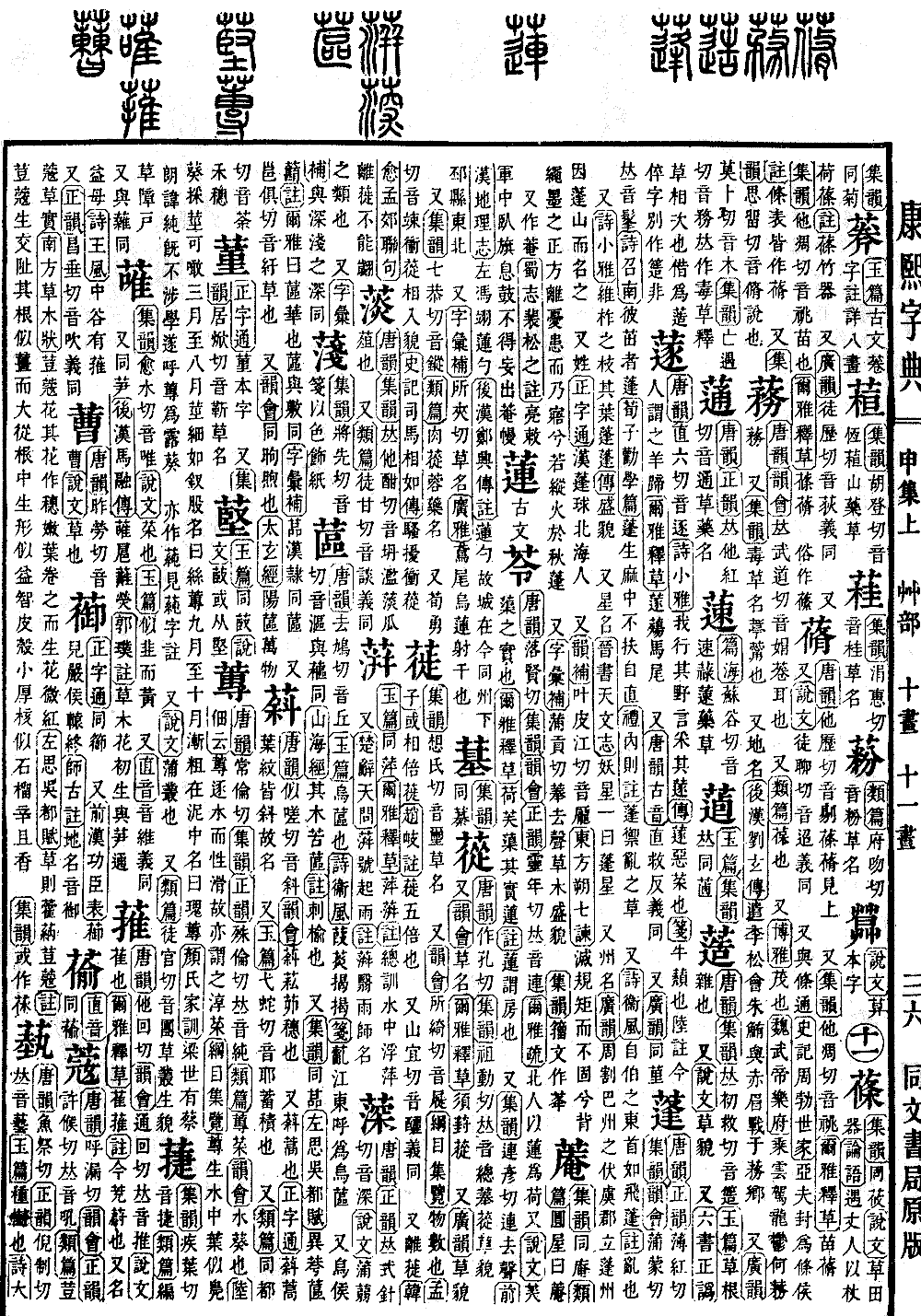
Archaic form: ling. Pronounced lian (rising tone) according to Tang Rhyme (Tangyun). Pronounced lian (rising tone) according to Collection of Rhymes (Jiyun), Rhyme Meetings (Yunhui), and Orthodox Rhymes (Zhengyun). According to the Commentary to the Literary Expositor (Erya Shu), people in the north call the lotus he. Also, according to Explaining Graphs and Analyzing Characters (Shuowen Jiezi), it is the fruit of the lotus flower (fuqu). According to the Literary Expositor, Commentary on Grasses (Erya, Shicao), he is fuqu; its fruit is called lian. Note: lian refers to the lotus seed pod. Also, pronounced lian (departing tone) according to Collection of Rhymes (Jiyun). According to the History of the Former Han Dynasty, Treatise on Geography (Qianhan, Dilizhi), there is a place called Lianshao in Zuofengyi. According to the Commentary on the Biography of Zheng Xing in the History of the Later Han Dynasty (Houhan, Zheng Xing Zhuan Zhu), Lianshao is an old city located northeast of the current Xiapi County in Tongzhou. Also, according to the Supplement to the Collection of Graphs (Zihui Bu), pronounced suo. The name of a plant. According to the Broad Extant Dictionary (Guangya), iris is also called wulian, which is the same as the leopard lily (shegan).