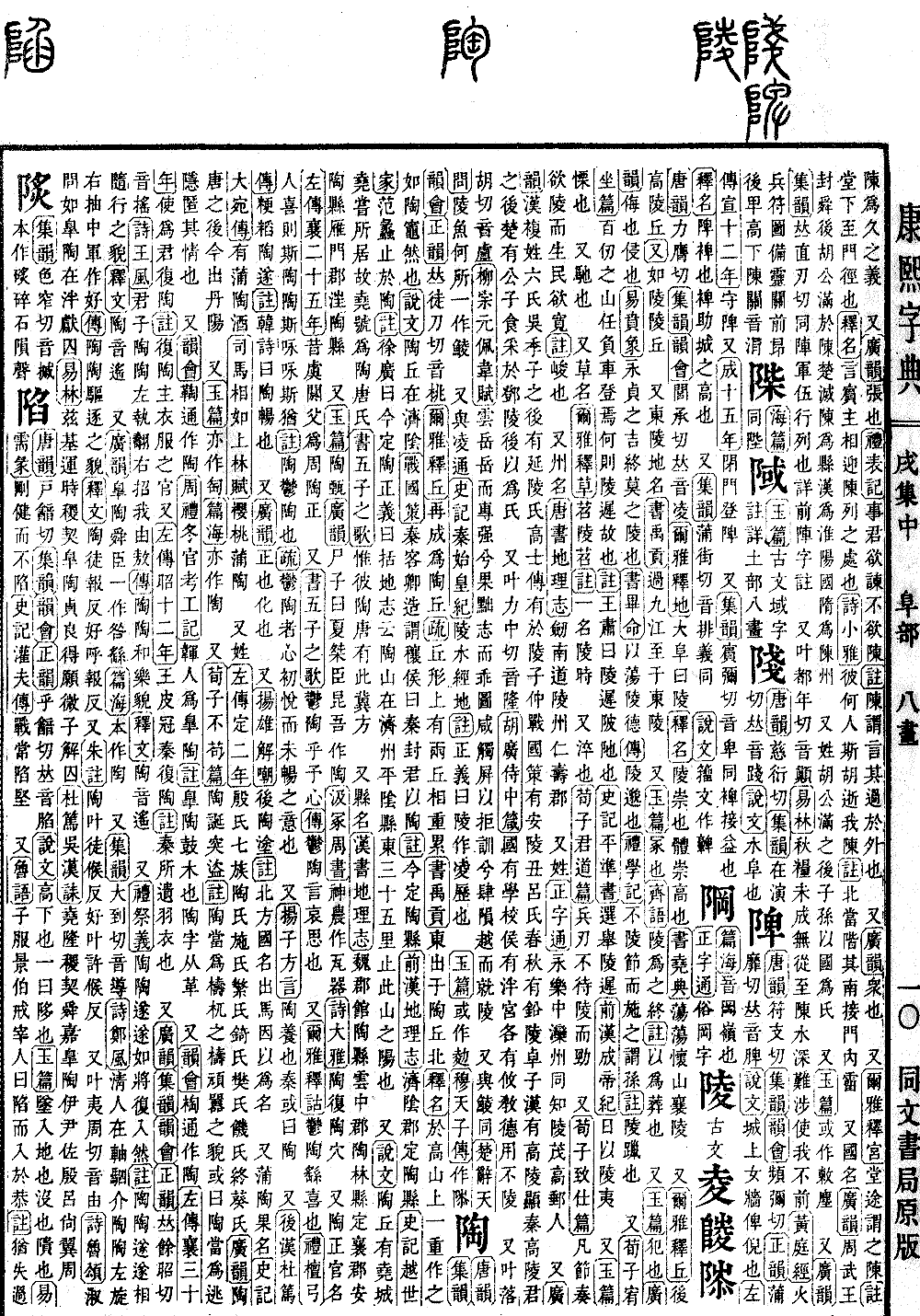
Xu Collection, Middle Volume. Radical: Mound (fù). Kangxi strokes: 16. Page number: 1354, entry 06.
Anciently written as the variant character lìng (夌). According to the Tang Rhymes (Tángyùn), pronounced "lì yīng qiè". According to the Collected Rhymes (Jíyùn) and the Rhyme Compendium (Yùnhuì), pronounced "lǘ chéng qiè". Read identically to líng (凌). The Explanations (Shìdì) chapter of the Erya (Ěryǎ) explains: A large earthen mountain is called líng. The Explanations of Names (Shìmíng) explains: Líng means lofty and grand in form. The Canon of Yao (Yáodiǎn) chapter of the Book of Documents (Shūjīng) records: The vast floodwaters enveloped the mountains and surged over the hills. Also, the Explanations (Shìqiū) chapter of the Erya (Ěryǎ) explains: That which is high at the rear is called língqiū. It also explains: That which rises like a mound is called língqiū. There is also "Dōnglíng", a place name. The Tribute of Yu (Yǔgòng) chapter of the Book of Documents (Shūjīng) records: Passing through Jiujiang, one arrives at Dōnglíng. Also, the Jade Chapters (Yùpiān) explains: A tomb. The Discourses of Qi (Qíyǔ) records: A tomb is the end of life. The Commentary explains: As a place of burial. Also, the Jade Chapters (Yùpiān) explains: To infringe upon. The Broad Rhymes (Guǎngyùn) explains: To insult, to encroach upon. The Image of Bì (Bìxiàng) chapter of the Classic of Changes (Yìjīng) records: Persistently upholding the righteous path brings good fortune; ultimately no one can encroach upon him. The Charge to Bì (Bìmìng) chapter of the Book of Documents (Shūjīng) records: Thereby indulging in wanton disregard for morality. The Commentary explains: Líng means to treat with disrespect. The Record of Learning (Xuéjì) chapter of the Book of Rites (Lǐjì) records: To carry out education without overstepping the stages of learning is called progressive instruction. The Commentary explains: Líng means to overstep. Also, the Yu Zuo (Yòuzuò) chapter of Xunzi (Xúnzǐ) records: A mountain a hundred rén (a unit of height) high, a laden cart can ascend it. Why is this? Because the slope is gentle. Wang Su's Commentary says: Língchí means a gently sloping gradient. The Treatise on the Standard Weight and Measures (Píngzhǔnshū) chapter of the Records of the Grand Historian (Shǐjì) records: The system of selection and recommendation declined. The Annals of Emperor Cheng (Chéngdì Jì) chapter of the Book of Han (Hànshū) records: Daily becoming more enfeebled. Also, the Jade Chapters (Yùpiān) explains: To tremble. It also explains: To gallop. It is also the name of a type of grass. The Explanations (Shìcǎo) chapter of the Erya (Ěryǎ) records: Tiáo is língtiáo. The Commentary explains: Also called língshí. It also means to temper or refine. The Way of the Ruler (Jūndào) chapter of Xunzi (Xúnzǐ) records: The edges of weapons become sharp without needing tempering. Also, the Returning from Office (Zhìshì) chapter of Xunzi (Xúnzǐ) records: In all matters, ritual and legal systems should be strict, but the nurturing of the common people should be generous. The Commentary explains: Jùn means strict and clear. It is also a prefecture name. The Treatise on Geography (Dìlǐzhì) chapter of the Old Book of Tang (Jiù Tángshū) records: In Jiannan Circuit there was Líng Prefecture, Renshou Commandery. It is also a surname. The Comprehensive Correct Character Dictionary (Zhèngzìtōng) records: Líng Mào, Assistant Prefect of Luanzhou during the Yongle reign, was a native of Gaoyou. Also, the Broad Rhymes (Guǎngyùn) records: During the Han dynasty, there were six double-character surnames. The descendants of Wu Jizi had the Yanling clan. The Biographies of Eminent Scholars (Gāoshì Zhuàn) features Yuling Zizhong. The Stratagems of the Warring States (Zhànguócè) features Anling Chou. The Master Lü's Spring and Autumn Annals (Lǚshì Chūnqiū) features Qianling Zhuozi. During the Han dynasty, there was Gaoling Xiǎn (a descendant of Lord Gaoling of Qin). In the state of Chu, there was a ducal son whose fief was Dengling, and later this was adopted as a surname. Also, an alternative pronunciation (yèyīn) is "lì zhōng qiè", read like lóng. Hu Guang's (Hú Guǎng) "Admonition for a Palace Attendant" (Shìzhōng Zhēn) records: The state has schools, the feudal lords have academies. Each has its own transformative influence, and virtue therefore does not decline. Also, an alternative pronunciation (yèyīn) is "luò hú qiè", read like lú. Liu Zongyuan's (Liú Zōngyuán) "Ode on Wearing a Leather Belt" (Pèiwéi Fù) records: Overbearing and unyielding like a lofty mountain, indeed going against one's will and deviating from the plan. All clash with the screen and reject instruction, wantonly falling towards decay. Also synonymous with the character líng (鯪). The Heavenly Questions (Tiānwèn) chapter of the Songs of Chu (Chǔcí) records: Where is the líng fish? One edition writes it as líng (鯪). Also interchangeable with the character líng (凌). The Annals of Qin Shihuang (Qínshǐhuáng Jì) chapter of the Records of the Grand Historian (Shǐjì) records: Traversing waters, passing through lands. The Commentary of Zheng Yi says: Líng (陵) is written as líng (凌), meaning to traverse. The Jade Chapters (Yùpiān) sometimes writes it as the variant character líng (凌). The Tale of King Mu, Son of Heaven (Mù Tiānzǐ Zhuàn) writes it as the variant character líng (凌).