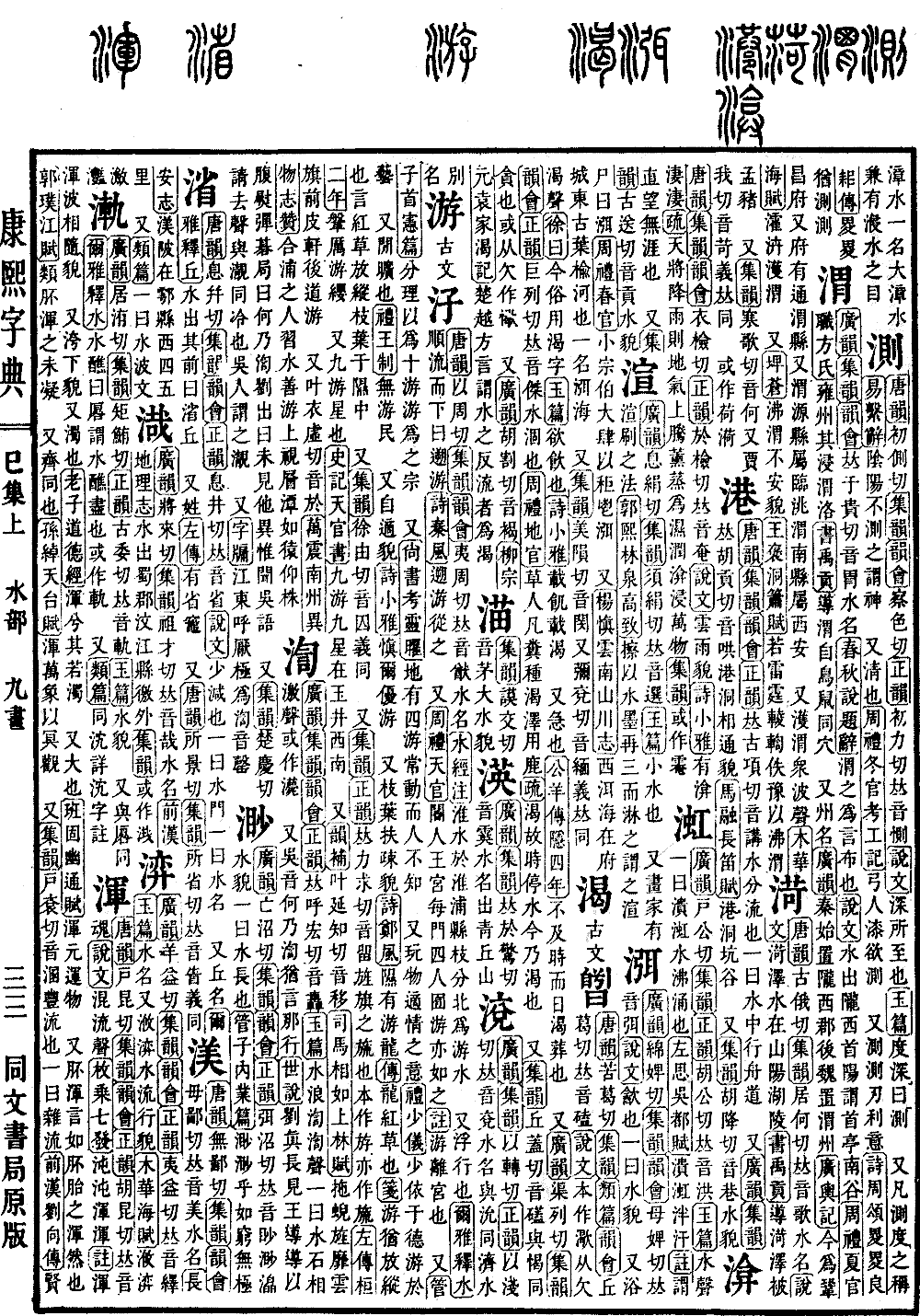
Si Collection, Upper Volume
Radical: Water (shuǐ)
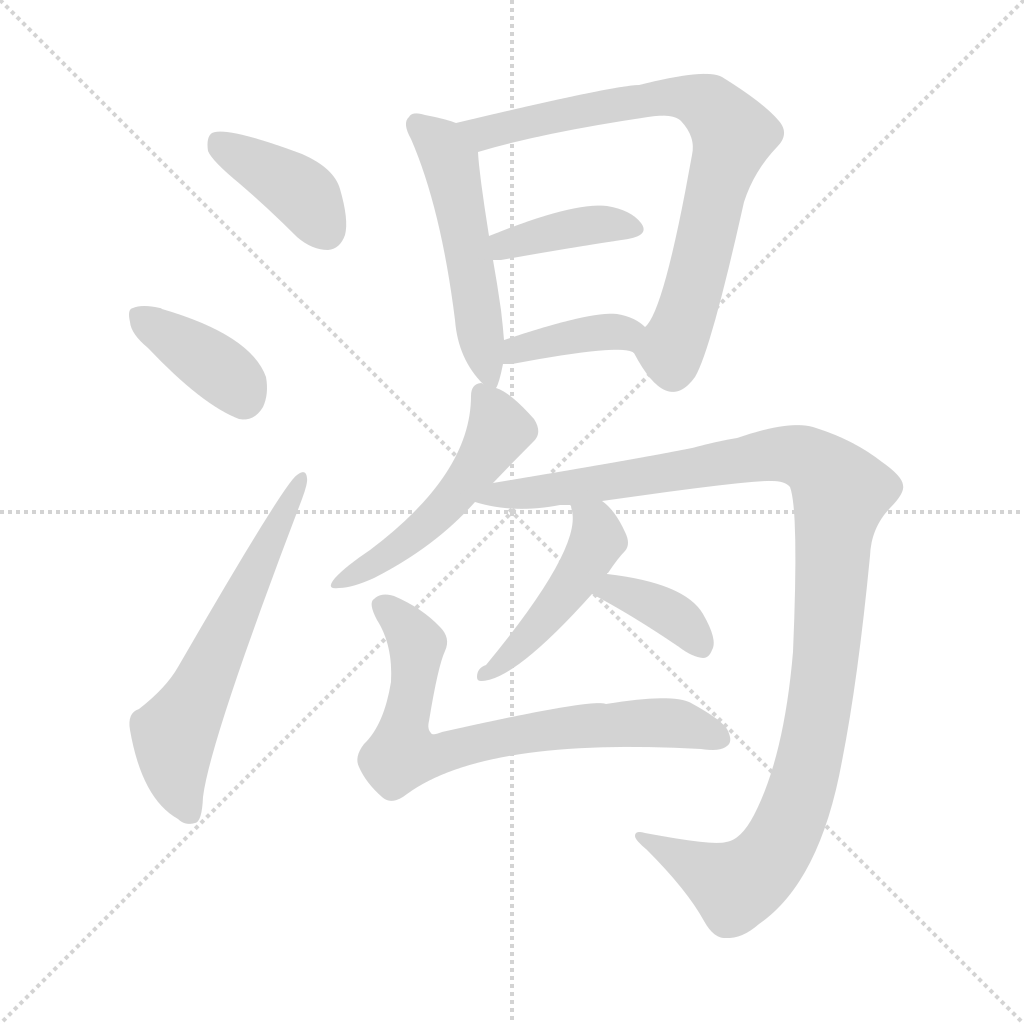
渴
Kangxi stroke count: 13
Page 635, Entry 09
Ancient form. According to Tang Rhymes (Tangyun), pronounced ke. According to Collected Rhymes (Jiyun), Categories of Characters (Leipian), and Dictionary of Rhymes (Yunhui), pronounced ke. According to Explanation of Simple and Compound Characters (Shuowen), originally written as the form with the missing-mouth radical component and the sound component ke. Xu states that the character is currently used in its popular form. According to Jade Chapters (Yupian), the desire to drink. In the Book of Odes (Shijing), it says: carrying hunger and carrying thirst. Also signifies urgent. In the Commentary of Gongyang (Gongyang Zhuan), for the fourth year of Lord Yin, it refers to a burial performed not at the proper time, which is called an urgent burial.
Also, according to Broad Rhymes (Guangyun), pronounced jie. According to Collected Rhymes (Jiyun), Dictionary of Rhymes (Yunhui), and Correct Rhymes (Zhengyun), pronounced jie. Signifies water drying up. In the Rites of Zhou (Zhouli), Earth Office, it says: for grass-tenders, when using fertilizer for seeds, for dry marshes use deer. The commentary explains that dry refers to places where water used to stand but has now dried up.
Also, according to Collected Rhymes (Jiyun), pronounced ke. Same as the term meaning greedy. Sometimes written with the missing-mouth radical component.
Also, according to Broad Rhymes (Guangyun), pronounced he. In the record by Liu Zongyuan regarding the Yuan Family Spring, it is noted that in the regional dialects of Chu and Yue, an eddy or backflowing water is called ke.