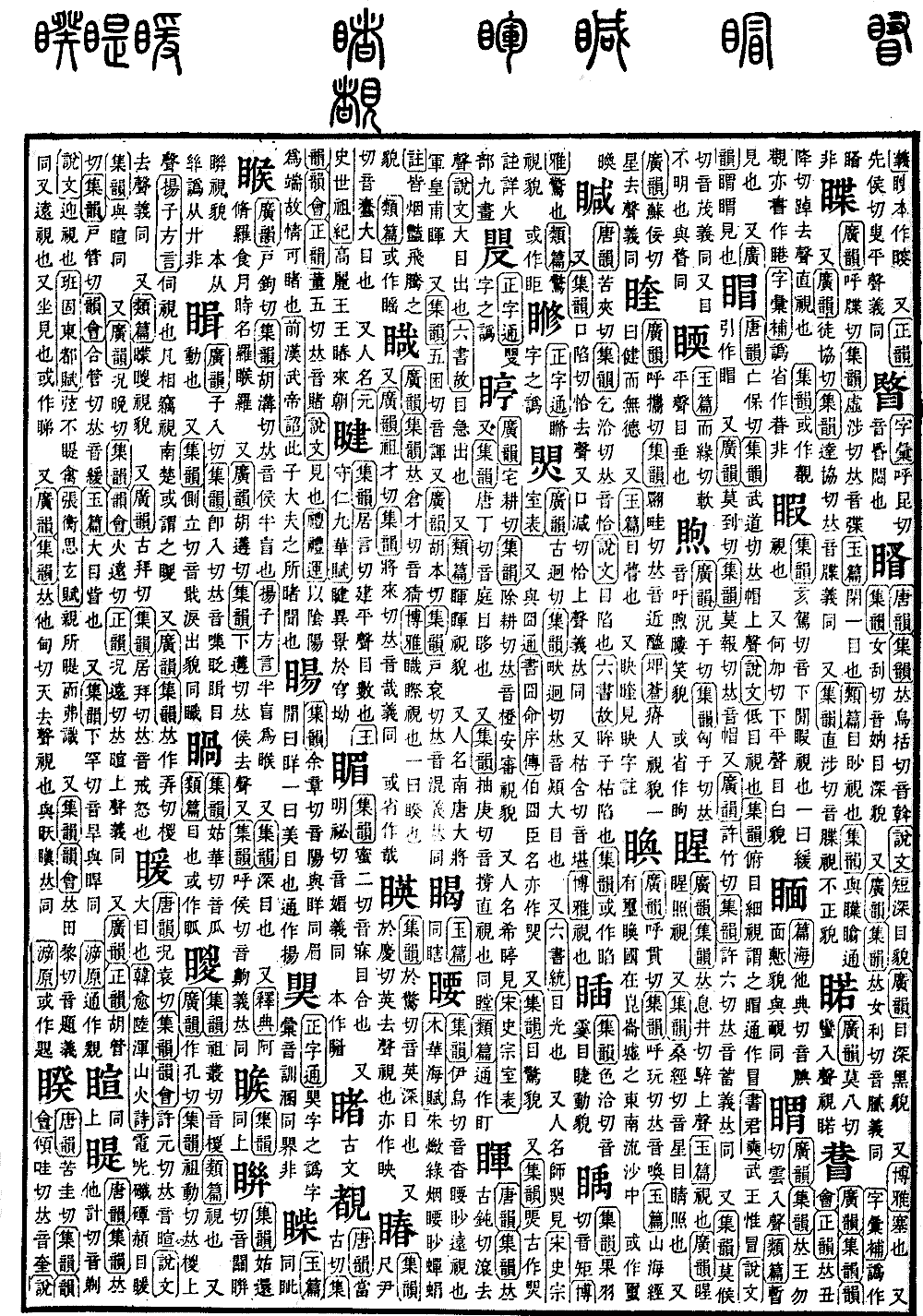
Wu Collection, Middle Volume
Radical: Eye (mù)
睽
Kangxi Dictionary Stroke Count: 14
Page 812, Entry 44
Pronounced kui.
Shuowen Jiezi (Explanation of Graphs and Analysis of Characters): Eyes not looking at one another.
Yupian (Jade Chapters): Eyes lacking spirit.
Liushugu (Fundamentals of the Six Writings): Turning against one another, extended to mean deviation or disagreement.
Book of Changes (Yijing), Sequence of Hexagrams: Kui means deviation.
Miscellaneous Hexagrams (Zagua): Kui means alienation.
Also pronounced gui. Same meaning.
Also, meaning different.
Old Book of Tang (Tangshu), Biography of Liu Zongyuan: To turn against one another and struggle.
History of Song (Songshi), Biography of Shen Qi: Internal suspicion arising.
Also, the appearance of eyes widened in a stare.
Han Yu, Yunzhou Xitang Poetry: Wanmu kui-kui (the appearance of many eyes gazing fixedly).
Also, a place name in the State of Chu.
Zuo Tradition (Zuozhuan), Year 27 of Duke Xi: The Viscount of Chu sent Ziwen to drill troops at the location of Kui.
Also pronounced ji. Kui-sui, the appearance of eyes widened in a stare.
Wang Yanshou, Rhapsody on the Lingguang Hall of Lu (Lu Lingguang Dian Fu): Han-tiao-lao and kui-sui (describing a strange appearance with eyes widened).
Note: In the Shuowen Jiezi, it is correctly written as 睽. The Juyou states it should be written differently, which is incorrect. The Zhengyun Jian states that the kui in kuigu (solitary/alienated) is written with the eye radical, the kui in kuiwei (deviation/disobedience) is written with the sun radical, and the kui in longkui (deaf and distant) is written with the ear radical. Common usage mixes them, which is incorrect. The Yuan claims that 暌 is a corrupted form of 睽, which is also incorrect.