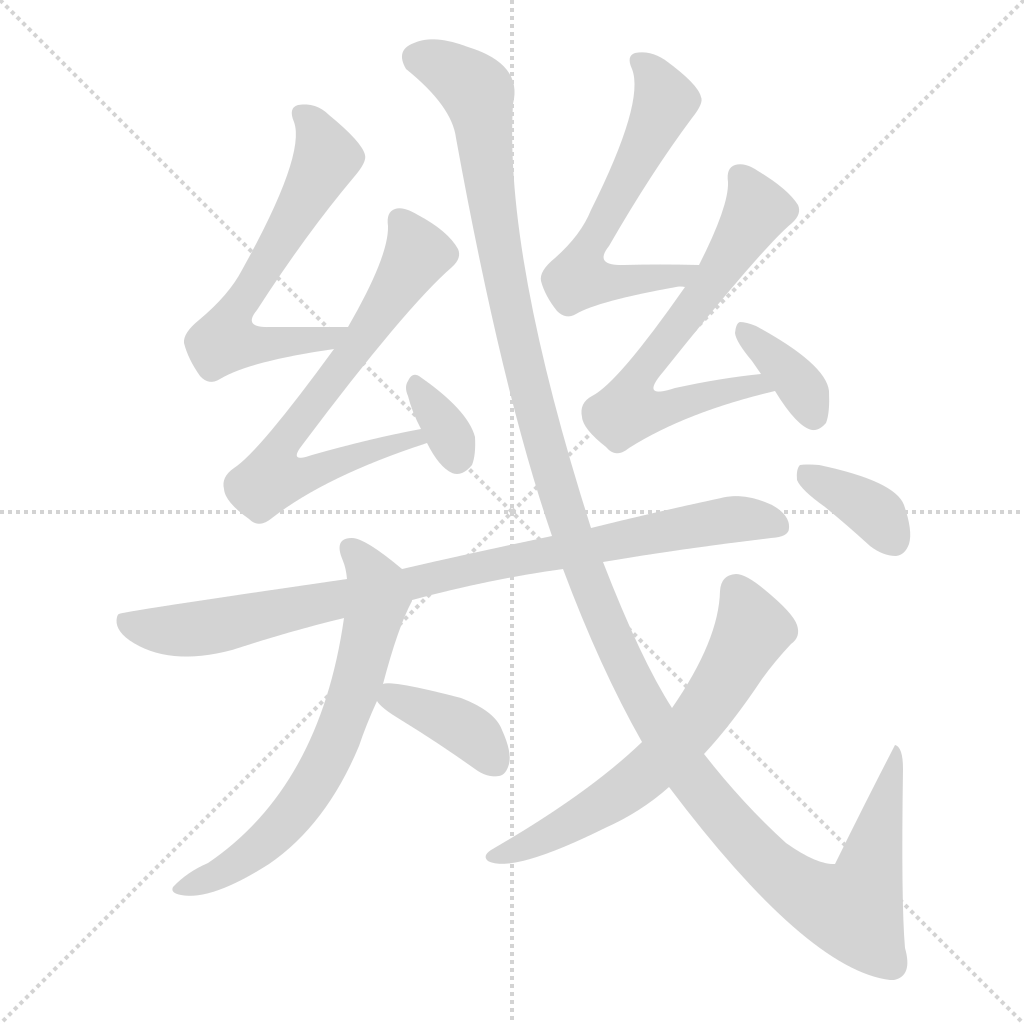
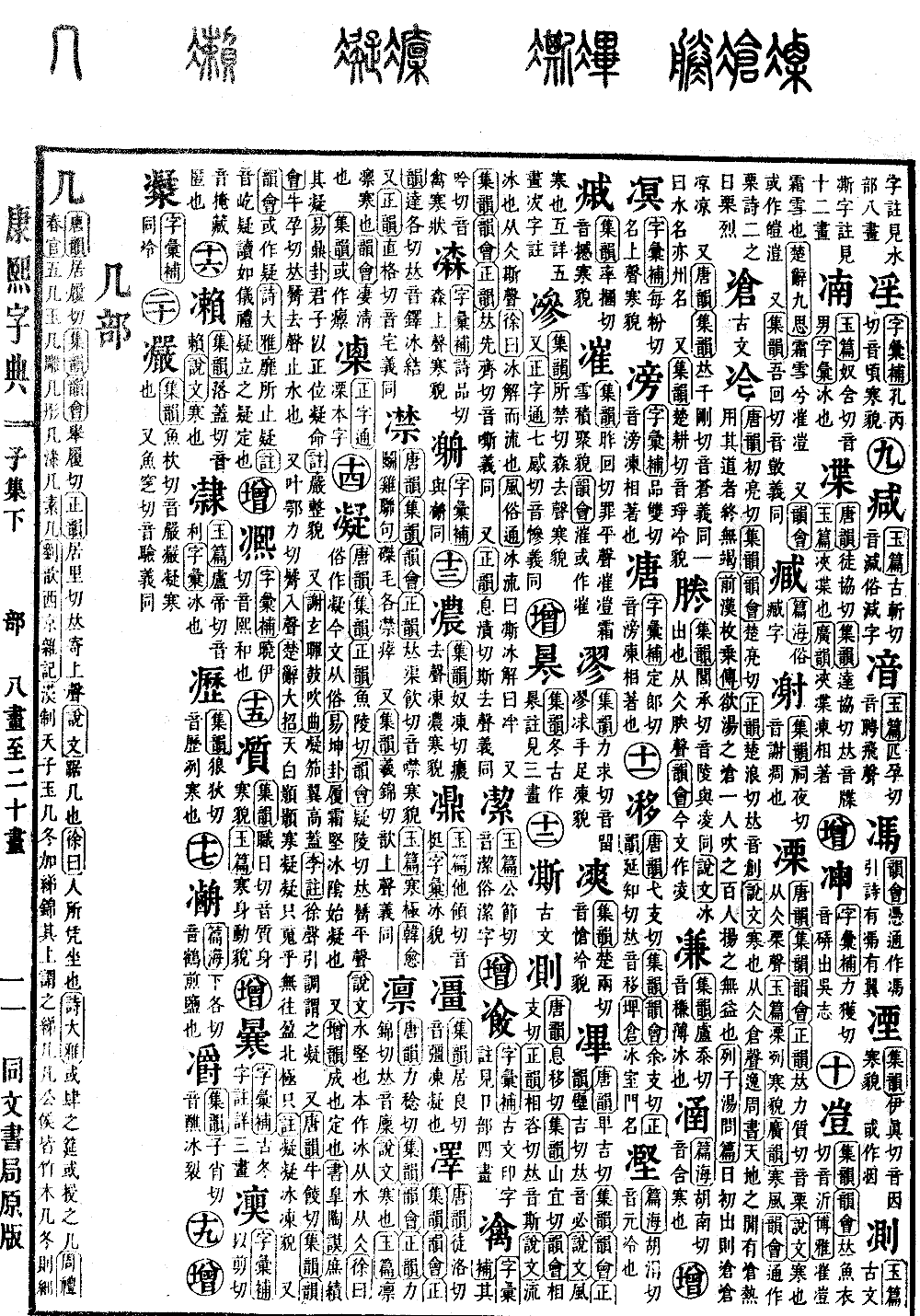
Yin Collection, Lower Volume
Radical: Tiny (yāo)
Kangxi stroke count: 12
Page 133, Entry 01
Ancient form. Pronounced ji.
In the Shuowen Jiezi (Explanation of Simple and Compound Characters), it means subtle.
In the Book of Changes (Yijing), section Appended Remarks (Xici): The subtle is the first sign of movement, the precursor to good fortune.
In the Book of Documents (Shangshu), chapter Counsels of Gao Yao (Gaoyao Mo): Be cautious and fearful, for in a single day or two, there are ten thousand subtle matters. The commentary states: This speaks of the need to be cautious and fearful of the subtle beginnings of all things.
Also, in the Shuowen Jiezi, it means danger. It is composed of the radical for tiny and the radical for defense (shu). Defense refers to military guard, and military guard implies danger.
In the Erya (Approaching Elegance), section Explaining Words (Shigu): Ji means danger. The commentary notes: Ji is like peril.
In the Book of Odes (Shijing), section Greater Odes (Daya): The net of heaven descends, and it is indeed perilous.
Also, in the Yupian (Jade Compendium), it means time or limit.
In the Book of Odes (Shijing), section Lesser Odes (Xiaoya): Bestowing upon you a hundred blessings, as if there were a fixed time and a standard. The sub-commentary states: The reason for bestowing a hundred kinds of blessings upon you, in terms of their arrival time, is as if there were a fixed schedule, and in terms of their quantity, as if there were a set measure.
Also, in the Erya, section Explaining Words: The phrase shuji means to hope for. The sub-commentary states: To hope for refers to what the heart desires.
In the Mencius (Mengzi): I hope the King will change this.
Also, it means to examine.
In the Book of Rites (Liji), section Jade Pendent Strings (Yuzao): The driver of the blind musician examines the pitch of the sounds.
In the Rites of Zhou (Zhouli), section Earth Official (Diguan), chapter Gate Overseer (Simen): To examine those whose entries and exits are unusual. The commentary notes: Not unusual means different from the crowd.
In the chapter Gate Overseer (Siguan): To examine even when there are no customs duties at the gate. The commentary notes: Even without taxes, one still maintains strict examination to prevent the entry or exit of treacherous individuals.
Also, in the Yunhui (Collection of Rhymes), it means to be nearly there.
In the Erya, section Explaining Words, it means near.
In the Book of Changes (Yijing), section Inner Sincerity (Zhongfu): The moon is nearly full.
In the Book of Rites (Liji), section Record of Music (Yueji): To understand music is to be close to the principles of ritual.
In the Records of the Grand Historian (Shiji), Biography of the Marquis of Liu (Liuhou Shijia): It nearly ruined your official business. Note: The Erya and Shiwenshu pronounce it ji (level tone); the Shiji Suoyin pronounces it qi (rising tone); the Liji Shiwenshu pronounces it ji (falling tone). It is also pronounced ju-yi. The Yunhui states: The two pronunciations of ji and qi are both correct.
Also, pronounced qi (rising tone).
In the Jiyun (Collection of Rhymes): The uneven edge of a vessel.
In the Book of Rites (Liji), section Suburban Sacrifice (Jiaotesheng): The beauty of the red-lacquered and carved edges. The commentary notes: Ji refers to the uneven edge of the lacquer decoration. The sub-commentary states: Carving means to engrave. Ji refers to the uneven edge. This means to decorate with red lacquer to create an uneven edge. The Shiwenshu records it as ju-yi.
Also, in the Guangyun (Broad Rhymes), pronounced ji (rising tone).
In the Yupian: Jiji means many.
In the Guangyun: Ji means what or how many.
In the Yunhui: Ji is a term used to inquire about quantity.
In the Zuo Tradition (Zuozhuan), twenty-seventh year of Duke Xi: If you settle them internally and defeat them externally, how much will you have gained?
In the Records of the Grand Historian (Shiji), Biography of the Ten Thousand Stone Gentleman (Wanshi Jun Zhuan): When the youngest son, Qing, was the Grand Coachman and was going out, the Emperor asked how many horses were in the carriage.
Also, in the Yunhui: A short period of time is called wuji (not much).
Also, when things are not numerous, it is also called wuji.
Also, in the Guangyun, pronounced ji (falling tone).
In the Guangyun: Ji means not yet finished.
Also, in the Jiyun: Interchanged with the character for to covet (ji).
In the Zuo Tradition (Zuozhuan), sixteenth year of Duke Ai: The people of the state look to the ruler as they look to the harvest, day by day hoping (ji) for his arrival. The commentary notes: Ji means to hope for.
In the Records of the Grand Historian (Shiji), Annals of Jin (Jin Shijia): Not long (wuji) before he became ruler. The commentary notes: Ji means to look forward to.