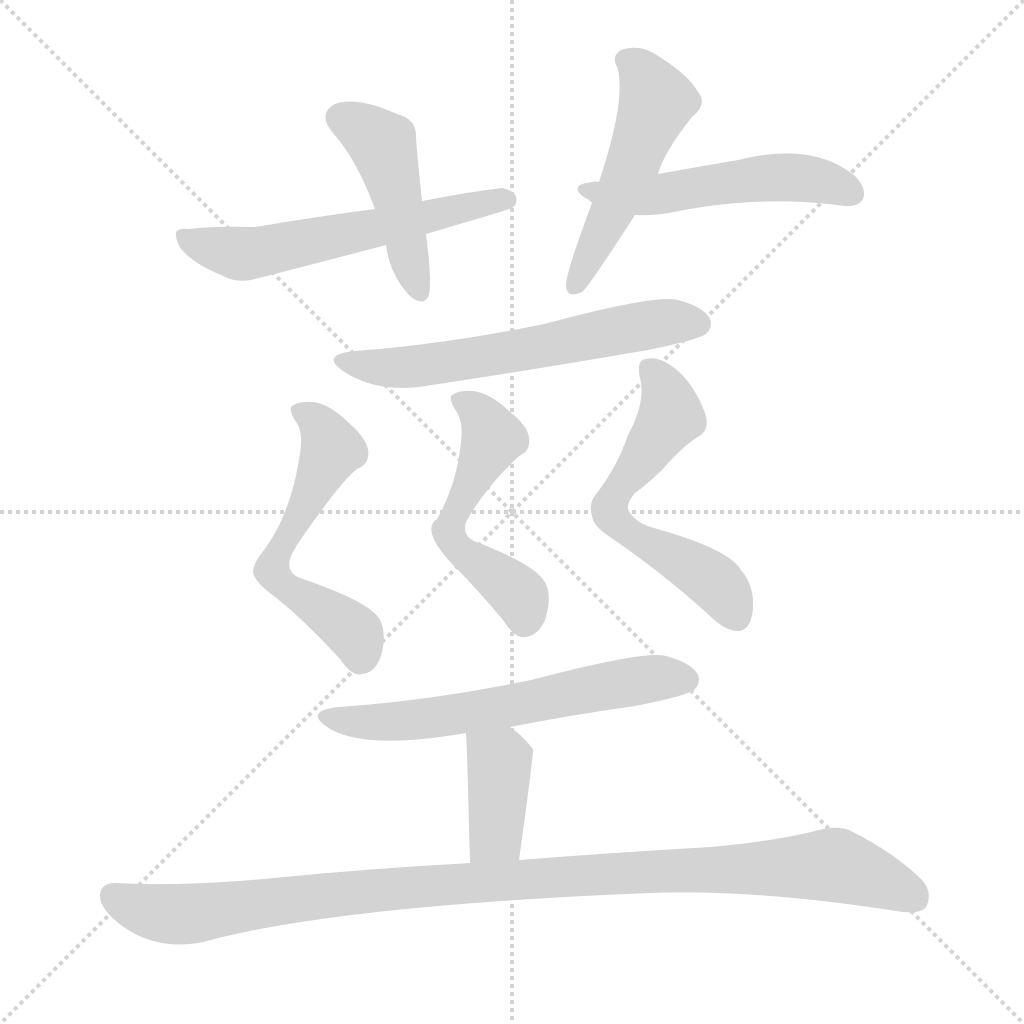
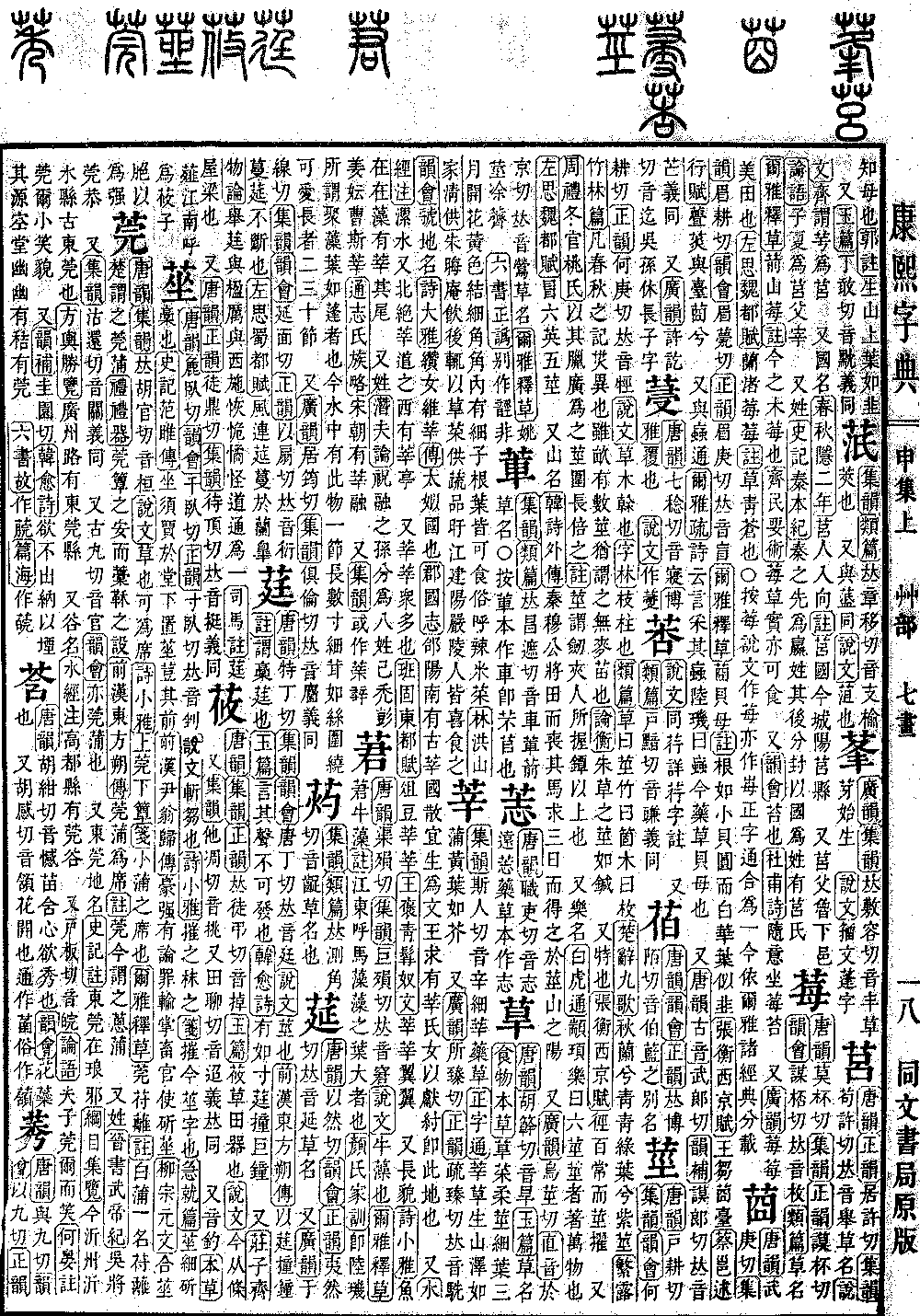
Shen Collection, Upper Volume
Radical: Grass (cǎo)
Kangxi Strokes: 13
Page 1034, Entry 09
Pronounced hēng.
As stated in the Shuowen Jiezi (Explanation of Graphs and Analysis of Characters): The stalks of plants and trees.
As stated in the Zilin (Forest of Characters): Supporting columns.
As stated in the Leipian (Classified Chapters): For plants, it is called jing; for bamboo, it is called ge; for trees, it is called mei.
As stated in the Chu Ci (Verses of Chu), Nine Songs: The autumn orchids are lush and verdant, their green leaves have purple stalks.
As stated in the Chunqiu Fanlu (Luxuriant Dew of the Spring and Autumn Annals), Bamboo Forest Chapter: Whenever the Spring and Autumn Annals (Chunqiu) records disasters or anomalies, even if there are a few wheat stalks in a single mu of land, it still states there are no wheat sprouts.
As stated in the Lunheng (Discourses in the Balance): The stalks of the vermilion grass are like needles.
It also denotes something that protrudes or stands independently.
As stated in Zhang Heng's Xijing Fu (Rhapsody on the Western Capital): A diameter of one hundred chang, with the stalk-like trunks standing tall.
Also, in the Rites of Zhou (Zhouli), Winter Officials, Taoist section: Use the widest part of the sword blade as the width of the sword hilt; the circumference of the sword hilt is twice its width.
Commentary: The term jing here refers to the sword hilt, which is the part above the pommel held by the human hand.
Also the name of a musical dance.
As stated in the Baihu Tong (Comprehensive Discussions in the White Tiger Hall): The musical compositions of Zhuanxu are called Six Jing; what is meant by jing is the manifestation of all things.
As stated in Zuo Si's Wei Du Fu (Rhapsody on the Capital of Wei): Encompassing musical works such as the Six Ying and the Five Jing.
Also the name of a mountain.
As stated in the Hanshi Waizhuan (Outer Commentary to the Han School's Book of Odes): Duke Mu of Qin was about to go hunting but lost his horse; after searching for three days, he found it on the south side of Jing Mountain.
Pronounced yīng.
A type of plant.
As stated in the Erya (Approaching Elegance), Interpretation of Grasses: The yao jing is the same as the tuqi.
As stated in the Liushu Zheng'e (Correction of the Six Writings): Writing it as a separate character is incorrect.
Textual research: In the Baihu Tong, the musical works of Zhuanxu are called Six Jing, meaning that jing represents the manifestation of all things. According to the original text, the phrase is corrected to read as jing.