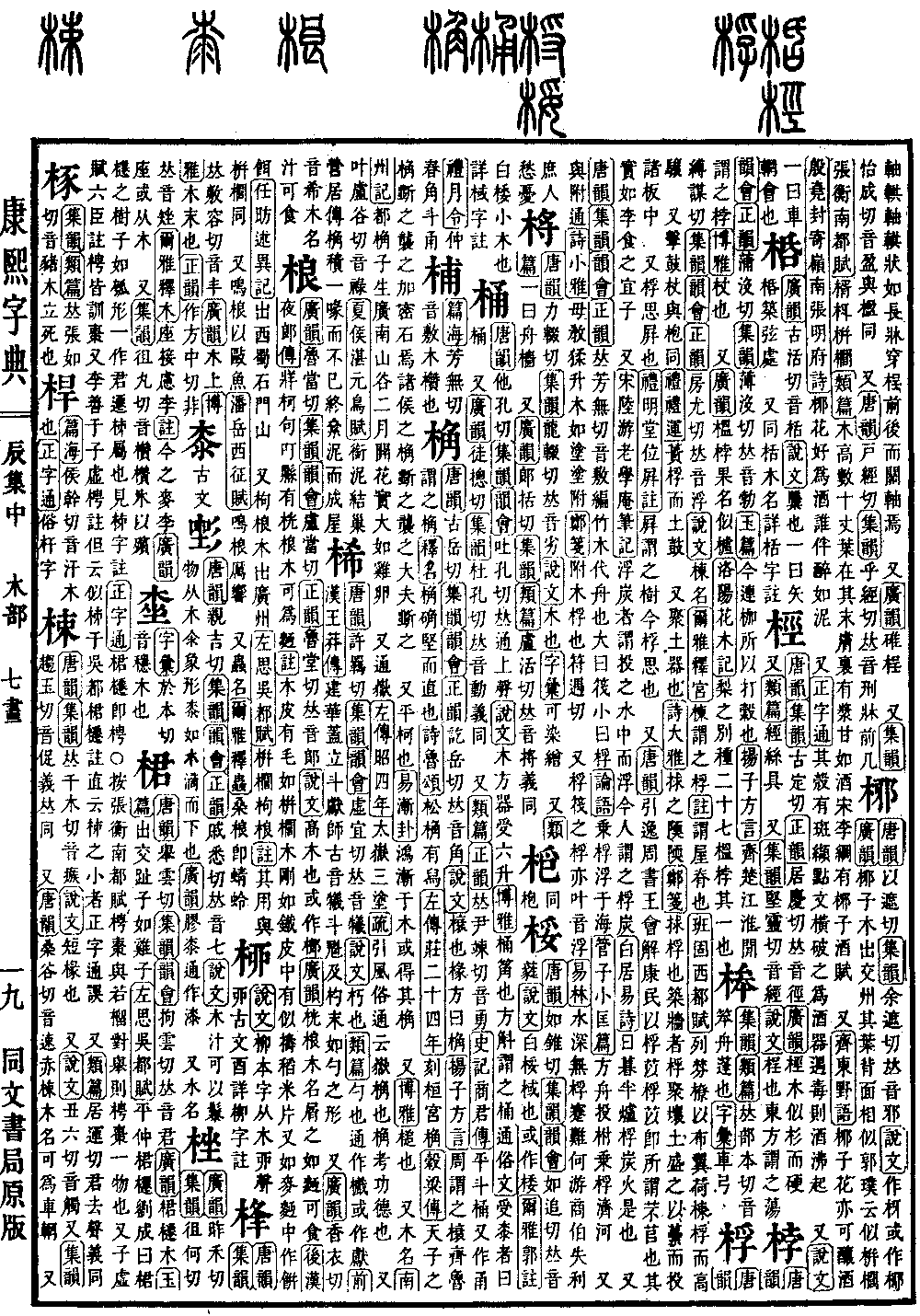
Chen Collection, Middle Volume
Radical: Wood (mù)
桷
Kangxi Strokes: 11
Page 527, Entry 12
Pronounced jué.
According to the Explaining Graphs and Analyzing Characters (Shuowen Jiezi), it refers to a rafter. Square-shaped rafters are called jue. The Dialects (Fangyan) by Yang Xiong states that in the Zhou state it is called cui, while in the Qi and Lu states it is called jue. According to the Definitions of Names (Shiming), jue implies firmness and straightness.
In the Book of Odes (Shijing), Lu Hymns: The pine rafters are large.
In the Spring and Autumn Annals (Chunqiu), 24th year of Duke Zhuang: They carved the rafters of the Huan Palace.
In the Guliang Commentary (Guliang Zhuan): The rafters of the Son of Heaven are hewn and polished, and reinforced with fine stone. The rafters of the feudal lords are hewn and polished; those of the great officers are hewn.
Also refers to a level branch.
In the Book of Changes (Yijing), Gradually hexagram: The wild goose gradually approaches the tree; perhaps it finds a flat branch.
Also, according to the Expanded Elegant (Boya), it refers to a mallet.
Also a type of tree. The Southern Regions Record (Nanzhou Ji) states that the dujue tree grows in the valleys of the south, blossoms in the second month, and bears fruit as large as a chicken egg.
Also interchangeable with yue (peak). In the Zuo Commentary (Zuozhuan), 4th year of Duke Zhao: The four peaks and three thoroughfares. The Commentary states that the Traditions of Customs (Fengsu Tong) says: Peaks are pillars, and pillars evaluate merits and virtues.
Also, rhyming with lu, pronounced lù. In the Rhapsody on the Swallow (Yuan Niao Fu) by Xiahou Zhan: Carrying mud to build a nest, busily constructing the rafters. Accumulating one beakful after another without cease, eventually piling mud to complete the house.
Textual Research:
In the Zuo Commentary, 24th year of Duke Zhuang: Carved the rafters of the Huan Palace. Changed to Spring and Autumn Annals in accordance with the original text.
In the Guliang Commentary: The rafters of the Son of Heaven are hewn and polished, and reinforced with fine stone. The rafters of the feudal lords are hewn and polished. Changed two instances of polished in accordance with the original text.
In the Zuo Commentary, 4th year of Duke Zhao: Four peaks and three thoroughfares. Changed from great peaks to four peaks in accordance with the original text.