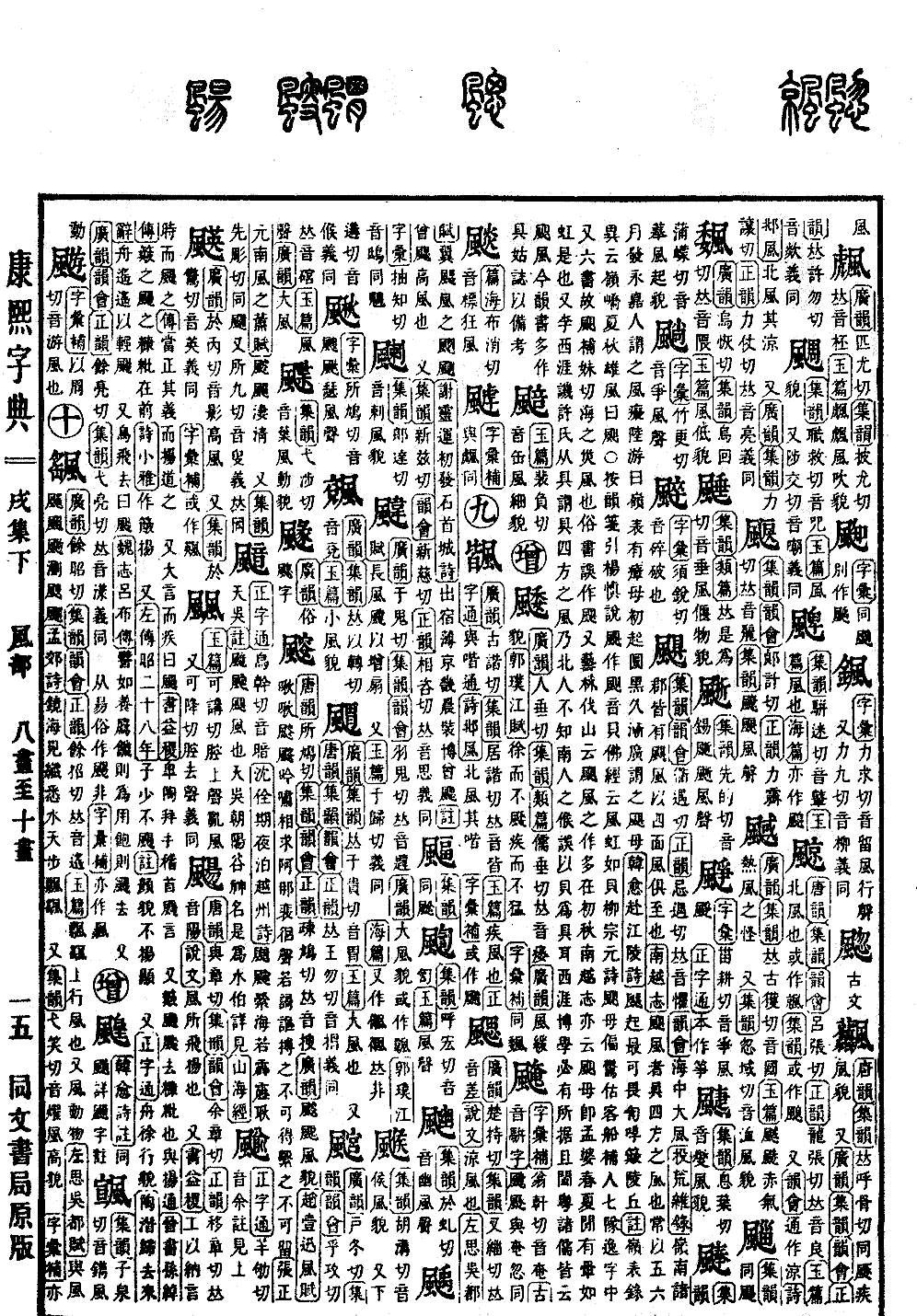
Xu Collection, Lower Volume
Radical: Wind (fēng)
Hurricane; Kangxi stroke count: 17; Page 1413
Pronounced ju.
Collection of Rhymes (Jiyun) and Rhyme Collection (Yunhui) state the pronunciation is qu-yu, and Correct Rhymes (Zhengyun) states the pronunciation is ji-yu; pronounced ju (falling tone).
Rhyme Collection (Yunhui): A great wind at sea.
Records of Southern Expulsion (Touhuang Zalu): In the prefectures of Lingnan, there are hurricane winds, so named because the wind arrives from all four directions simultaneously.
Records of Nanyue (Nanyue Zhi): A hurricane is a wind that possesses the qualities of all four directions. It typically occurs in the fifth and sixth months. People in Yongjia call it wind madness.
Lu You says: In the regions south of the ranges, there is the hurricane mother. Initially, it appears as a black circle, which gradually expands over time, known as the hurricane mother.
Han Yu, Poem on Traveling to Jiangling: The hurricane rises, most fearsome, roaring and tossing hills like mounds.
Commentary: Records of Strange Things from the Ranges (Lingbiao Luyi) states: In the regions of Lingqiao, the fierce wind of summer and autumn is called a hurricane.
Note: The Rhyme Annotations (Yun Jian) cites Yang Shen, who says the character for hurricane should be written with the sound bei (falling tone). Buddhist scriptures state that the wind is like a cowrie shell (bei). Liu Zongyuan’s poem mentions the mother [of the wind] startling merchant ships, which has been added to the seventh category of missing characters.
The Origins of the Six Writings (Liushu Gu) states the pronunciation is mei (falling tone); it is a disaster wind of the sea. Common writing mistakenly uses the form for hurricane.
Forest of Arts: Mountain Clearing (Yilin Fashan) states: The wind usually occurs in early autumn. Records of Nanyue (Nanyue Zhi) also states: The hurricane mother is the same as the Meng Po; during spring and summer, there is a halo like a rainbow.
Li Xiya criticizes Xu Shen for using the component meaning tool, saying that interpreting it as wind from all four directions is a mistake made by northerners who do not understand the southern character and mistakenly substituted the component for cowrie shell. Li Xiya was highly learned and must have had his sources; furthermore, the scholars of Fujian and Guangdong all use the form with the component for wind. Currently, most rhyme books use the form with the component for tool; this is recorded for reference.