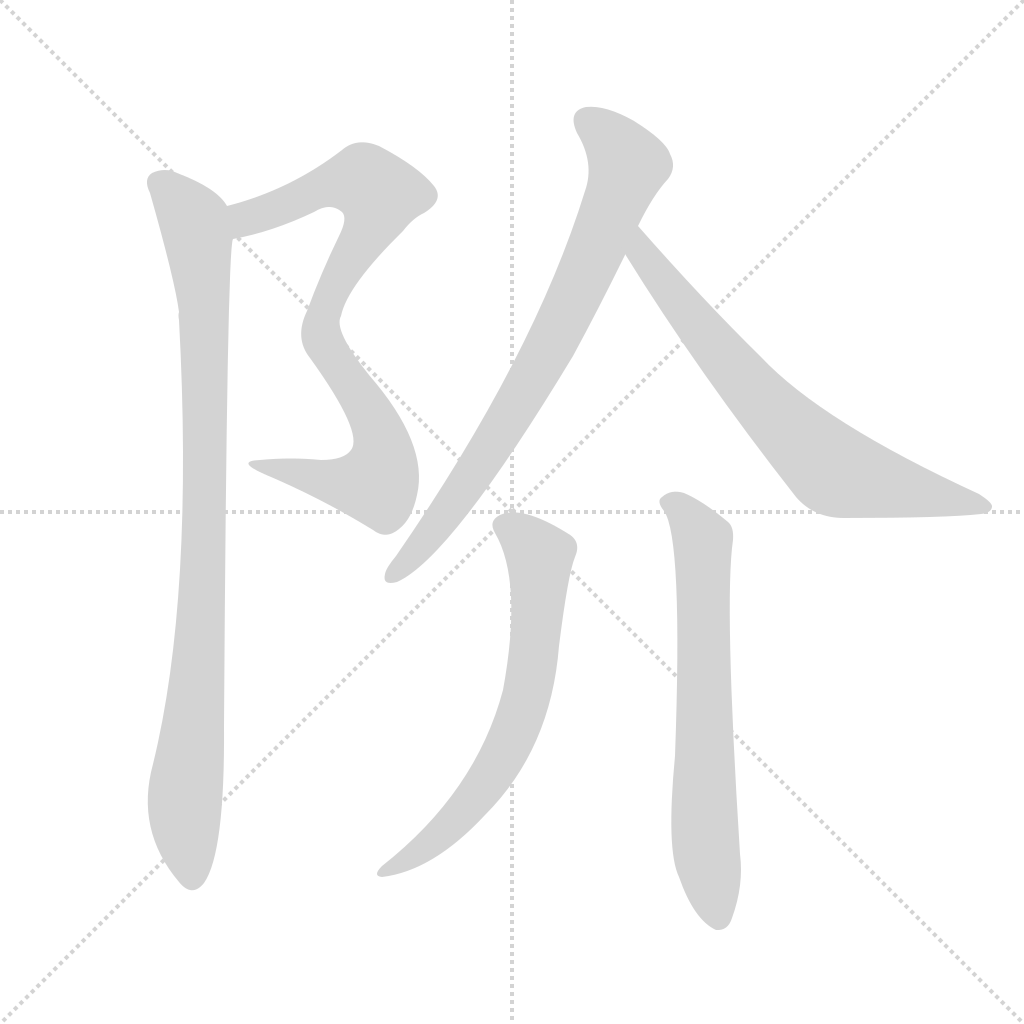
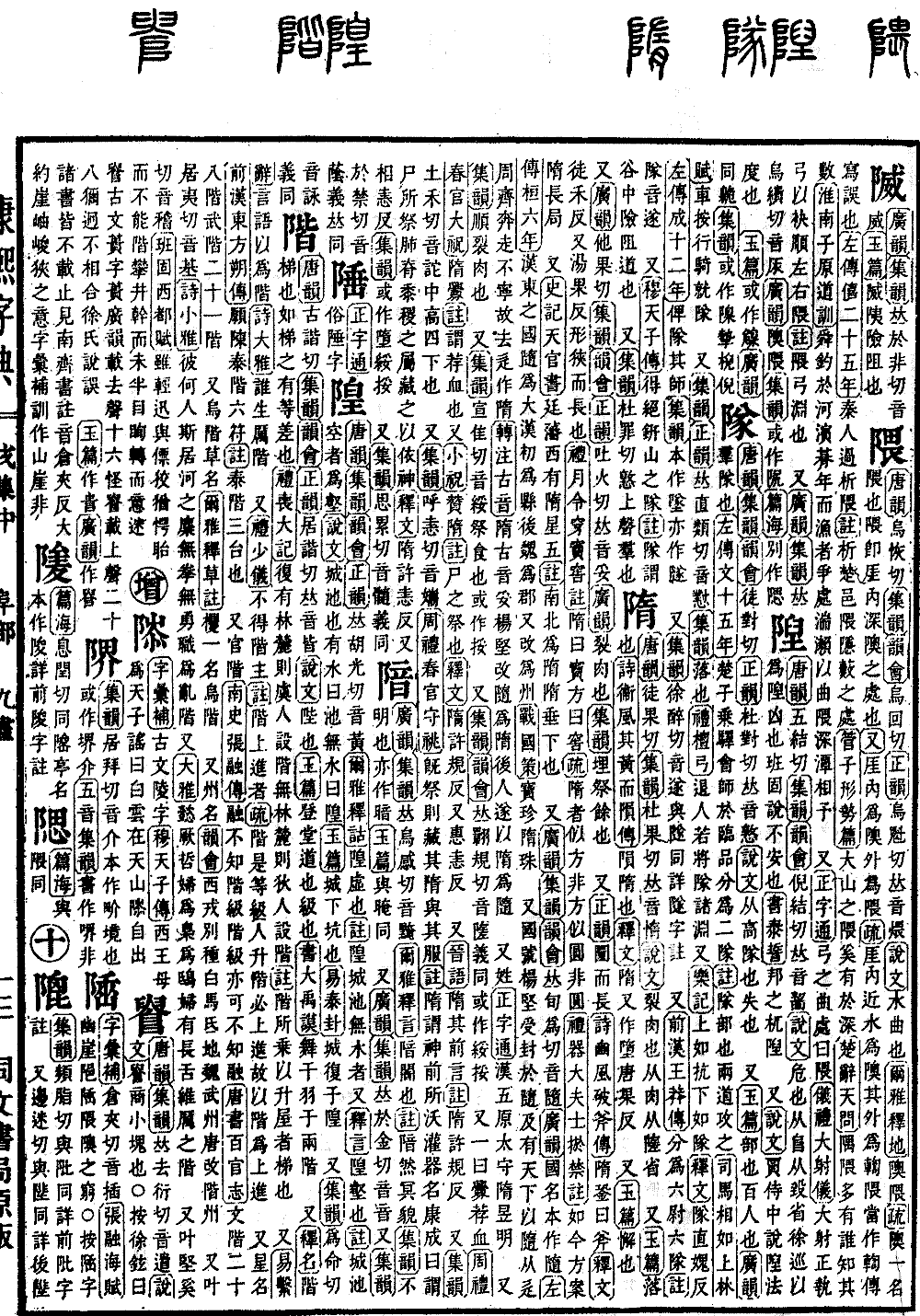
Xu Collection, Middle Volume. Radical: Mound (fù). Character: jiē. Kangxi stroke count: 17. Page 1357.
The Tang Rhymes (Tangyun) records the pronunciation as a combination of gǔ and xié. The Collected Rhymes (Jiyun), Rhyme Collection (Yunhui), and Correct Rhymes (Zhengyun) record it as a combination of jū and xié. It is pronounced like the character jiē.
Explaining Graphs and Analyzing Characters (Shuowen Jiezi) defines it as the steps to a throne or palace.
Jade Chapters (Yupian) defines it as the path for ascending to a hall; a step or grade.
The Counsels of the Great Yu (Dayu Mo) in the Book of Documents (Shangshu) states: Danced with shields and feathers between the two sets of steps.
Explaining Names (Shiming) states: A step is like a ladder, as a ladder has graduated levels or differences in height.
The Great Record of Mourning Rites in the Book of Rites (Liji) states: If there are forests or foothills, the foresters set up the ladder. If there are no forests or foothills, the Di people set up the ladder. The commentary notes: Here, the word refers to that which is used to climb onto the roof, a ladder.
The Appended Phrases (Xici) in the Book of Changes (Yijing) states: Speech and language serve as the steps to success or failure.
The Book of Odes (Shijing) states: Who produced the steps of this disorder?
The Lesser Etiquette in the Book of Rites states: One must not outstep the host. The commentary notes: The word means one who advances upward. The sub-commentary explains: Steps represent grades or levels. When a person ascends steps, they must advance upward; therefore, the word is used to mean advancing upward.
It is also the name of stars. The Biography of Dongfang Shuo in the Book of Han (Hanshu) states: I wish for the six signs of the Great Steps. The commentary notes: The Great Steps refers to the Three Platforms (Santai) constellation.
It also refers to official rank. The Biography of Zhang Rong in the History of the Southern Dynasties (Nanshi) states: Rong did not know of rank or level, and rank or level likewise might not know Rong.
The Records of Officials in the Book of Tang (Tangshu) states: There are twenty-eight ranks for civil officials and twenty-one ranks for military officials.
It is also called wūjiē, the name of a plant. The Commentary on Explaining Plants in the Erya states: The quégé plant is also known as wūjiē.
It is also the name of a prefecture. The Rhyme Collection states: This was originally the land of the White Horse Di people, a branch of the Western Rong. It was called Wuzhou during the Wei dynasty and renamed Jiezhou during the Tang dynasty.
It is also a rhyming variant pronounced like jī. The Book of Odes states: What man is that, dwelling on the bank of the river? Without strength or courage, he is simply a source of disorder.
The Book of Odes also states: Admirable is that wise woman, but she is like an owl or a kite. A woman with a long tongue is the step to disorder.
It is also a rhyming variant pronounced like jī. The Rhapsody on the Western Capital (Xidu Fu) by Ban Gu states: Though they be light and swift or nimble and crafty, they still stare in amazement and are unable to ascend. Before climbing halfway up the well-frame, their eyes swirl and their minds become dazed.