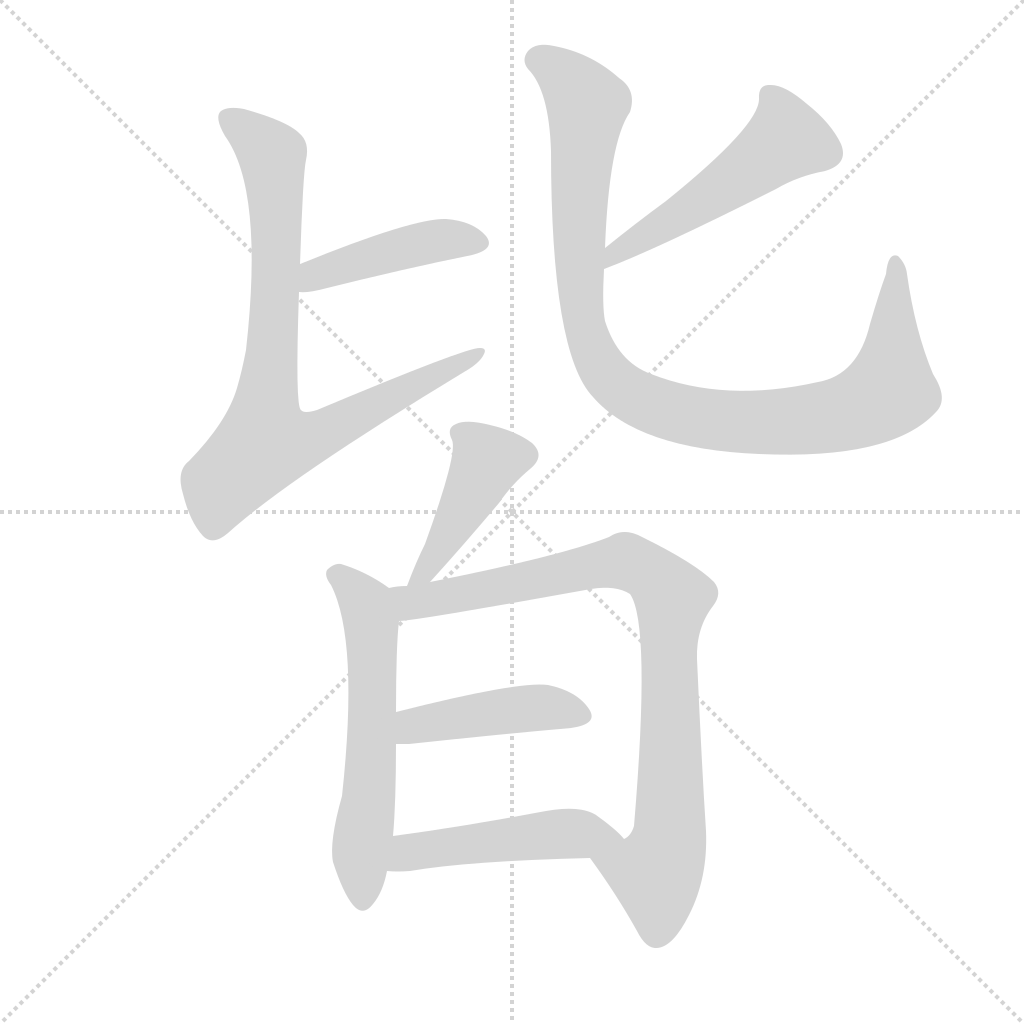
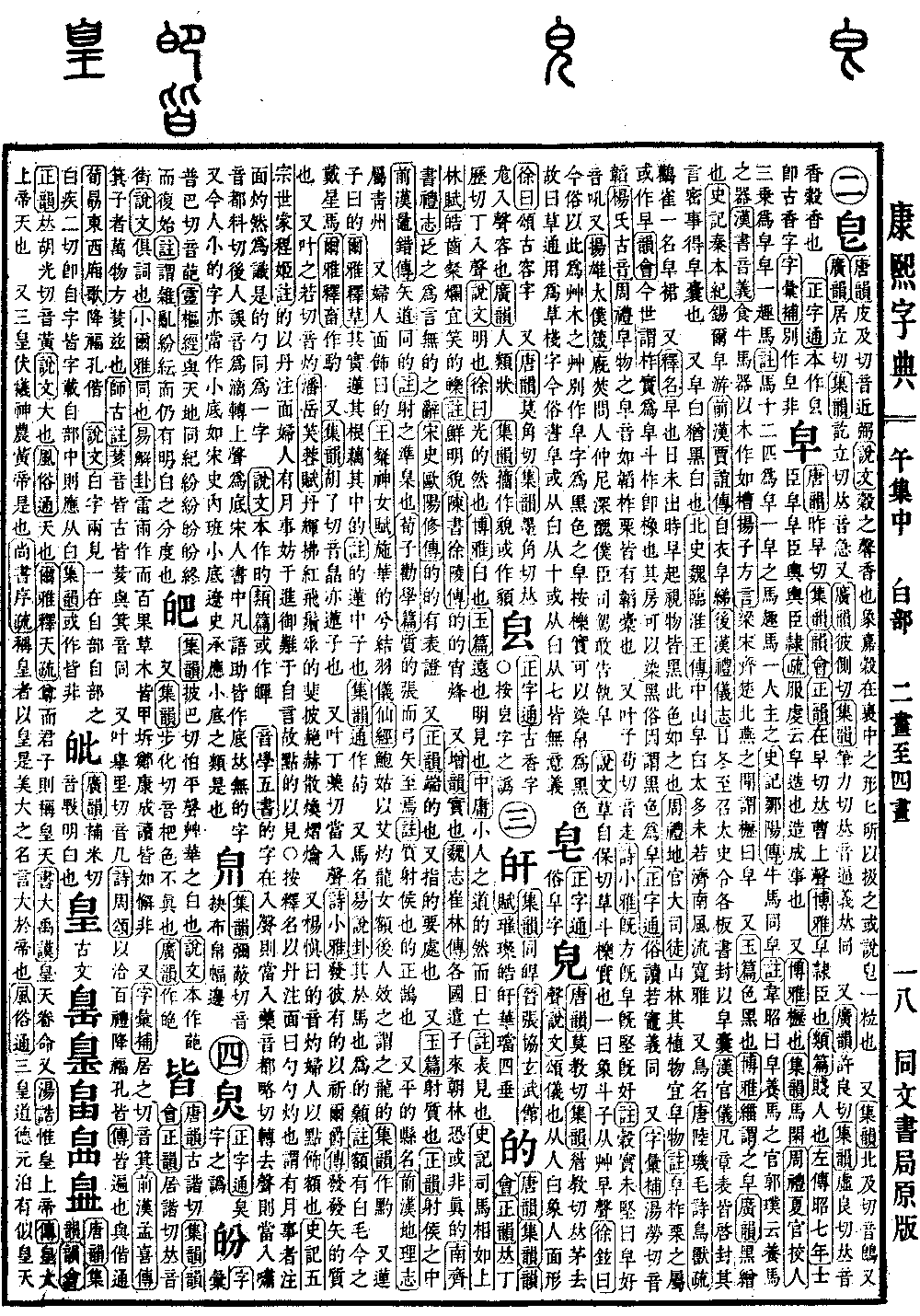
Wu Collection, Middle Volume
Radical: White (bái)
Kangxi strokes: 9
Page 786, Entry 12
Pronounced jie.
In the Shuowen Jiezi (Shuowen), it denotes a collective term. In the Xiao Erya (Xiao Erya), it means the same as. In the Book of Changes (Yijing), within the Jie hexagram, it states: Thunder and rain arise, and all fruits, grasses, and trees crack their shells. Zheng Kangcheng reads this character as xie, which is incorrect.
Also pronounced ji. In the History of the Former Han (Qianhan Shu), in the biography of Meng Xi, it is written that Jizi is the point where all things begin to sprout. Yan Shigu notes: The term gai is pronounced jie. In ancient times, the pronunciations of jie, gai, and ji were identical.
Also, rhyming as ji (rising tone). In the Book of Odes (Shijing), within the Odes of Zhou, it states: To manage all rites, bestowing blessings universally. The commentary states: jie means everywhere. It is used interchangeably with xie. In the Eastern and Western Chamber Songs by Xun Xu, it is written as xie.
The Shuowen Jiezi mentions the character white twice; one instance is under the Self radical, where white is pronounced ji (falling tone) and refers to the character for self. Since the character jie is listed under the White radical, it should be categorized under white. According to the Jiyun (Jiyun), it is sometimes written in a variant form, but that is incorrect.