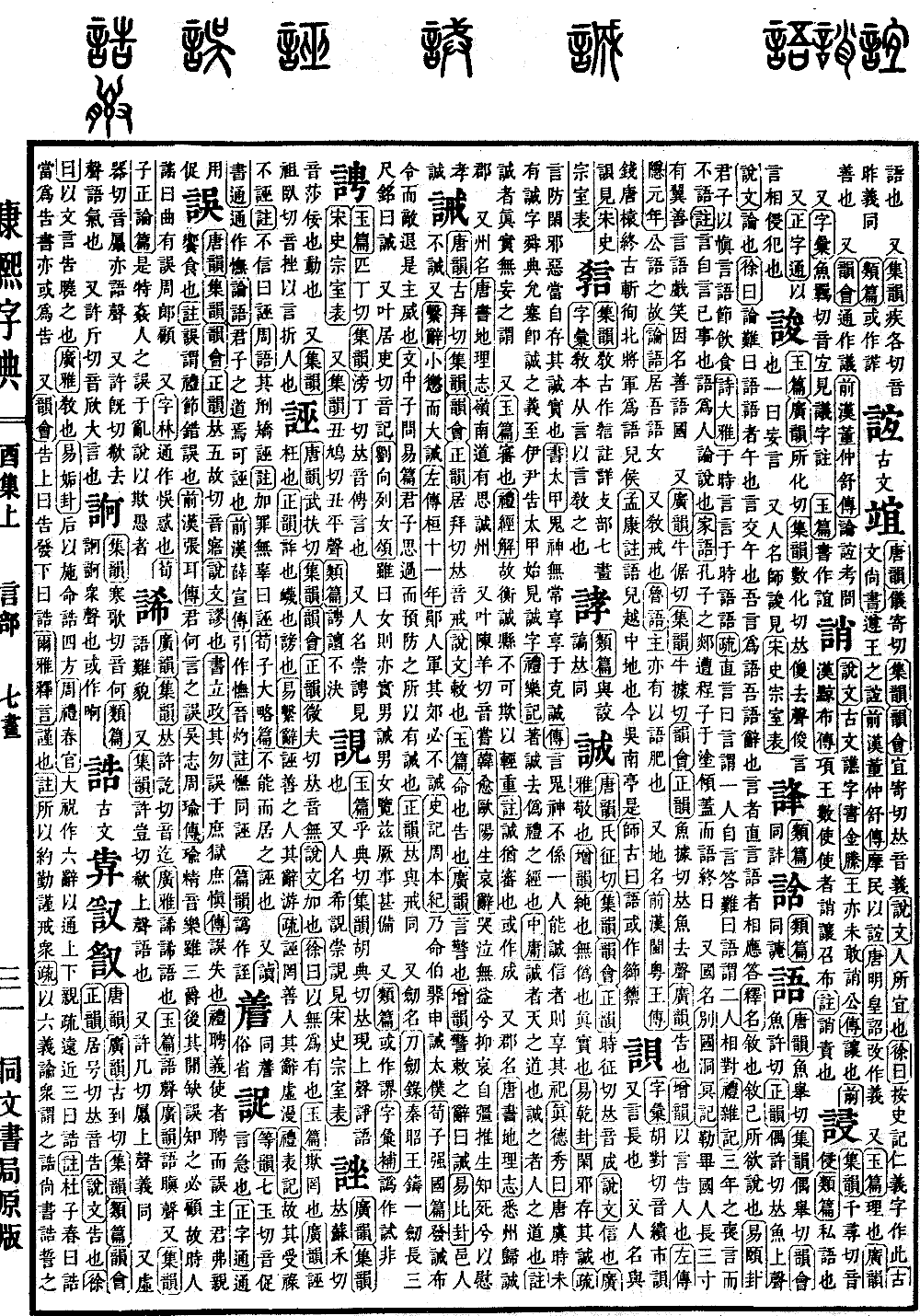
You Collection, Upper Volume
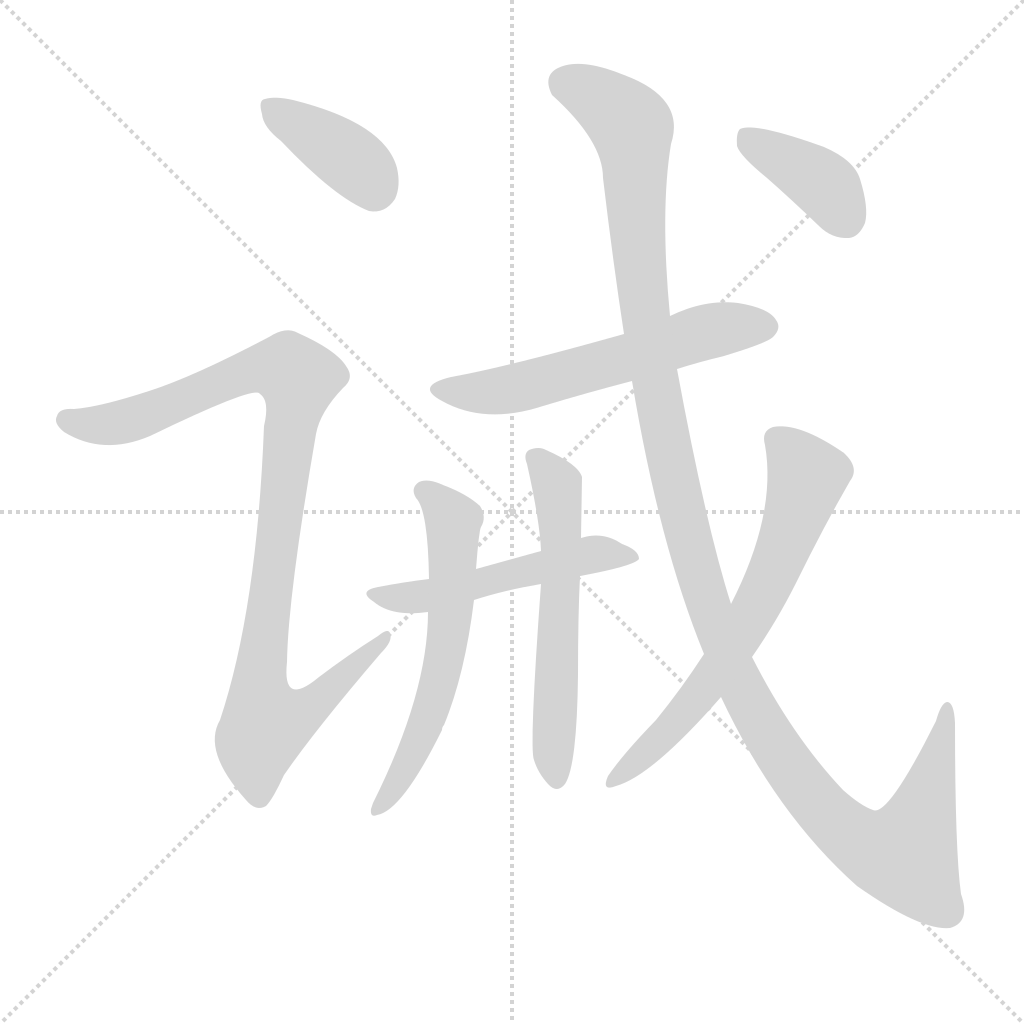
Radical: Speech (yán)
Jie
Kangxi stroke count: 14
Page 1163, Entry 01
Pronounced jie (falling tone).
Shuowen Jiezi (Shuowen): To admonish.
Yupian: To command, to notify.
Guangyun: Words of warning.
Zengyun: Words of warning and admonition are called jie.
Book of Changes (Yijing), Bi Hexagram: The people of the city are not cautioned.
Also in the Appended Statements: Minor punishment serves as a great admonition.
Zuo Zhuan, 11th year of Duke Huan: The people of Yun camped in their outskirts; they surely did not take precautions.
Records of the Grand Historian (Shiji), Annals of Zhou: He commanded Bo Jiong to warn the grand charioteer.
Xunzi, Chapter on Strengthening the State: Issuing admonitions and proclaiming orders to cause the enemy to retreat is the majesty of a ruler.
Wenzhongzi, Questions on the Changes: A superior man thinks of his faults and guards against them beforehand; this is why there are admonitions.
Zhengyun: The same as the character for warn.
Also the name of a sword.
Records of Swords (Daojian Lu): King Zhao of Qin forged a sword three feet long, inscribed with the name Jie.
Also rhyming with ji (falling tone).
Liu Xiang, Eulogy for Exemplary Women: Although it is a model for women, it is truly an admonition for men. When men and women examine this, the matters are very complete.
Also in the Classified Dictionary (Leipian), sometimes written as a variant form.
Zihui Bu: Erroneously written as another form, which is incorrect.