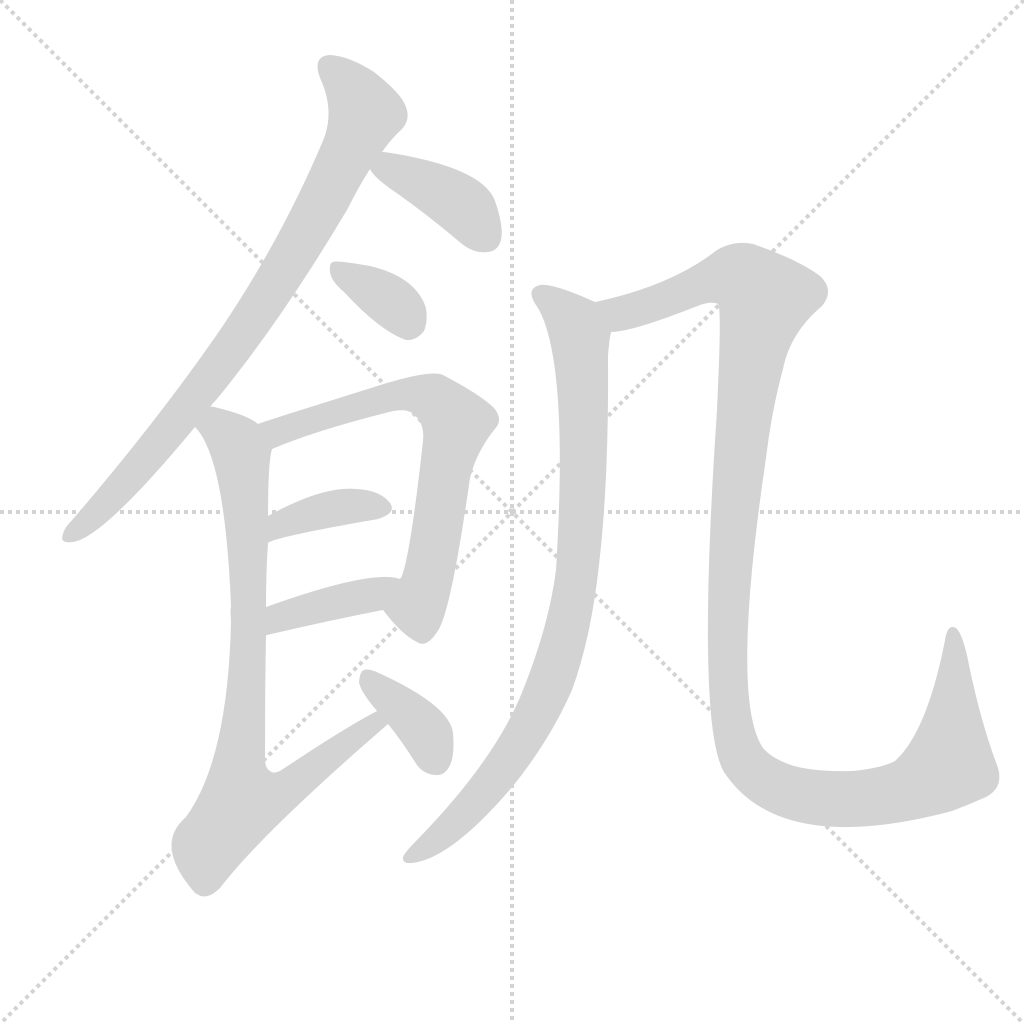
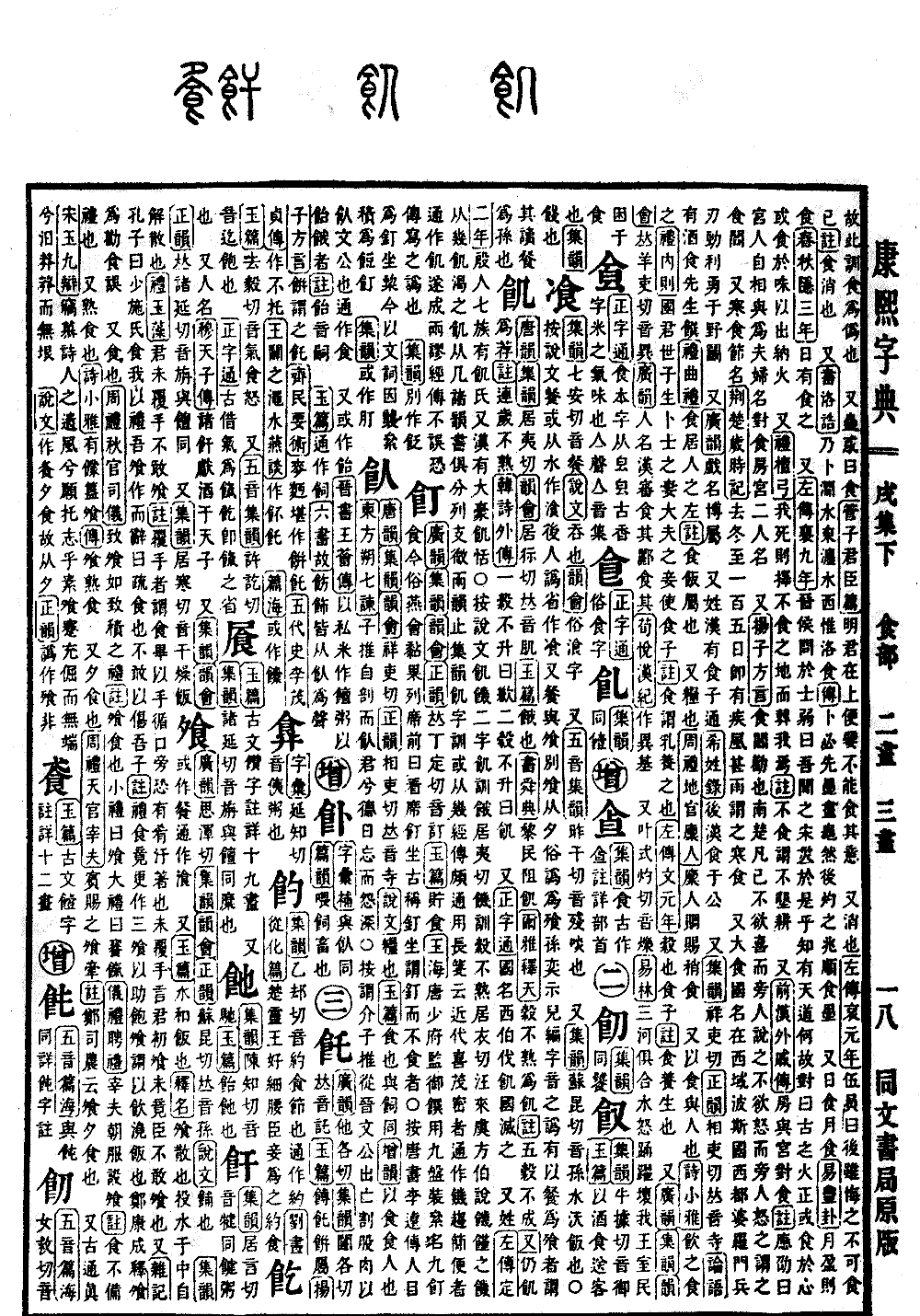
Xu Collection, Lower Volume
Radical: Food (shí)
Kangxi strokes: 11
Page 1416, Entry 08
Pronounced ji.
In the dictionary Yu Pian, it is defined as hungry.
In the Book of Documents (Shujing), within the Canon of Shun (Shundian), it is written: The common people suffered from famine.
In the Erya, in the section on explaining the heavens, it is stated: When grain does not ripen, it is called ji.
Commentary: The five grains have not matured.
Also, consecutive years of famine are called jian.
Commentary: Successive years without a harvest.
In the Han Dynasty Illustrations of the Odes (Hanshi Waizhuan), it is written: When one type of grain does not grow, it is called qian; when two types of grain do not grow, it is called ji.
Also, a name of a country. The Lord of the West attacked the State of Ji and destroyed it.
Also, a surname. In the Zuo Tradition (Zuozhuan), in the fourth year of Duke Ding, it is mentioned that among the seven clans of the Shang people, there was the Ji clan.
Also, there was a great nobleman named Ji Tian during the Han Dynasty.
According to the Explaining Graphs and Analyzing Characters (Shuowen Jiezi), the characters for famine (ji) and crop failure (jin) are separate; ji means hungry and is pronounced ji, while jin means grain that does not ripen and is pronounced jin. Wang Lai, the provincial governor of Yu, stated: The character for the famine of hunger uses the component for small table, and the character for the famine of hunger and thirst also uses the component for small table. All the rhyme dictionaries separate these into different rhyming categories, but only in the Collected Rhymes (Jiyun) is the character ji sometimes defined using the component for small table, while in the classics and commentaries, they are quite interchangeable.
The Long Records (Changqian) states: In modern times, those who like complexity write it as jin, and those who seek convenience write it as ji, both of which are errors. The classics and commentaries are not wrong; it is feared that these are errors in transcription.
In the Collected Rhymes (Jiyun), a variant form is listed. In the Longkan, it is the same.
Textual research: In the Zuo Tradition (Zuozhuan), fourth year of Duke Ding, it is the Ji clan among the seven clans of the Shang people. Following the original text, the year has been corrected from two to four, and Shang people has been corrected from Shang men.