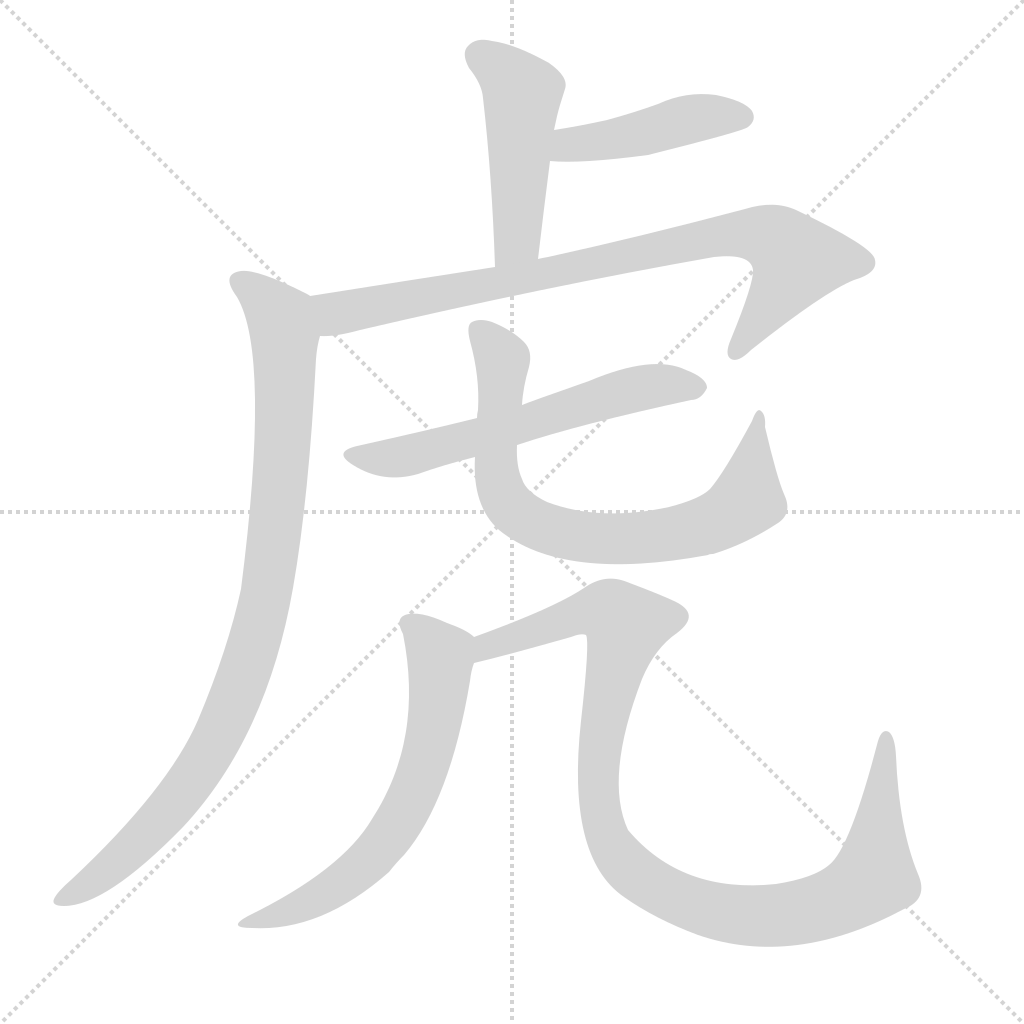
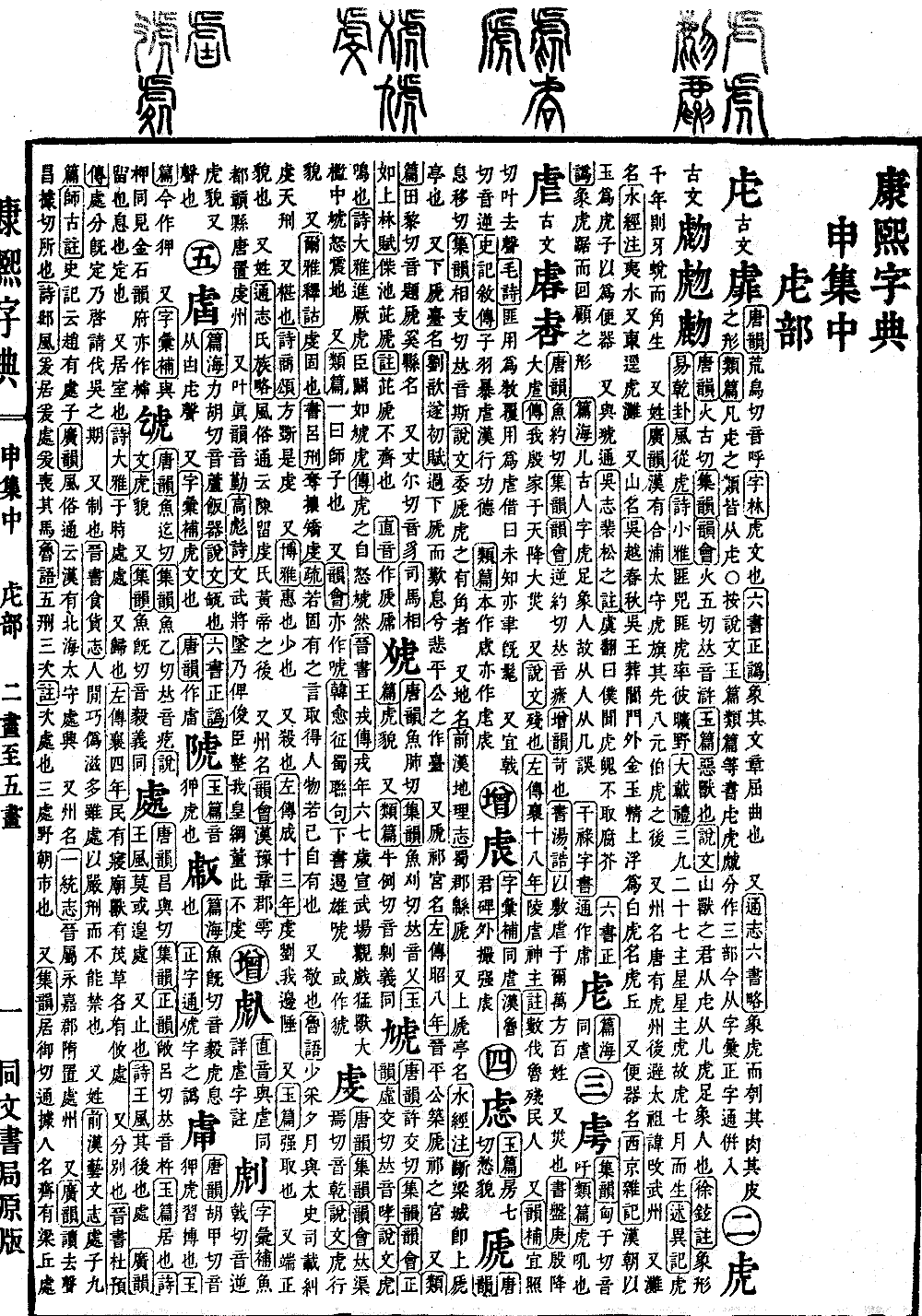
Shen Collection, Middle Volume. Radical: Tiger (hǔ). Kangxi stroke count: 8. Page 1073, Entry 03.
Ancient character written as.
Tang Rhyme (Tangyun): Pronounced hu.
Collected Rhymes (Jiyun) and Rhyme Collection (Yunhui): Pronounced hu, sounds similar to hu.
Jade Chapters (Yupian): Defined as a fierce wild beast.
Explanation of Graphs and Analysis of Characters (Shuowen Jiezi): Stated to be the king of all beasts in the mountains; the character is composed of tiger and person, as the tiger's paw resembles a human foot.
Xu Xuan commentary: This is a pictographic character.
Book of Changes (Yijing), Qian Hexagram: Contains the phrase, "The wind follows the tiger."
Book of Odes (Shijing), Lesser Odes (Xiaoya): Writes, "It is neither rhinoceros nor tiger, yet it runs along the wilderness."
Record of Rites by Dai the Elder (Da Dai Liji): Records that among the twenty-seven primary stars, the constellation governs the tiger, which is why the tiger's gestation period is seven months.
Record of Strange Accounts (Shuyiji): States that when a tiger reaches one thousand years of age, it sheds its teeth and grows horns.
Also used as a surname.
Broad Rhymes (Guangyun): Records that during the Han dynasty, there was a Governor of Hepu named Hu Qi, whose ancestors were descendants of Bo Hu, one of the Eight Originals (eight ancient virtuous men).
Also a name of a prefecture; during the Tang dynasty, Hu Prefecture was established, but later changed to Wu Prefecture to avoid the naming taboo of the Grand Progenitor.
Also a name of a rapid.
Commentary on the Water Classic (Shuijing Zhu): Records that the Yi River flows eastward through Tiger Rapid.
Also a name of a mountain.
Spring and Autumn of Wu and Yue (Wuyue Chunqiu): Records that the King of Wu was buried outside the Chang Gate, and the essence of gold and jade floated upward to form a White Tiger, hence the name Tiger Hill.
Also a name for a urinal.
Miscellaneous Records of the Western Capital (Xijing Zaji): Records that during the Han dynasty, jade was used to craft a tiger-shaped object used as a urinal.
Also interchangeable with the character amber (hǔ).
Records of the Three Kingdoms (Sanguozhi), Records of Wu, Pei Songzhi commentary: Quotes Yu Fan: I have heard that amber does not attract rotting straw or chaff.
Rectification of the Six Writings (Liushu Zhenge): States that the character shape resembles a tiger squatting and looking back.
Sea of Texts (Pianhai): Explains that the component for person is the ancient form of the character for human, and since the tiger's paw resembles a human foot, it follows the character for human. Writing it with the component for table is incorrect.
Book of Characters for Official Emolument (Ganlu Zishu): Records that the common variant form may be written as.