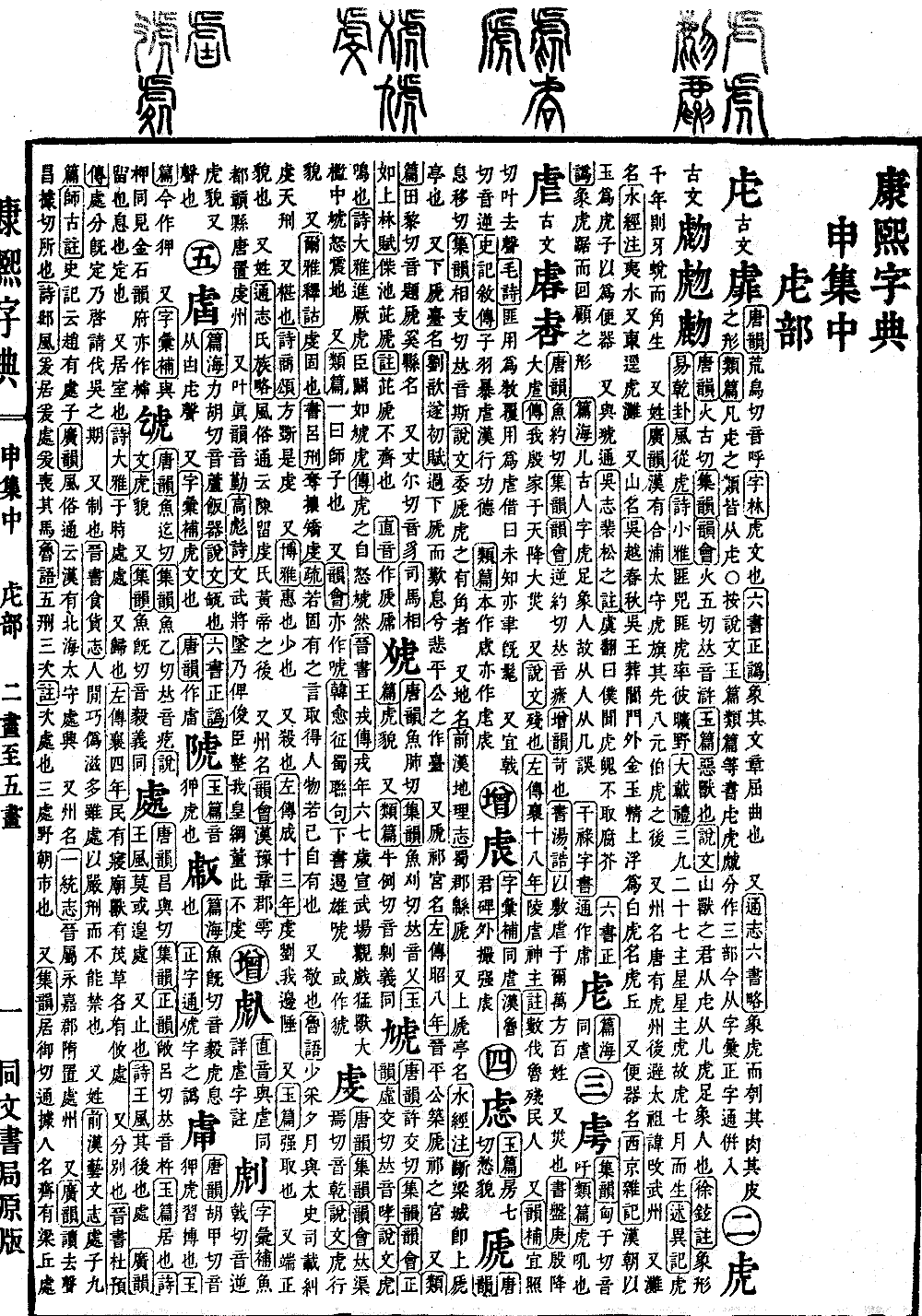
Shen Collection, Middle Volume
Radical: Tiger (hǔ)
虒
Kangxi stroke count: 10
Page 1073, Entry 14
Pronounced si. Defined in the Explaining Graphs and Analyzing Characters (Shuowen jiezi) as a tiger with horns. Also refers to a place name. The History of the Former Han (Qian Hanshu), Geography Treatise, records that Miansi existed in the Shu Commandery. There is also Shangsi, which is the name of a pavilion. The Commentary on the Water Classic (Shuijing zhu) records that Duanliang City is Shangsi Pavilion. There is also Xiasi, which is the name of a terrace. Liu Xin’s Fu on the Initial Intent (Suichu fu) writes: Passing by Xiasi and sighing, lamenting that Duke Ping of Jin built this terrace. There is also Siqi, which is the name of a palace. The Zuo Tradition (Zuo zhuan), Year Eight of Duke Zhao, records that Duke Ping of Jin built the Siqi Palace.
Pronounced ti. Sixi is the name of a district.
Pronounced zhi. Sima Xiangru’s Fu on the Upper Forest (Shanglin fu) contains the term cisi. The commentary explains cisi as the appearance of being uneven.
In the work Direct Pronunciations (Zhiyin), it is written as sisi. In the character si, the tiger component is written in the shape of the person radical, and the si component is written in the shape of the follow radical.