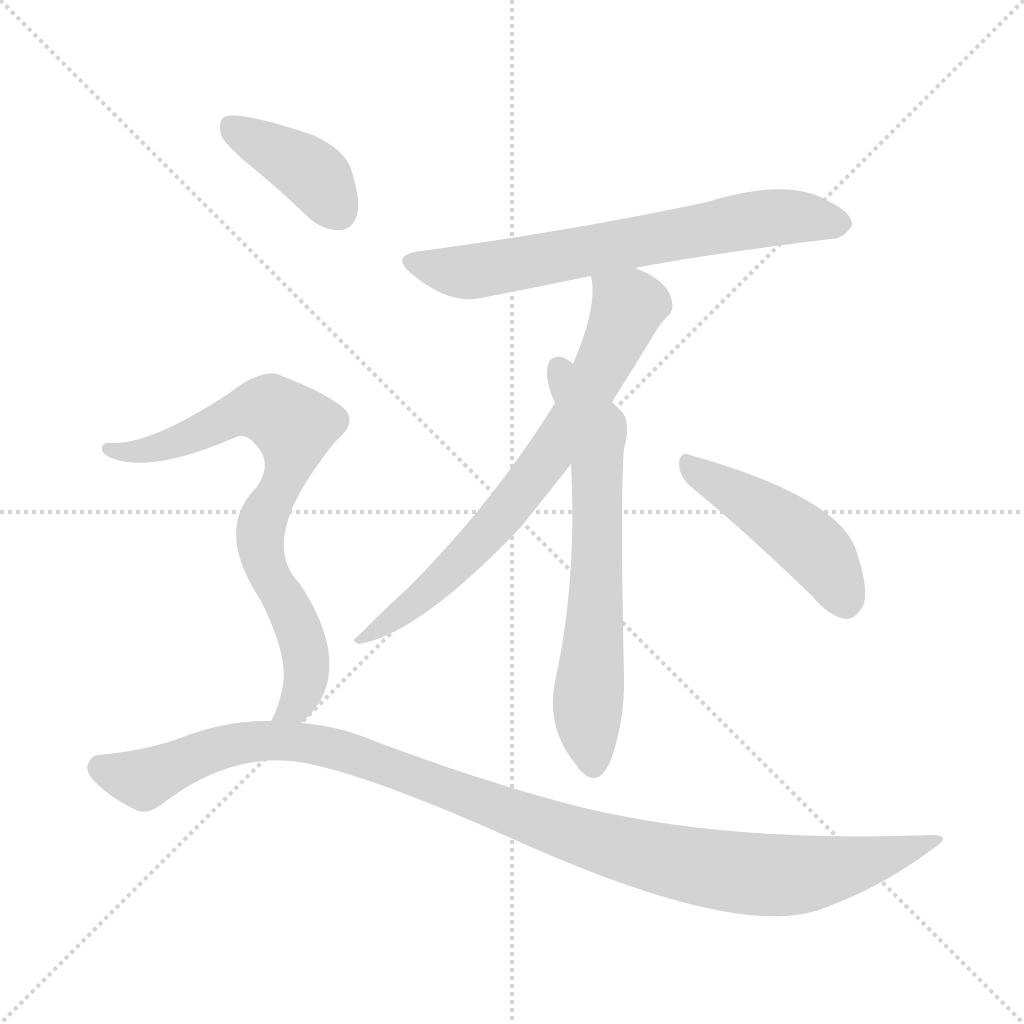
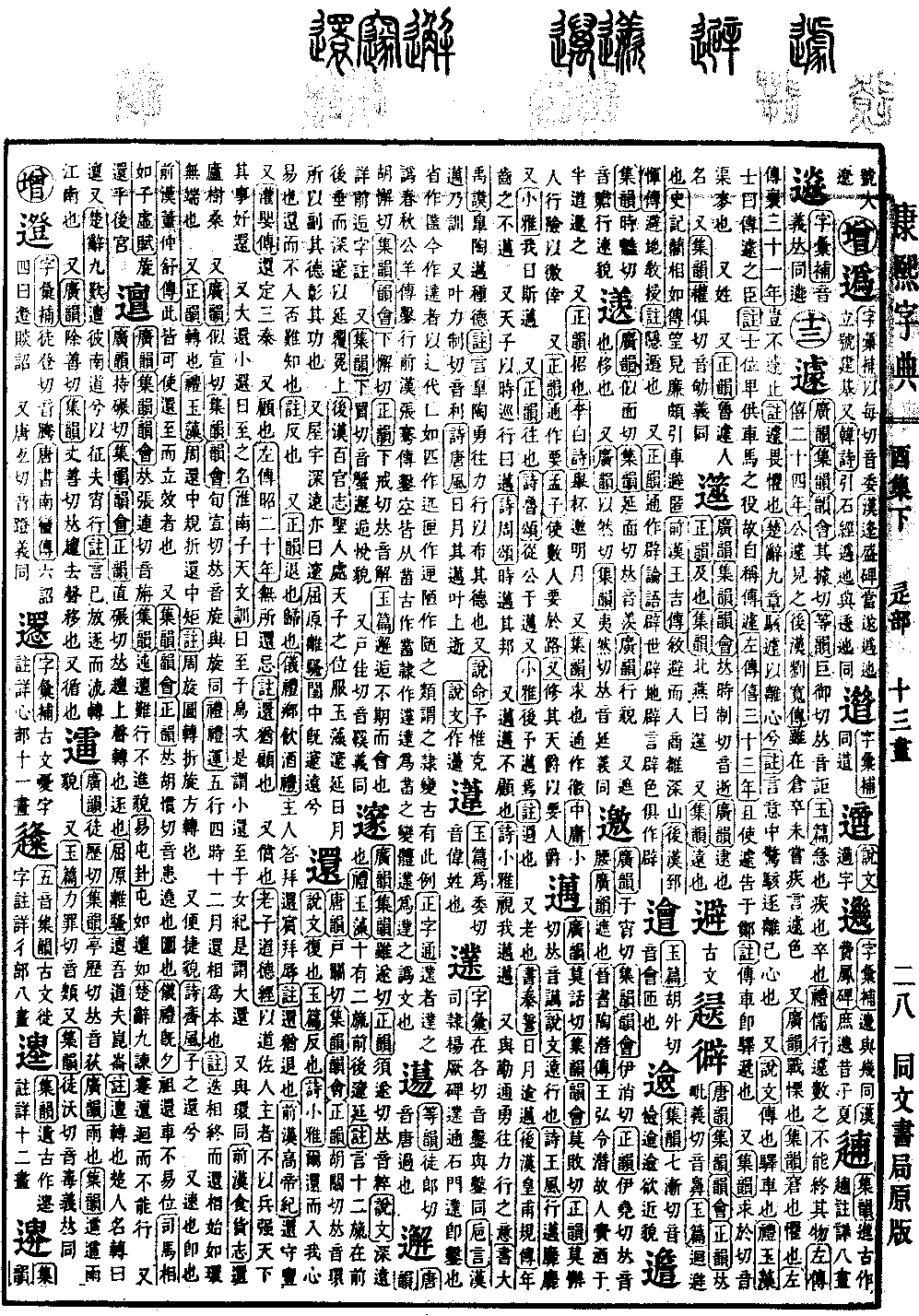
Supplementary Notes, You Collection, Radical: Walk (chuò); Kangxi strokes: 20; Page 1266, Entry 01. In the Compilation of Character Classes (Pianhai leibian), pronounced fou. Also pronounced fou. Commonly written as the character huan, which is incorrect.
Huan. Pronounced huan. As defined in the Analytical Dictionary of Characters (Shuowen), to return. In the Jade Chapter (Yupian), to reverse. In the Book of Odes (Shijing), Xiao Ya: You return and enter, my heart is at ease. You return and do not enter, it is difficult to know if this is so. The commentary states: to reverse. Furthermore, to retreat or to return home. In the Book of Etiquette and Ceremonial (Yili), Village Drinking Ritual: The host returns the bow and retreats, the guest bows for the honor. The commentary states: huan means to retreat. In the History of the Former Han (Qianhan shu), Annals of Emperor Gao: He returned to defend Feng. Also, in the Biography of Guan Ying: He returned to pacify the Three Qins. Also, to look back. In the Zuo Tradition (Zuozhuan), 20th year of Duke Zhao: There is nothing to look back upon with dread. The commentary states: huan is similar to looking back. Also, to repay. In the Laozi (Daode jing): Those who assist a ruler with the way do not use military force to dominate the world, for such actions tend to return upon oneself. Also, Great Return and Small Return, names for solar periods. In the Huainanzi, Treatise on Astronomy: When the sun reaches the position of the Bird, it is called the Small Return. When it reaches the position of the Girl, it is called the Great Return. Also, same as the character for ring. In the History of the Former Han (Qianhan shu), Treatise on Food and Money: Surround the huts with mulberry trees.
Also pronounced xuan. Same as the word for revolve. In the Book of Rites (Liji), Rite of Universal Application: The Five Phases, four seasons, and twelve months revolve and become the basis for one another. The commentary states: they cycle through and end, then revolve and begin anew, like a ring with no end. Also, to turn. In the Book of Rites (Liji), Jade Precepts: When walking in a circle, it accords with the compass; when turning, it accords with the square. The commentary states: revolving in a circle, and turning with right angles. Also, the appearance of being agile. In the Book of Odes (Shijing), Odes of Qi: Your agility. Also, to be fast or immediate. In the History of the Former Han (Qianhan shu), Biography of Dong Zhongshu: These are all things that can be made to quickly arrive and take effect. Also, pronounced huan. To circle or to surround. In the Book of Etiquette and Ceremonial (Yili), The Evening After the Funeral: The ancestral carriage circles without changing its position. In the Rhapsody on the Master of Void (Zixu fu) by Sima Xiangru: Revolving and circling in the rear palace.