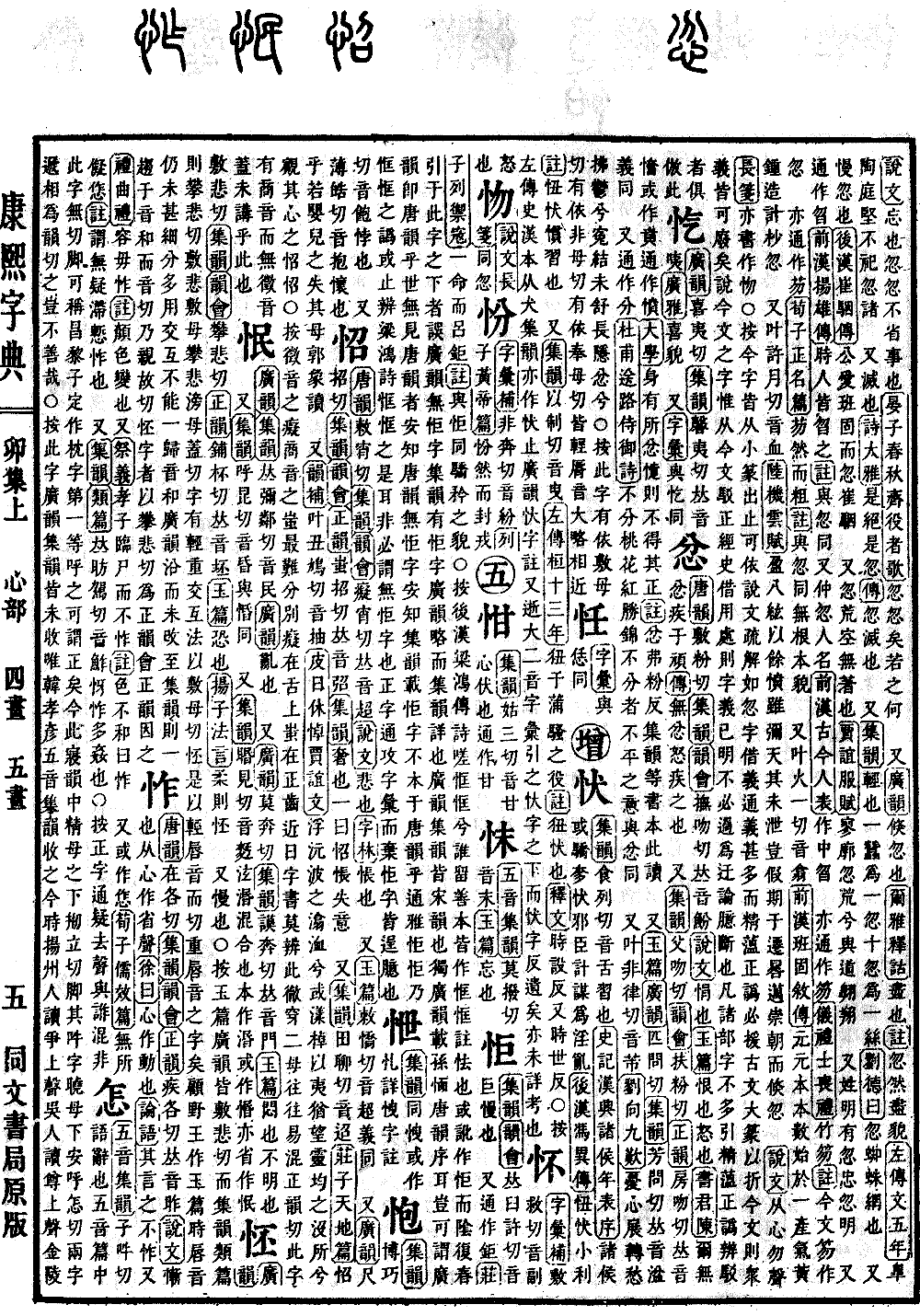
Mao Collection, Upper Volume
Radical: Heart (xīn)
Kangxi Strokes: 20
Page 379, Entry 05
Treasury of Characters (Zihui bu): Pronounced fu. Meaning to be angry.
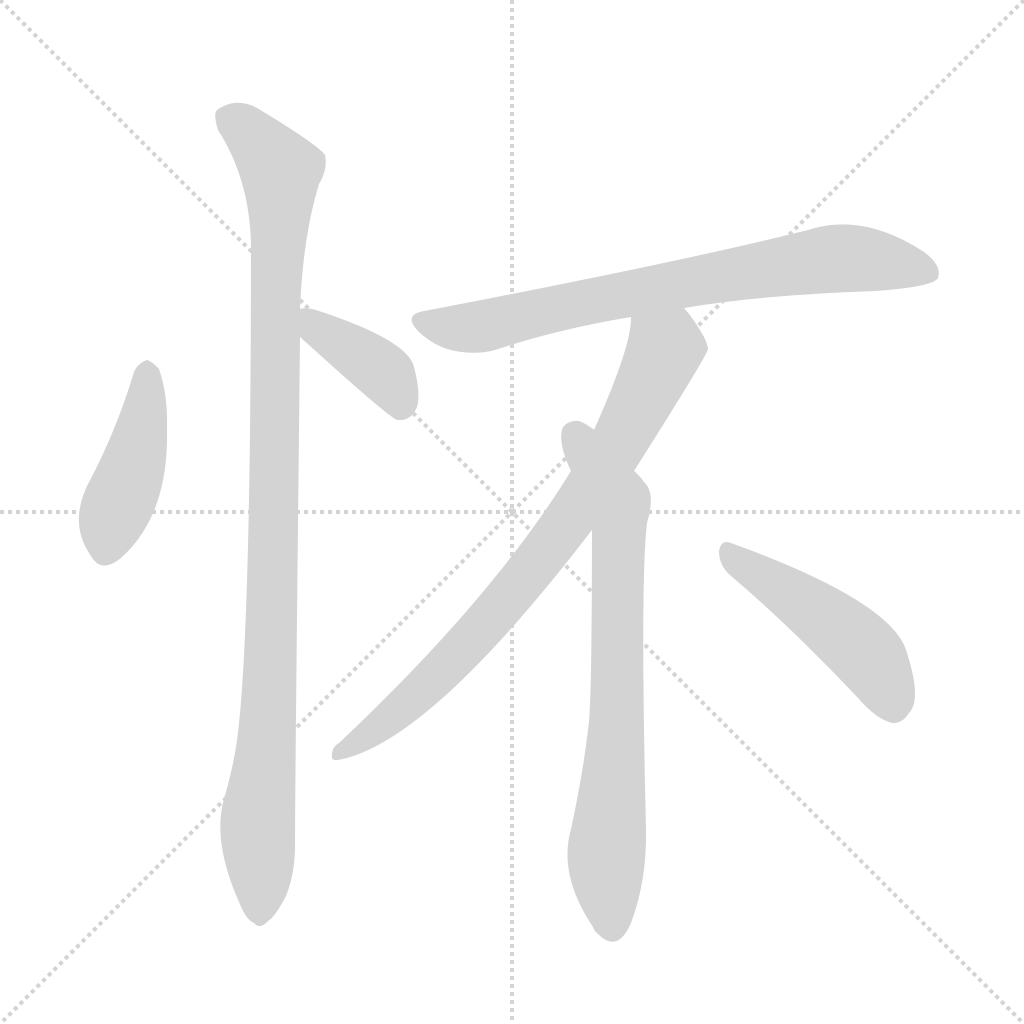
Old form of the character is written as huai (variant form).
Tang Rhyme (Tangyun): Pronounced huai.
Collected Rhymes (Jiyun) and Rhyme Collection (Yunhui): Pronounced huai.
Explanation of Graphs and Analysis of Characters (Shuowen): To think or ponder. Derived from the heart radical, with huai as the phonetic component.
Analects (Lunyu): The superior person cherishes virtue.
Also, to return or submit.
Classic of History (Shujing), Counsels of the Great Yu (Da Yu Mo): The black-haired people submit to him.
Commentary: To return to him.
Also, to come.
Book of Odes (Shijing), Odes of Qi (Qi feng): Why does he not come?
Also, Odes of Zhou (Zhou song): To cherish and soothe all the spirits.
Commentary: Huai means to come.
Also, to be peaceful.
Classic of History (Shujing), Oath of Qin (Qin shi): The prosperity and peace of the state.
Book of Odes (Shijing), Odes of Wang (Wang feng): Be at peace, be at peace.
Also, to encompass or wrap.
Classic of History (Shujing), Canon of Yao (Yao dian): Vastly flooding the mountains and rising above the hills.
Also, to store or hide.
Analects (Lunyu): If one hides one's precious jade, and the state is confused.
Book of Rites (Liji), Records of Ritual (Qu li): If one has fruits with pits, one hides the pits in one's bosom.
Also, to soothe or comfort.
Book of Odes (Shijing), Odes of Gui (Gui feng): Comfort him with beautiful sounds.
Also, the bosom or chest.
Zuo Tradition (Zuo zhuan), 17th Year of Duke Cheng (Cheng shiqi nian): The precious jade fills my bosom.
Analects (Lunyu): Only then are they free from the bosom of their parents.
Also, to be pained or sad.
Book of Odes (Shijing), Odes of Bei (Bei feng): When I speak of it, I am pained.
Mao Commentary: Huai means to be pained.
Also, private or selfish.
Book of Odes (Shijing), Odes of Xiao Ya (Xiao ya): Every time I am selfish, I fail to achieve.
Zheng Commentary: Huai means private or selfish.
Also, Er Ya, Explaining Words (Er ya, Shi gu): To arrive.
Commentary: The meeting place of Qi and Lu at the outskirts is called Huai.
Book of Odes (Shijing), Odes of Xiao Ya (Xiao ya): Sincerely arrive and do not forget.
Zheng Commentary: To arrive. To arrive with sincerity and not forget.
Also, Er Ya, Explaining Words (Er ya, Shi gu): To stop or cease.
Sub-commentary: To arrive and to stop.
Also, Explaining Names (Shi ming): Huai means to return or revolve. Originally having the intention to leave, one returns back to where one started. It also means to submit; to come and submit to oneself.
Also, in the Law of Posthumous Titles (Shifa): One who is benevolent and wise is titled Huai.
Also, a place name.
Classic of History (Shujing), Tribute of Yu (Yu gong): Tanhuai successfully achieved its results.
Also, a prefecture name. During the Spring and Autumn period, it was the city of Yewang; in the Han dynasty, it was Henei Commandery; in the Tang dynasty, Huai Prefecture was established.
Also, a surname. In the Three Kingdoms period, the Wu dynasty official Huai Xu.
Also, commonly written as huai (variant form).
History of the Former Han (Qian Han shu), Biography of Empress Xu (Xu hou zhuan): Holding sincerity and loyalty.
Also, rhyming with huai (huai tone).
Book of Odes (Shijing), Odes of Zhou Nan (Zhou nan): Climbing that high and craggy mountain, my horse is exhausted. I will drink from that metal wine vessel, so that I do not remain sad for long.
Also, rhyming with hui (hui tone).
Songs of Chu (Chu ci), Nine Songs (Jiu ge): I sigh long and deep, about to ascend; my heart turns back, looking back with longing.
Also, rhyming with ke (ke tone).
Huainanzi, Treatise on Seasonal Rules (Shi ze xun): Be balanced and not sycophantic, bright and not fastidious. Wrapping and covering, nothing is left outside the bosom.
Zhou Boqi says: The character huai (original form) means to hide or tuck something into one's clothing. It is derived from the clothing radical, with a phonetic component. What the heart contemplates, holds, and stores is also called huai. In clerical script, it is written as huai.