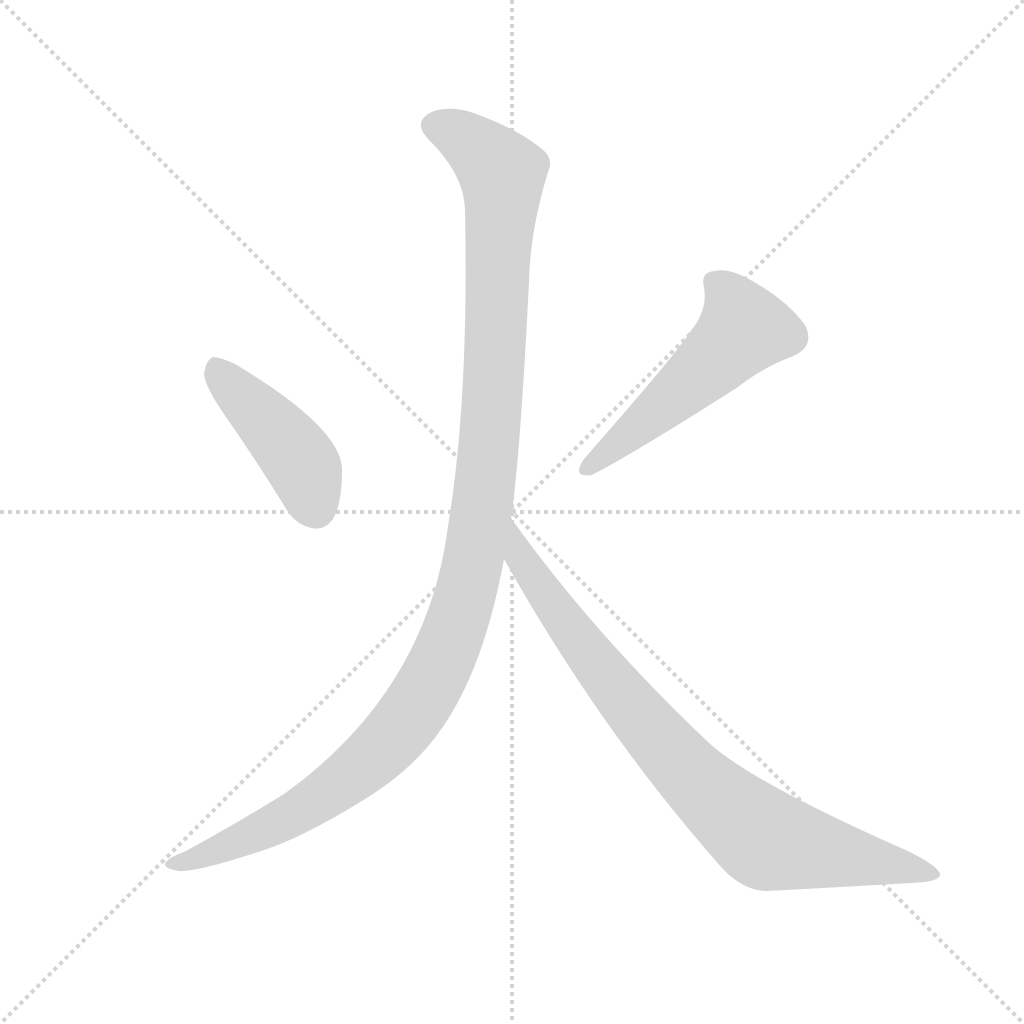
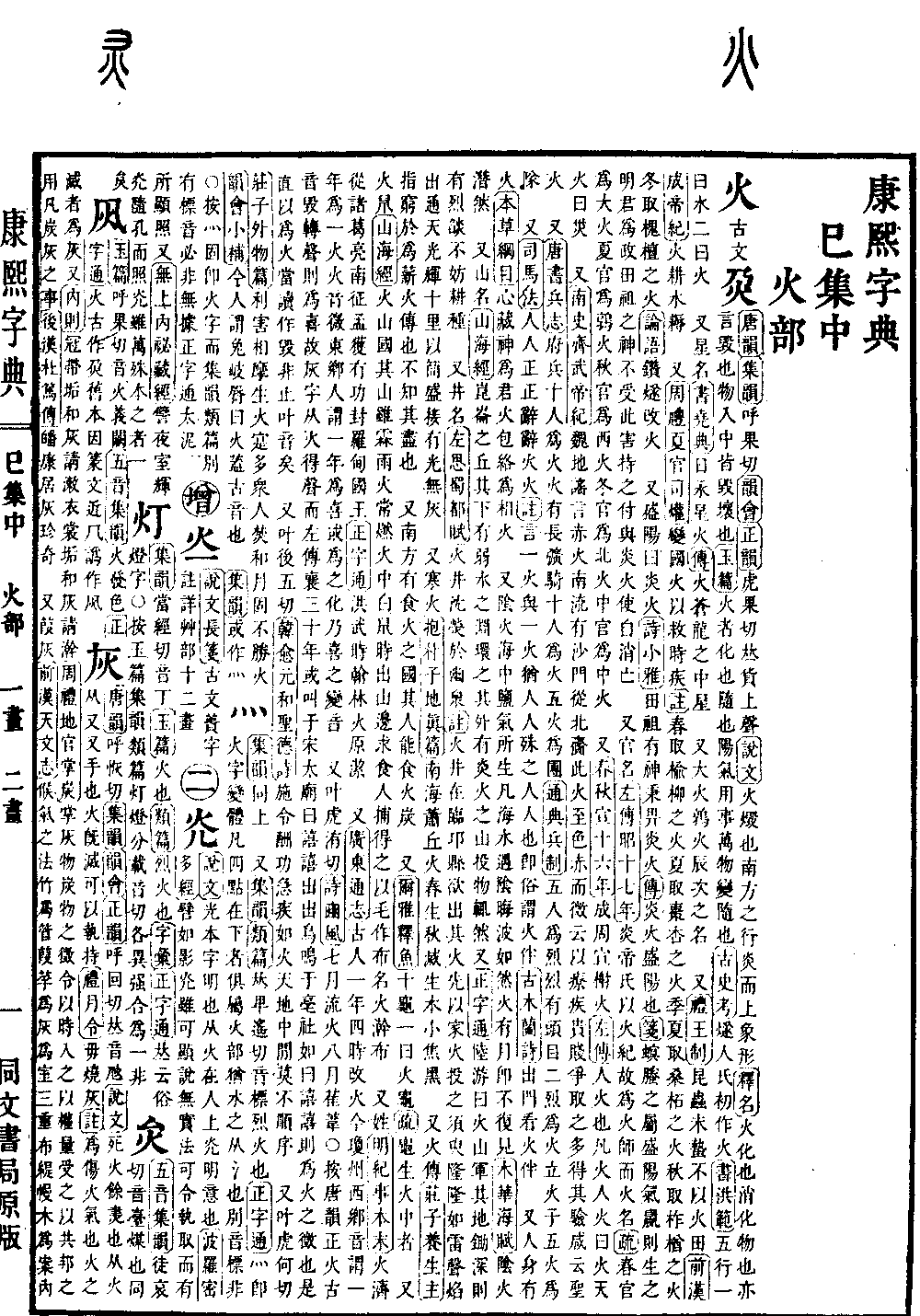
Si Collection, Lower Volume Radical: Fire (huǒ); Kangxi Stroke Count: 4; Page 665, Entry 01
Ancient character. Tang Rhyme (Tangyun) and Collection of Rhymes (Jiyun) state: Pronounced huo (rising tone). Rhyme Compendium (Yunhui) and Correct Rhymes (Zhengyun) state: Pronounced huo (rising tone).
Shuowen Jiezi states: Fire means to destroy. It belongs to the south and possesses the characteristics of heat and rising. The shape is a pictograph.
Explanation of Names (Shiming) states: Fire is transformation, as it can digest all things. It is also said to be destruction, as objects placed within it are destroyed.
Jade Chapter (Yupian) states: Fire means change and following. When the yang energy functions, all things change accordingly.
Ancient History Examinations (Gushikao) states: The Sui Ren Clan first invented fire.
Book of Documents (Shangshu), section Great Plan (Hongfan) states: Among the five elements, the first is water, and the second is fire.
Also refers to a star name.
Book of Documents (Shangshu), section Canon of Yao (Yaodian) states: When the day is longest, the Fire Star appears in the south. Commentary (Zhuan) explains: Fire refers to Antares in the Heart constellation of the seven mansions of the Azure Dragon.
Also refers to Big Fire and Quail Fire, which are names of stellar divisions in ancient astronomy.
Also, Book of Rites (Liji), section Royal Regulations (Wangzhi) states: When insects have not yet hibernated, do not use fire to hunt in the fields.
Book of Han (Qian Hanshu), section Annals of Emperor Cheng, mentions fire cultivation and water weeding, a method of farming.
Also, Rites of Zhou (Zhouli), section Summer Officials, Master of Fire (Siguo) records: Changing the wood used for fire in the capital to prevent seasonal illnesses. Note (Zhu) explains: In spring, take fire from elm and willow wood; in summer, from jujube and apricot; in late summer, from mulberry and tallow; in autumn, from oak and nara oak; in winter, from pagoda tree and sandalwood.
Analects (Lunyu) states: Drill wood to obtain fire, changing the wood according to the seasonal shifts.
Also refers to intense yang energy, called scorching fire.
Book of Odes (Shijing), section Minor Odes (Xiaoya) states: The Ancestor of Fields has divine power; he hands the pests over to the scorching fire. Commentary (Zhuan) explains: Scorching fire refers to intense yang energy. Jian notes: Pests like the ming and teng insects are born from excessive yang energy. A wise ruler governs, and the god of the fields prevents them from causing harm, seizing them and handing them to the scorching fire to cause them to perish on their own.
Also refers to an official title.
Zuo Tradition (Zuozhuan), seventeenth year of Duke Zhao, states: The Flame Emperor used fire to record events, so he established fire masters and used fire to name official positions. Exegesis (Shu) explains: The spring official was called Great Fire; the summer official, Quail Fire; the autumn official, Western Fire; the winter official, Northern Fire; and the central official, Central Fire.
Also, Spring and Autumn Annals (Chunqiu), sixteenth year of Duke Xuan, records: A fire broke out in the Xuan Pavilion of Chengzhou. Zuo Tradition (Zuozhuan) states: This was a man-made fire. Any fire caused by humans is called fire; naturally occurring fire is called disaster.
Also, History of the Southern Dynasties (Nan Shi), Annals of Emperor Wu of Qi, records: There was a rumor in Northern Wei that red fire was flowing south. A monk brought this fire from the north; its color was red and faint. It was said to cure diseases, and both noble and commoners scrambled to get it. Many found it effective and called it holy fire.
Also, New Book of Tang (Xin Tangshu), section Military Records, records: In the fu-bing (militia) system, ten men made one fire, and each fire had a fire leader. In the kuo-qi (garrison cavalry), ten men made one fire, and five fires made one regiment.
General Statutes (Tongdian), section Military Records, records: Five men made one fierce, and each fierce had a leader; two fierce made one fire, with a fire son appointed; five fires made one team.
Also, Sima Fa (Art of War) states: When people are upright, their language is like fire. Note (Zhu) explains: This refers to the relationship between one fire and another, similar to how people differ from one another. This is what is colloquially called fire companion, meaning a companion.
Old Ballad of Mulan (Gu Mulan Shi) says: Go out and see my fire companions.
Also refers to fire within the human body.
Compendium of Materia Medica (Bencao Gangmu) states: The heart stores the spirit and is the sovereign fire. The pericardium is the ministerial fire.
Also includes hidden fire, which is produced by the saline vapors of the sea. Whenever the sea encounters cloudy weather, the waves resemble burning flames; when the moonlight appears, they are no longer visible.
Mu Hua's Sea Rhapsody (Haifu) states: Hidden fire burns in the darkness.
Also refers to a mountain name.
Classic of Mountains and Seas (Shanhaijing) states: Below the Kunlun Hills, there is a deep abyss of weak water; outside, there is the Mountain of Scorching Fire. Anything thrown into it, east or west, will burn.
Also, Zhengzitong records: Lu You stated that in Huoshan Prefecture, if one hoed the ground deeply, flames would emerge, but it did not hinder cultivation.
Also refers to a well name.
Zuo Si's Rhapsody on the Capital of Shu (Shu Du Fu) states: Fire wells emit light from deep springs. Note (Zhu) explains: The fire well is in Linqiong County. To draw out its fire, one first casts a household fire-seed into it; soon there is a rumbling like thunder, and flames shoot into the sky, illuminating ten miles. Using bamboo pipes to channel it, there is light but no ashes.
Also mentions cold fire.
Baopuzi, section On Earthly Truth (Dizhen Pian), states: On Xiao Hill in the South Seas, there is a kind of fire that is born in spring and extinguished in autumn. If one lights small wood with it, the wood will turn scorched and black.
There is also the theory of fire transmission.
Zhuangzi, section The Secret of Caring for Life (Yang Sheng Zhu), states: The fat and grease are used up as firewood, but the fire-seed is transmitted onward, without end.
Also, there are countries in the south that eat fire, where people can consume burning charcoal.
Also, Erya, section Explaining Fishes, records: Of the ten kinds of turtles, the first is called the fire turtle. Exegesis (Shu) explains: This is a turtle that lives in fire.
There is also the fire rat.
Classic of Mountains and Seas (Shanhaijing) states: In the Huoshan Kingdom, the mountains burn continuously even when it rains. Within the fire are white rats that frequently come to the edge of the mountains to seek food. People catch them and use their hair to weave cloth, called fire-washable cloth.
Also refers to a surname.
Ming History (Ming Shi Jishi Benmo) records: Huo Ji followed Zhuge Liang on the southern campaign against Meng Huo and for his merits was enfeoffed as the King of Luodian.
Zhengzitong records: During the Hongwu era, there was a Hanlin scholar named Huo Yuanjie.
Also, Guangdong Tongzhi records: The ancients changed the wood for fire according to the four seasons. Nowadays, the dialect in the western countryside of Qiongzhou calls one year one fire, with the pronunciation of fire being light. People in the eastern countryside call one year xi, or hua, which is a phonetic variation of xi.
Also, in rhyme, it is pronounced hui (rising tone).
Book of Odes (Shijing), section Bin Odes, states: In the seventh month, the Fire Star moves west; in the eighth month, the reeds are harvested.
According to Tangyun Zheng: The ancient pronunciation of fire was hui; shifted, it is read as xi, which is why the character for ash is derived from fire. Furthermore, Zuo Tradition (Zuozhuan), thirtieth year of Duke Xiang, records: Someone shouted in the Ancestral Temple of the State of Song: Xi, xi, chu, chu. Also, a bird sang at the Bo Shrine. If one says xi, it is an omen of fire. This suggests that fire should be read as hui, not just as a rhyme variation.
Also, in rhyme, it is pronounced hou (rising tone).
Han Yu's Poem on the Sacred Virtues of Yuanhe states: Bestowing commands and rewarding merits, as swift as fire. Between heaven and earth, nothing is not compliant and orderly.
Also, in rhyme, it is pronounced huo (rising tone).
Zhuangzi, section External Things (Waiwu), states: The fire generated by the friction of profit and loss is truly great; the masses burn their inner peace, and the moon, being yin, cannot suppress the fire.
Yunhui Xiaobu states: Contemporary people call the cleft lip of a rabbit fire. This is likely the ancient pronunciation.
Jiyun records: It is sometimes written as the radical for fire.