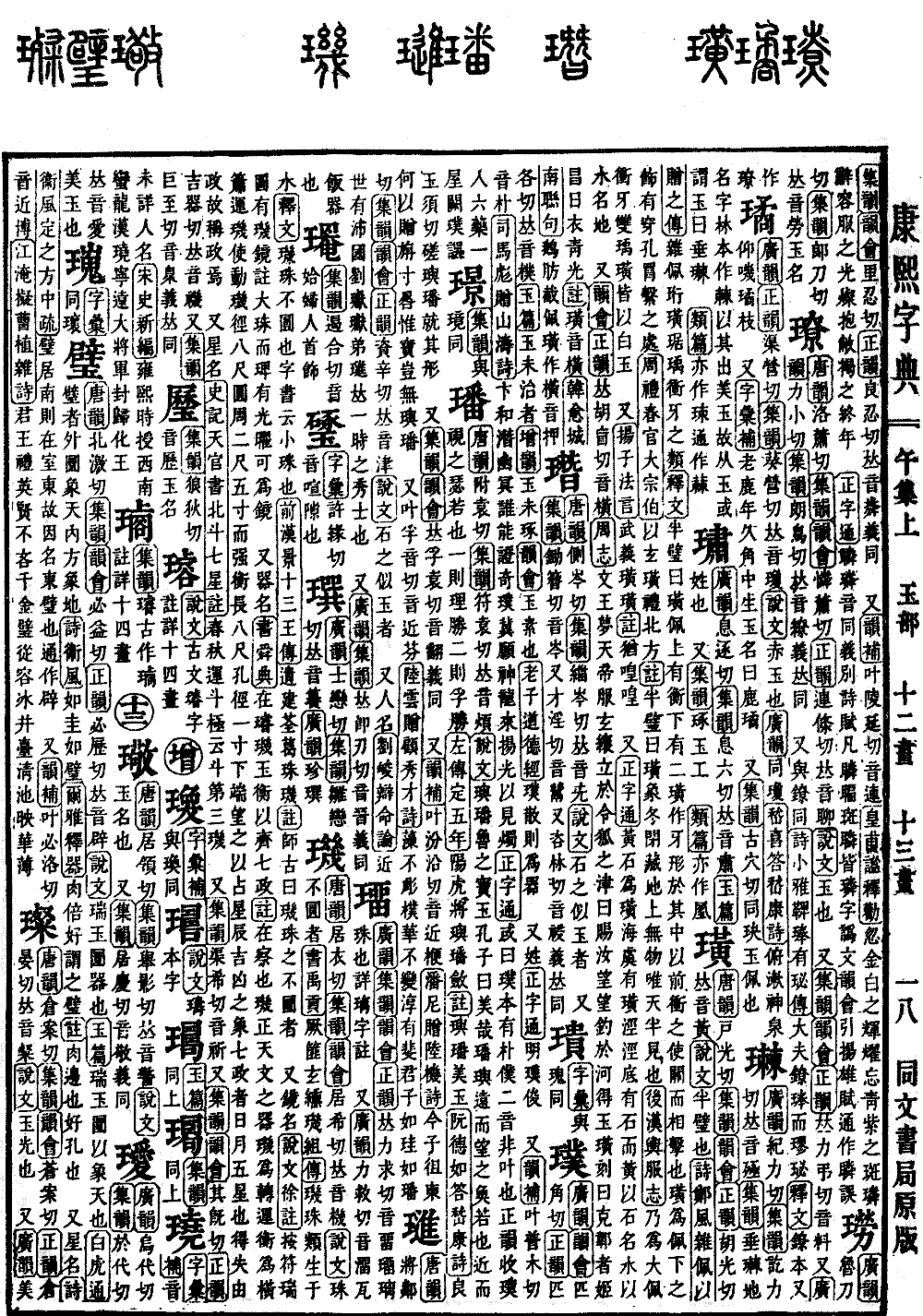
Wu Collection, Upper Volume
Radical: Jade (yù)
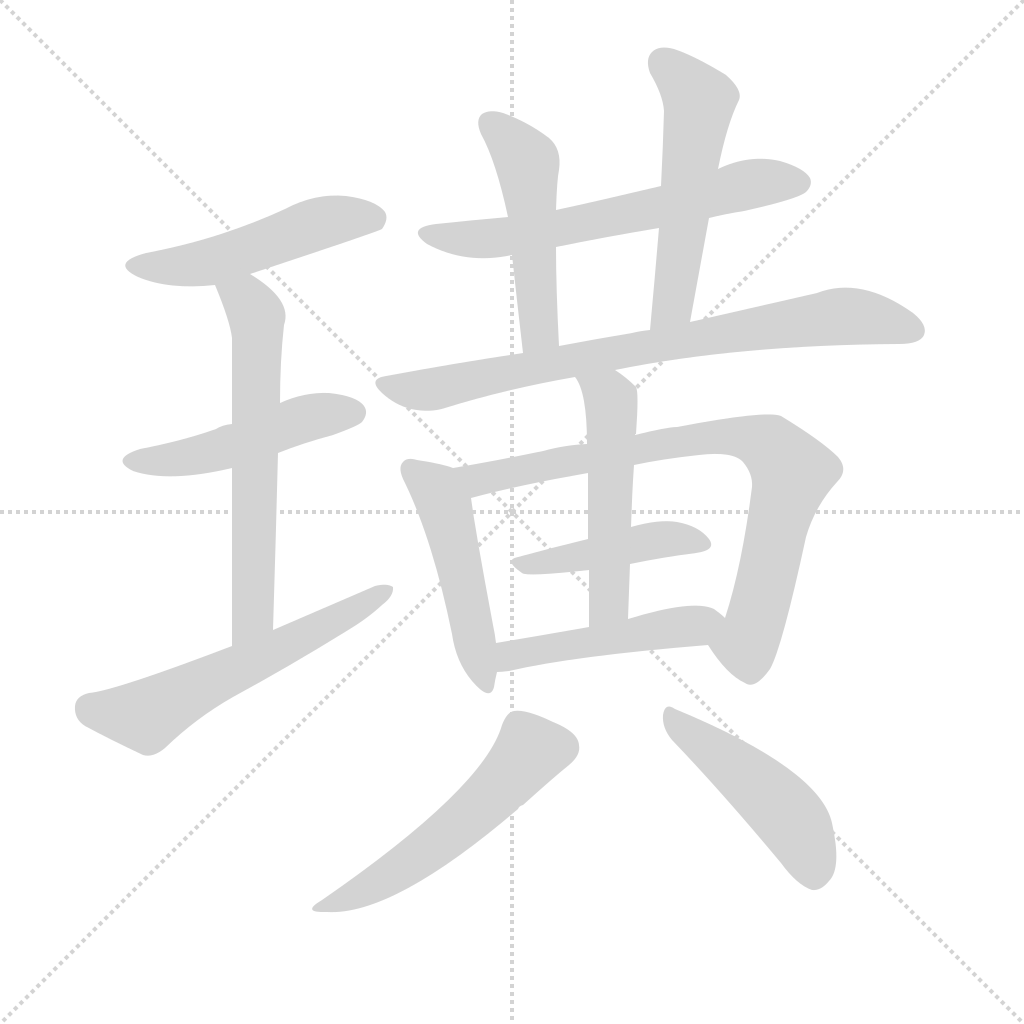
璜 (huáng)
Kangxi stroke count: 17
Page 742, Entry 06
Pronounced huáng.
According to the Shuowen Jiezi, it is a semi-circular jade disc.
In the commentary to the Book of Odes (Shijing), Zheng Feng section, regarding the passage on miscellaneous girdle ornaments being given as a gift, it is noted that these include the heng, huang, ju, yu, and chongya ornaments.
The Shiven notes that a semi-circular jade disc is called a huang. There is a horizontal piece at the top of the girdle set, with two huang below it, shaped like teeth in the center, which strike against each other. The huang serves as an ornament at the bottom of the set, featuring a hole for cord attachment.
In the Rites of Zhou (Zhouli), Spring Offices, Grand Master of Ceremonies, it is stated that the huang is used to pay homage to the north. The commentary explains that a semi-circular disc is called a huang, representing winter's containment, where nothing exists on the ground and only the sky is half-visible.
In the Book of the Later Han (Hou Hanshu), Treatise on Carriages and Attire, it is written that the great girdle ornaments, including the chongya, twin yu, and huang, are all made of white jade.
Also, in the Model Sayings (Fayan) by Yang Xiong, the phrase appears as huang huang, which the commentary explains as being similar to the sound huang huang (clamorous or majestic).
According to the Zhengzitong, yellow stone is called huang; there is a place called Huangjing in Haiyu where the riverbed contains yellow stones, with the water named after the stones and the land named after the water.
Also, pronounced héng.
In the Zhou Records (Zhouzhi), it is written that King Wen dreamt of the Heavenly Emperor wearing a sash, standing at the ford of Linghu, saying: I bestow upon you the hope. Wang fished in the river and obtained a jade huang, inscribed with the words: He who conquers the city of Bei is Ji Chang, daily clothed in blue light. The commentary notes that huang is pronounced héng.
In the collected verses of Han Yu, titled Chengnan Lianju, the phrase "goose fat cut into ornaments" uses huang with the pronunciation héng.