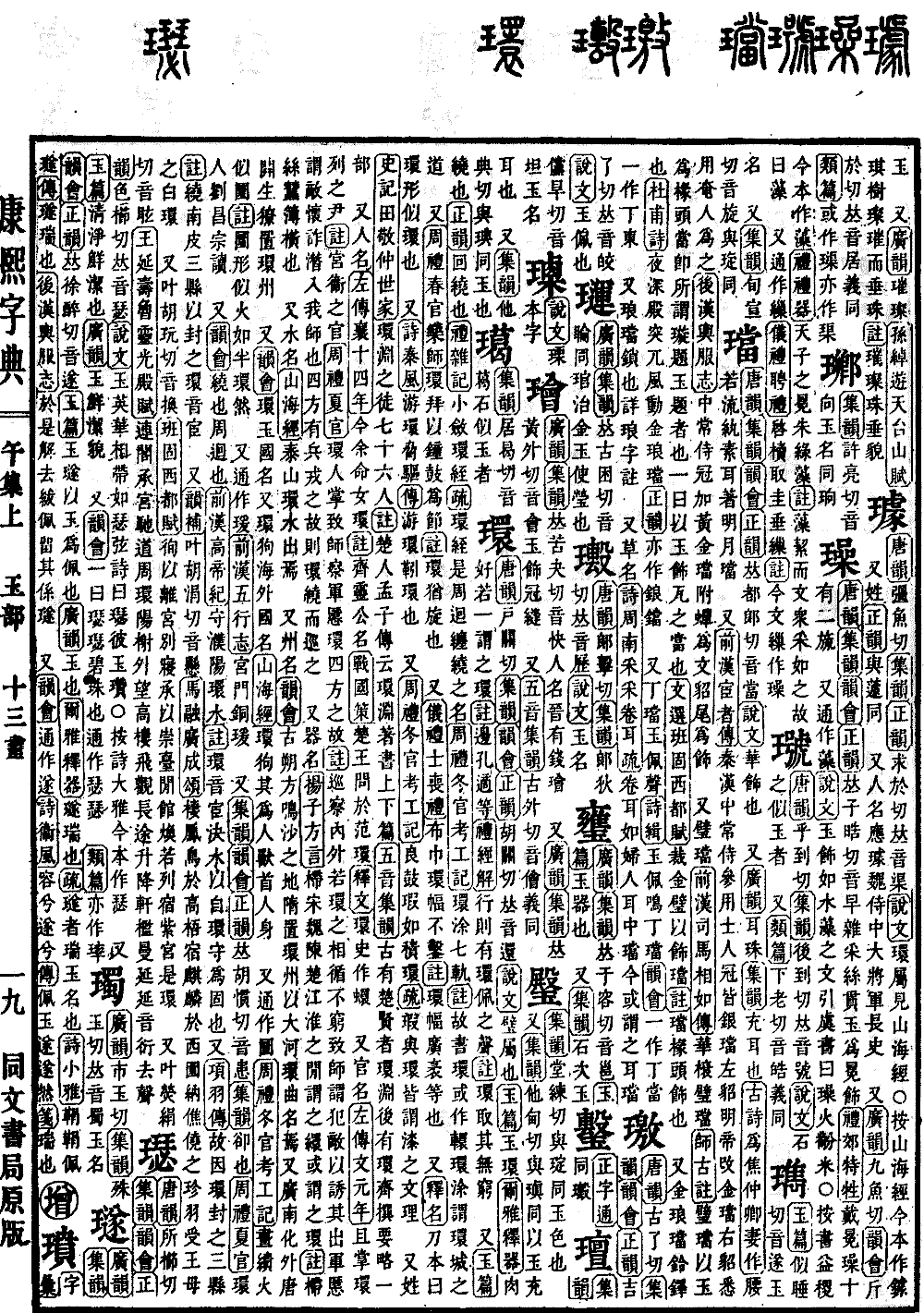
Wu Collection, Upper Volume
Radical: Jade (yù)
Kangxi Strokes: 18
Page 743, Entry 01
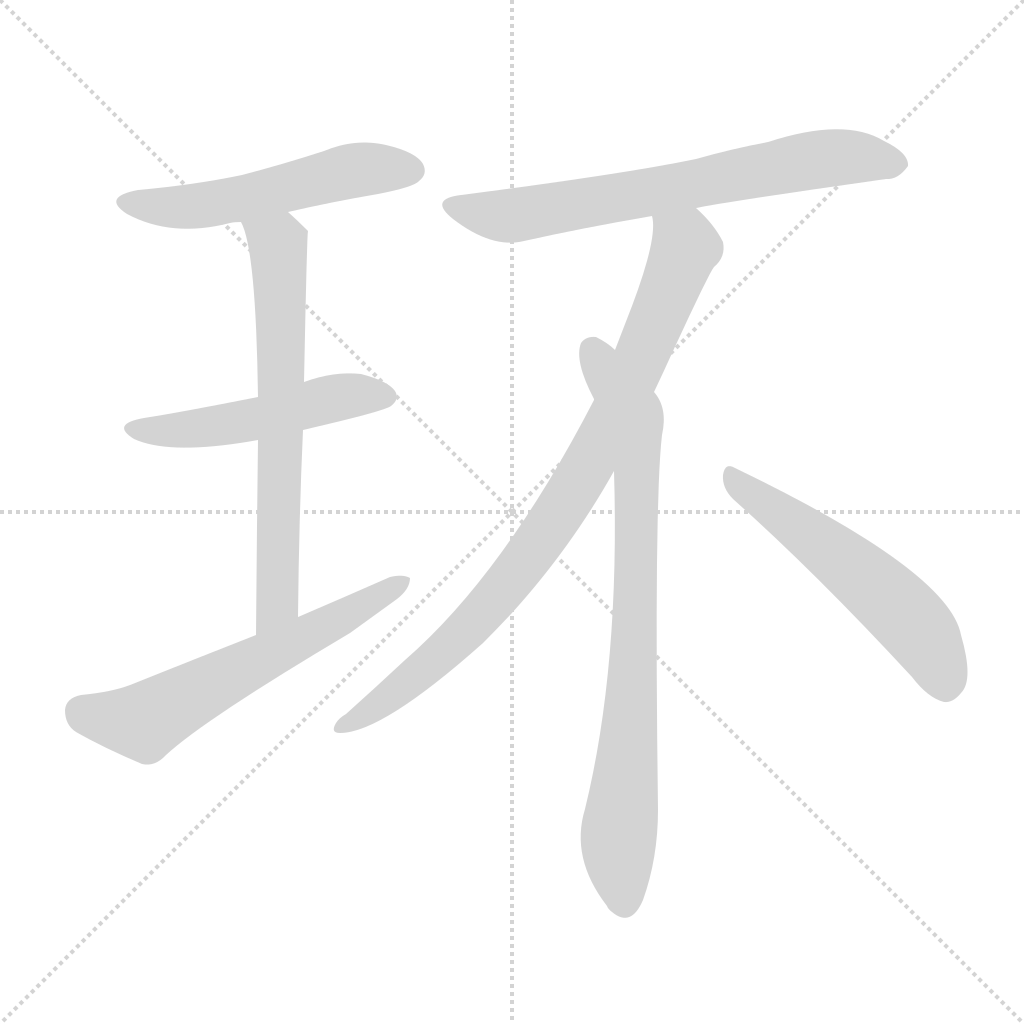
Pronounced huan.
According to the Analytical Dictionary of Characters (Shuowen Jiezi), a type of jade disk.
In the Jade Chapters (Yupian), a jade ring.
In the Literary Expositor (Erya), specifically in the Section on Tools, a ring where the width of the ring matches the size of the hole is called huan.
Commentary: The edges and the hole are of equal proportion.
In the Book of Rites (Liji), in the Section on Explanations of the Classics, it says one has the sound of jade pendants when walking.
Commentary: The ring is so named for its quality of being infinite.
Also, in the Jade Chapters (Yupian), to circle or wrap around.
In the Correct Rhymes (Zhengyun), to loop back and surround.
In the Book of Rites (Liji), in the Section on Miscellaneous Records, refers to a mourning sash tied in a loop.
Commentary: A loop sash refers to a wrapping or binding.
In the Rites of Zhou (Zhouli), in the Winter Offices, Records of Tradesmen, refers to a road seven tracks wide circling the city.
Commentary: In some ancient texts, the character is written as a variant form. A circular road refers to a path around the city.
Also, in the Rites of Zhou (Zhouli), in the Spring Offices, Music Master, mentions circling in greeting using bells and drums to set the rhythm.
Commentary: To circle, or to rotate.
Also, in the Ceremonial Rites (Yili), in the Section on Gentleman's Funeral Rites, mentions cloth fabric used for the sash without perforations.
Commentary: The width of the fabric is uniform.
Also, in the Explanations of Names (Shiming), the base of a knife is called a huan because it is shaped like a ring.
Also, in the Book of Odes (Shijing), in the Odes of Qin, mentions the side rings of a carriage.
Commentary: These are the rings on the traces.
Also, in the Rites of Zhou (Zhouli), in the Winter Offices, Records of Tradesmen, it says fine drums have flaws like accumulated rings.
Commentary: Both flaws and rings refer to the patterns of the lacquer.
Also a surname.
In the Records of the Grand Historian (Shiji), in the House of Tian Jingzhong, mentions seventy-six followers of Huan Yuan.
Commentary: The writings of Master Meng of Chu state: Huan Yuan wrote a book in two parts, upper and lower.
In the Five Sounds Collected Rhymes (Wuyin Jiyun), there was an ancient sage of Chu named Huan Yuan, and later one named Huan Qi, who compiled a collection of summaries.
Also a personal name.
In the Zuo Commentary (Zuozhuan), 14th Year of Duke Xiang, it says: Now I command you, Huan.
Commentary: This was the personal name of Duke Ling of Qi.
In the Strategies of the Warring States (Zhanguoce), the King of Chu asked Fan Huan.
Commentary: In the Exegesis of Characters, it is noted that in the official histories, Huan is written as a variant form.
Also an official title.
In the Zuo Commentary (Zuozhuan), 1st Year of Duke Wen, mentions the director who managed the circular palace guard.
Commentary: An office for guarding the palace.
In the Rites of Zhou (Zhouli), in the Summer Offices, the Huan Official manages challenges to the enemy, observes military treachery, and handles matters regarding the four directions.
Commentary: To patrol inside and outside, like a ring that follows itself endlessly. Challenging the enemy refers to provoking them to emerge. Military treachery refers to enemies hiding and infiltrating our ranks. When there are military threats from the four directions, one patrols in a circle.
Also a tool.
In the Master Yang's Dialects (Yangzi Fangyan), it mentions a silk-worm frame, which in the regions of Song, Wei, Chu, and along the Jiang and Huai rivers is called a huan or a loop.
Commentary: A horizontal frame for silkworms.
Also a river name.
In the Classic of Mountains and Seas (Shanhai Jing), the Huan River rises from Mount Tai.
Also a prefecture name.
In the Rhyme Collection (Yunhui), an ancient site of the northern frontier at Mingsha; the Sui Dynasty established Huan Prefecture, named for the curving flow of a great river.
Also, in the wild regions of Guangnan, the Tang Dynasty established Huan Prefecture to manage the local tribes.
Also, in the Rhyme Collection (Yunhui), Huan Jade, the name of a state.
Also Huan Dog, the name of an overseas state.
In the Classic of Mountains and Seas (Shanhai Jing), it describes the people as having animal heads and human bodies.
Also used interchangeably with the character for circle/round.
In the Rites of Zhou (Zhouli), in the Winter Offices, Records of Tradesmen, it describes painting fire in a circular form.
Commentary: The circular shape resembles fire, like a half-ring.
Also used interchangeably with the character for a jade ring (yuan).
In the History of the Former Han (Qianhan Shu), in the Treatise on the Five Elements, it mentions the bronze ring of the palace gate.
Also pronounced huan.
In the Collected Rhymes (Jiyun), to reject.
In the Rites of Zhou (Zhouli), in the Summer Offices, the Huan Official. Read by Liu Changzong.
Also in the Rhyme Collection (Yunhui), to wrap around or go in a circle.
In the History of the Former Han (Qianhan Shu), in the Annals of Emperor Gaozu, it describes defending Puyang by surrounding it with water.
Commentary: Huan is pronounced huan; it refers to diverting water to surround and secure the defense.
Also in the Biography of Xiang Yu, it says he was granted the three counties surrounding his fief.
Commentary: Circling the three counties of Nanpi as his fief. Pronounced huan.
Also in the Rhyme Supplement (Yunbu), rhymes with xuan.
In Ma Rong's Ode to Guangcheng, it mentions nesting phoenixes in the tall paulownia trees and sheltering unicorns in the western garden, receiving the rare feathers of the Jiaoyao tribe and accepting the white jade ring of the Queen Mother of the West.
Also rhymes with huan.
In Ban Gu's Rhapsody on the Western Capital (Xidu Fu), it mentions the secondary palaces and chambers, supported by lofty terraces and quiet halls, shining like the arranged stars, with the Purple Palace circling them.
Also rhymes with xuan.
In Wang Yanshou's Rhapsody on the Lingguang Palace of Lu (Lu Lingguangdian Fu), it mentions connecting pavilions and palaces, and elevated walkways circling around. The solar pavilions look outward, with high towers and flying observatories. Long paths rise and fall, and the balustrades extend gracefully.