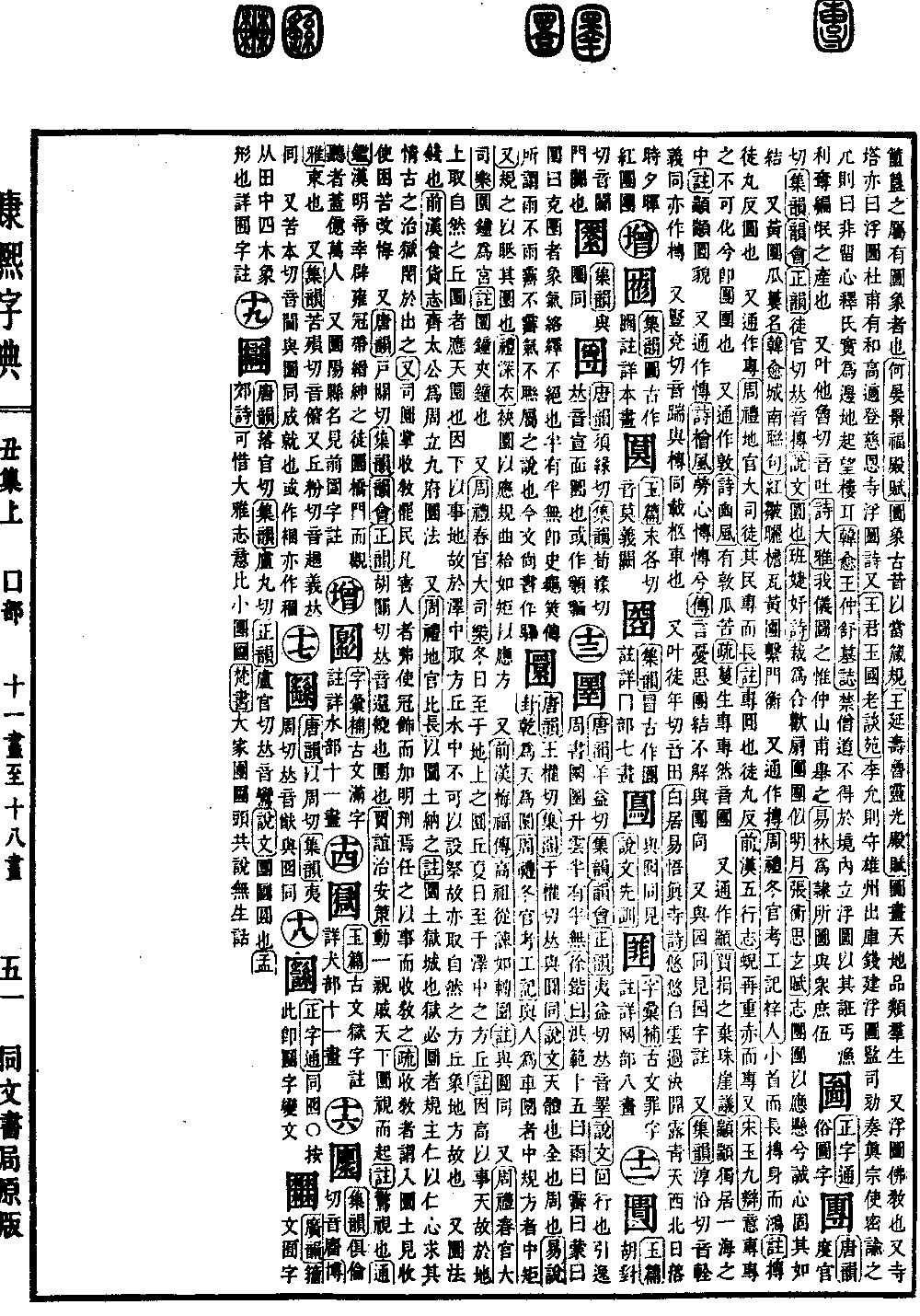
Chou Collection, Upper Volume
Radical: Enclosure (wéi)
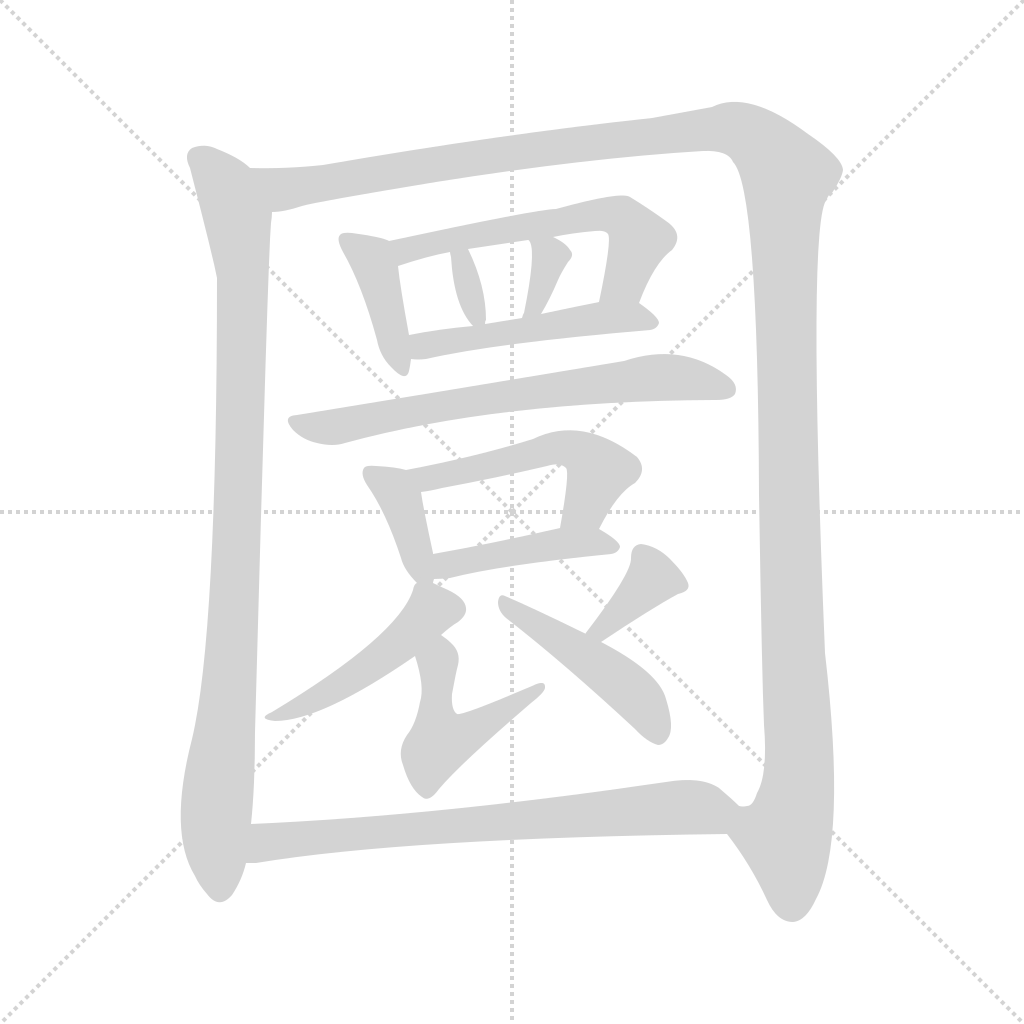
圜
Kangxi strokes: 16
Page 221, Entry 12
Pronounced quan.
Pronounced quan.
Equivalent to the character for round.
Shuowen Jiezi states: The body of the heavens, complete, surrounding.
Book of Changes (Yijing), Explanation of the Trigrams: Qian represents heaven, and represents the round.
Rites of Zhou (Zhouli), Winter Officers, Record of Artificers: The cart maker makes carriages; those that are round follow the compass, those that are square follow the square.
Ibid: Use a compass to inspect their roundness.
Book of Rites (Liji), Deep Garment: The sleeves are rounded to correspond to the compass, and the curved collar is like a square to correspond to the square.
Also, History of the Former Han (Qian Hanshu), Biography of Mei Fu: Emperor Gaozu followed it as easily as rolling a round object. Commentary: Equivalent to the character for round.
Also, Rites of Zhou, Spring Officers, Grand Minister of Music: The round bell serves as the palace note. Commentary: The round bell is the Jiazhong pitch.
Also, Rites of Zhou, Spring Officers, Grand Minister of Music: At the winter solstice, perform a sacrifice at the round mound on the land; at the summer solstice, perform a sacrifice at the square mound in the marsh. Commentary: Because one uses the height to serve heaven, one takes a natural mound on the land; the roundness corresponds to the roundness of heaven. Because one uses the lowlands to serve the earth, one takes a square mound in the marsh; as one cannot set up a sacrifice in the water, one also takes a natural square mound to symbolize the squareness of the earth.
Also, the round method, referring to currency.
History of the Former Han, Treatise on Food and Money: Duke Tai of Qi established the nine-treasury round method for the Zhou dynasty.
Also, Rites of Zhou, Earth Officers, Neighborhood Heads: Confine them in the round prison. Commentary: The round prison is the prison walls. Prisons must be round because the compass represents benevolence, and by using a benevolent heart to seek the truth, the ancients managed prisons with pity to set them free.
Also, the Minister of Prisons manages the receiving and instructing of idle people; for all who harm others, they are not allowed to wear caps or ornaments, are branded, assigned tasks, and are instructed. Sub-commentary: To receive and instruct means to enter the round prison, to be subjected to confinement, and to make one suffer so that they may repent.
Also, pronounced huan.
To wind around, to encircle.
Jia Yi, Discourse on Peace and Order: If you move one relative, the whole world will look around in alarm and rise up. Commentary: A fearful gaze.
Comprehensive Mirror in Aid of Governance (Zizhitongjian): When Emperor Ming of Han visited the Hall of the Circular Moat, the ranks of the gentry and officials encircled the bridge gate to watch and listen, numbering in the hundreds of millions.
Also, Huanyang, the name of a district. See the commentary on the character yin.