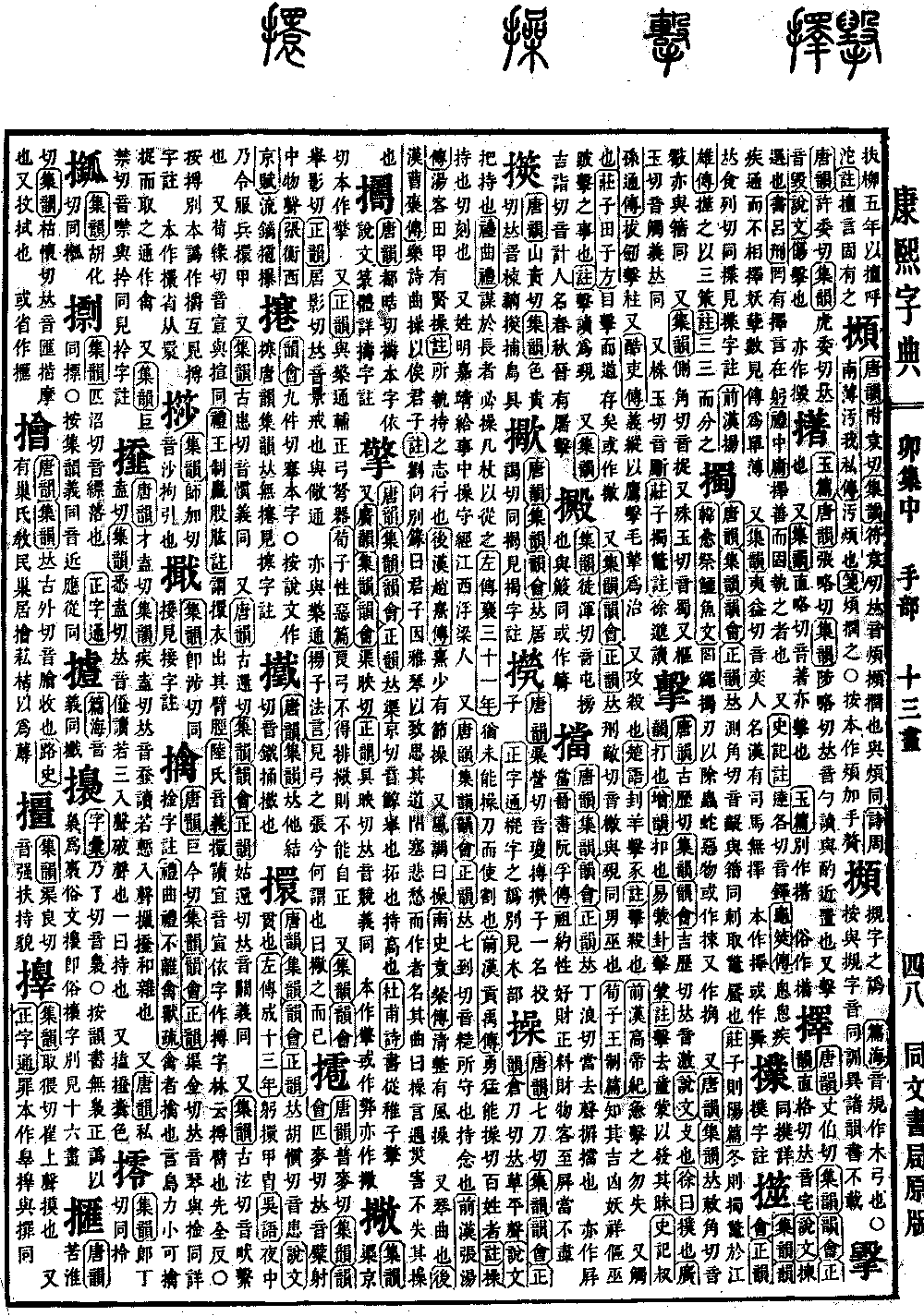
Mao Collection, Middle Volume
Radical: Hand (shǒu)
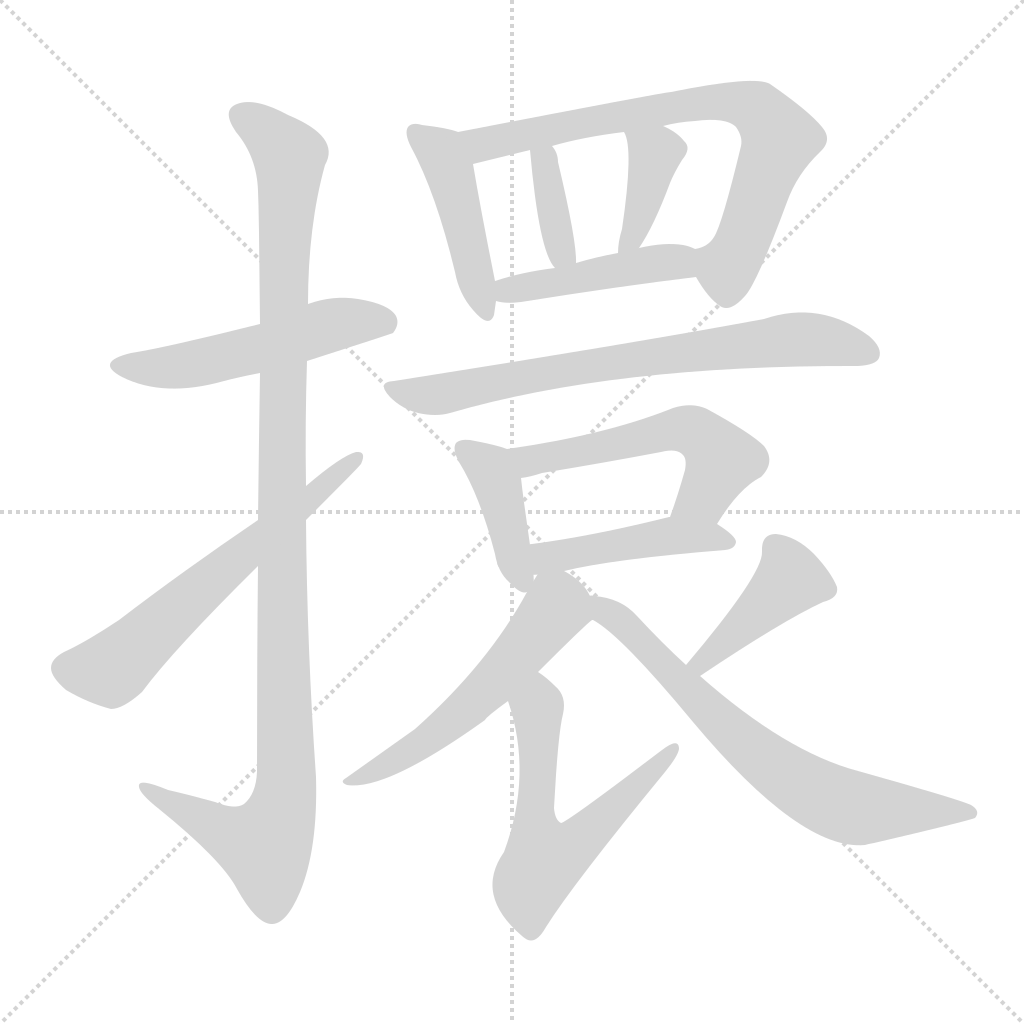
Huan
Kangxi Stroke Count: 17
Page 458, Entry 22
Tang Rhyme (Tangyun), Collected Rhymes (Jiyun), Rhyme Compendium (Yunhui), and Correct Rhymes (Zhengyun) state the pronunciation is huan (falling tone).
Shuowen Jiezi states it means to pierce or string together.
Zuo Tradition (Zuozhuan), 13th Year of Duke Cheng: To personally don armor and a helmet.
Discourses of the States (Guoyu), Wu Section: At midnight, orders were issued for the soldiers to don armor and take up weapons.
Also, Collected Rhymes (Jiyun) states the pronunciation is guan (falling tone). The meaning is the same.
Also, Tang Rhyme (Tangyun) states the pronunciation is guan (level tone); Collected Rhymes (Jiyun), Rhyme Compendium (Yunhui), and Correct Rhymes (Zhengyun) state the pronunciation is guan (level tone). The meaning is the same.
Also, Collected Rhymes (Jiyun) states the pronunciation is quan (falling tone). It means to tie or bind.
Also, pronunciation is xuan (level tone). It is the same as the character for baring the arm.
Book of Rites (Liji), Royal Regulations (Wangzhi), Commentary: Refers to rolling up sleeves to expose the arms and calves.
Lu's Phonetic Annotations (Lu Shi Yin Yi): The character Huan should be pronounced xuan (level tone), and based on the character structure, it is written as a variant. The Zi Lin dictionary states: it refers to the arm. Pronounced xuan (level tone). Note: Other versions mistakenly write it as a variant. See also the entry for the character variant.
Originally written as the variant. When abbreviated, it is written as Huan.