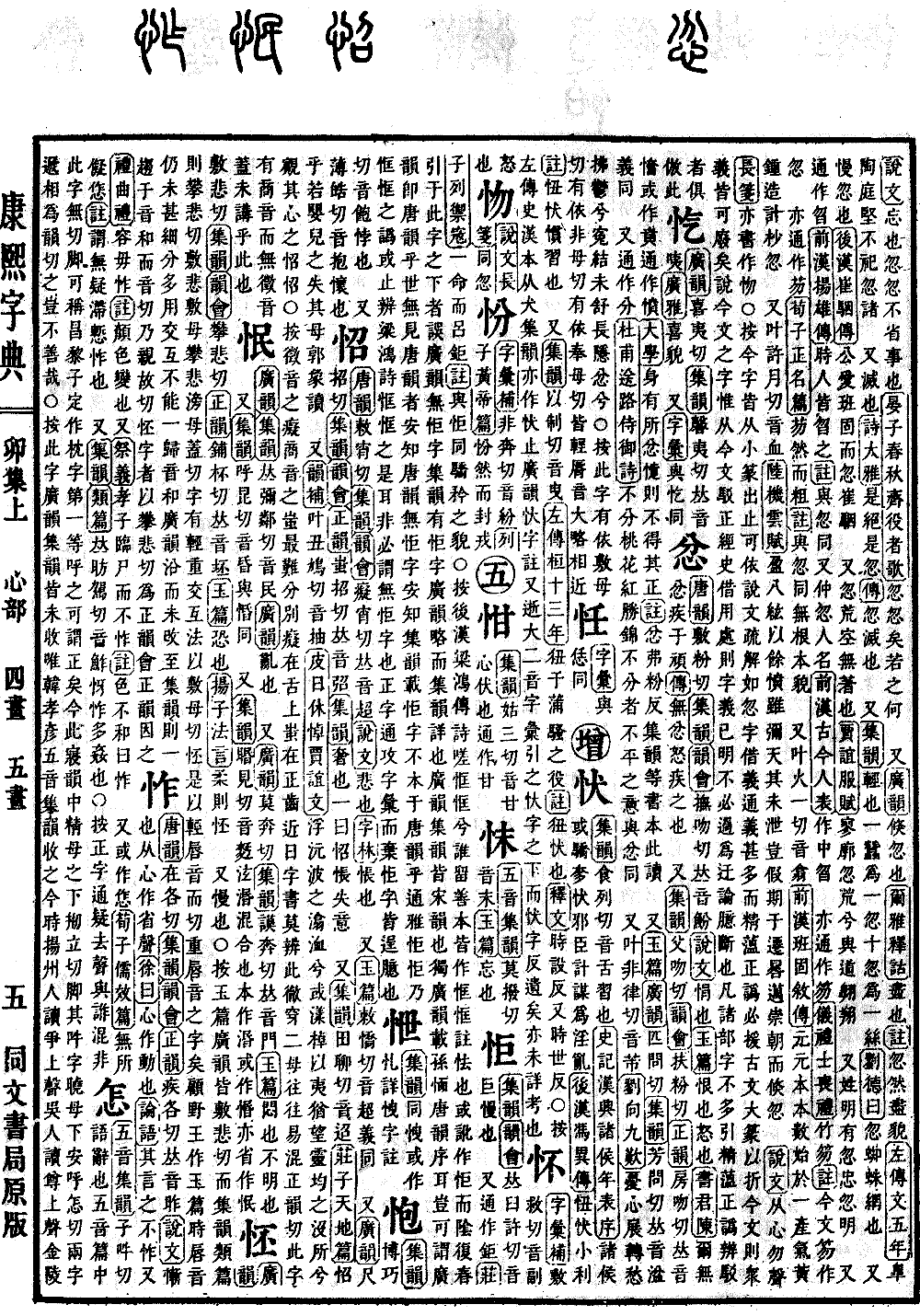
Mao Collection, Upper Volume
Radical: Heart (xīn)
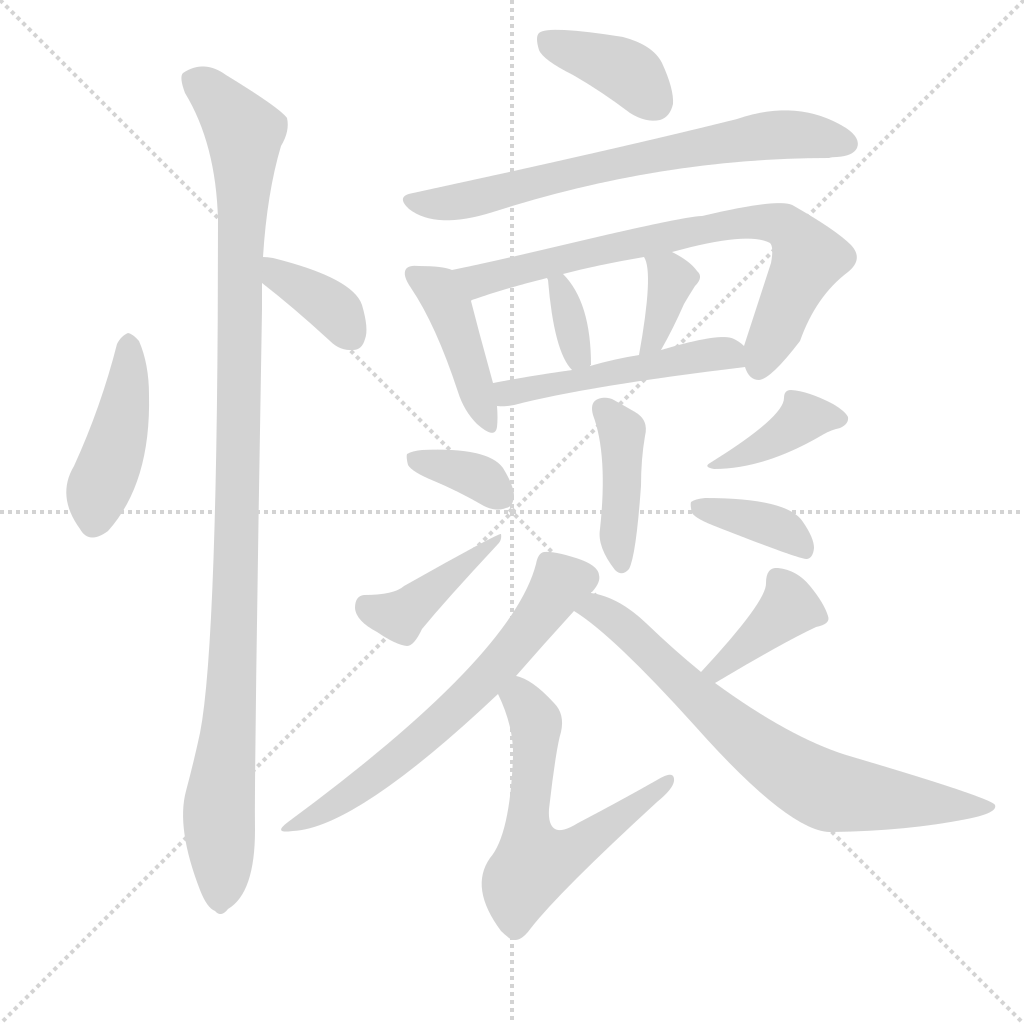
懷; Kangxi strokes: 20; Page 379
Ancient form: 褱
Tang Rhyme (Tangyun): Pronounced huai
Collected Rhymes (Jiyun) and Rhyme Compilation (Yunhui): Pronounced huai
Explaining Graphs and Analyzing Characters (Shuowen Jiezi): To think or to ponder. Composed of Heart (radical) and Huai (phonetic).
Analects of Confucius (Lunyu): The gentleman cherishes virtue.
Also, to return.
Book of Documents (Shangshu): The common people return to him.
Note: To return to him.
Also, to come.
Book of Odes (Shijing): Why is there no one coming?
Also, Book of Odes (Shijing): To attract and pacify the hundred spirits.
Note: Huai means to come.
Also, to settle or be at peace.
Book of Documents (Shangshu): The glory and peace of the state.
Book of Odes (Shijing): To be at peace, to be at peace.
Also, to wrap or contain.
Book of Documents (Shangshu): The flood waters washed against the mountains and rose above the hills.
Also, to hide or store.
Analects of Confucius (Lunyu): To hide one's treasure and let the state go to ruin.
Book of Rites (Liji): Those that have pits should have their pits contained.
Also, to comfort.
Book of Odes (Shijing): To comfort them with fine music.
Also, the bosom or the chest.
Zuo Tradition (Zuozhuan): Do the jewels fill my bosom?
Analects of Confucius (Lunyu): Only then are they free from their parents' bosoms.
Also, to be hurt or pained.
Book of Odes (Shijing): Thinking of them brings pain.
Mao Commentary: Huai means pain.
Also, to be selfish.
Book of Odes (Shijing): Every selfish thought falls short.
Zheng Commentary: Huai means selfish.
Also, Erya: To arrive.
Note: The meeting place of the states of Qi and Lu in the suburbs is called Huai.
Book of Odes (Shijing): Arrive in sincerity and do not forget.
Zheng Commentary: To arrive. Sincere arrival and not forgetting.
Also, Erya: To stop.
Sub-commentary: To arrive and stop.
Also, Definition of Names (Shiming): Huai means to return. Originally having the intention of leaving, one returns to oneself. It also means to submit; coming to submit to oneself.
Also, Posthumous titles: One who is benevolent, wise, and virtuous is called Huai.
Also, place name.
Book of Documents (Shangshu): Tanghuai achieved results.
Also, prefecture name. A city named Yewang during the Spring and Autumn period, Henei Prefecture during the Han dynasty, and Huai Prefecture established during the Tang dynasty.
Also, a surname. Huai Xu, a Secretary of the Ministry in the Wu state during the Three Kingdoms period.
Also, commonly written as 褢.
History of the Former Han (Qian Hanshu): Holding sincerity and maintaining loyalty.
Also, rhyming with huai, pronounced hui.
Book of Odes (Shijing): Climbing the craggy mountain, my horse is weary and exhausted. I pour the wine from the bronze vessel, so as not to think long of the past.
Also, rhyming with hui, pronounced hui.
Songs of Chu (Chuci): I heave a long sigh as I ascend, my heart lingers and turns back. If the appearance is pleasing to others, the observer is calm and forgets to return.
Wei Emperor (Wei Wendi): I stretch my neck and heave a long sigh, traveling far with many thoughts. Why is my heart so depressed, longing to return to the east?
Also, rhyming with ke, pronounced ke.
Huainanzi: Even-handed and not biased, bright and not harsh. Wrapped and covered, nothing is not contained within.
Zhou Boqi says: Huai (褱) means to hide or carry in one's clothing. Composed of Clothing (radical) and Gui (phonetic). That which the heart contemplates and stores is also called Huai. The clerical script is written as 懷.
Page 379, Entry 01