Si Collection, Upper Volume
Radical: Water (shuǐ)
Kangxi Strokes: 14
Page 642, Entry 09
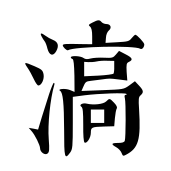
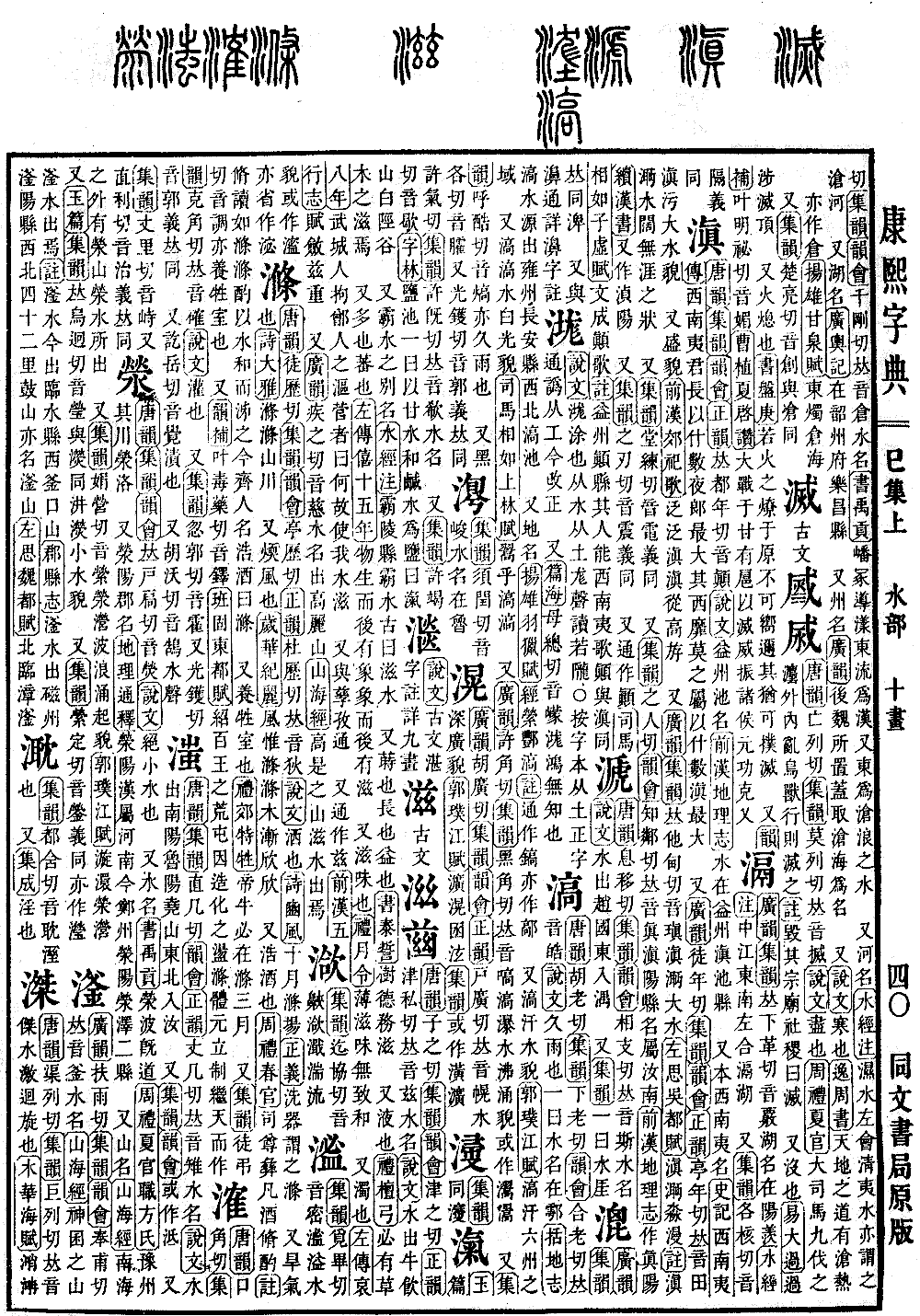
Pronounced hǎo. According to Explaining Graphs and Analyzing Characters (Shuowen Jiezi), it refers to prolonged rainfall. Another theory identifies it as a water name located in the Hu region. According to Geography of the World (Kuodizhi), the Hao River originates from Hao Pond, northwest of Chang'an County in Yong Prefecture.
It also refers to a place name. Yang Xiong's Rhapsody on the Feather Hunt (Yulie Fu) states: Passing through and winding around Feng and Hao. Note: In this context, it is used interchangeably with the character for Hao. It may also be written as a variant form (hào).
It is also used in the term haohan, describing the appearance of vast water. Guo Pu's Rhapsody on the Yangtze River (Jiang Fu) contains the phrase: Vast across the lands of the six provinces. It is also used as haohao, describing the appearance of white light reflecting off the surface of water. Sima Xiangru's Rhapsody on the Imperial Park (Shanglin Fu) contains the description: Glistening in a haohao manner.
Pronounced hè. The term haopu describes the appearance of boiling and surging water. It is sometimes written as a variant form (xù).
Pronounced hè. It also refers to prolonged rainfall.
Pronounced huò.
Pronounced guō. The meaning is the same.