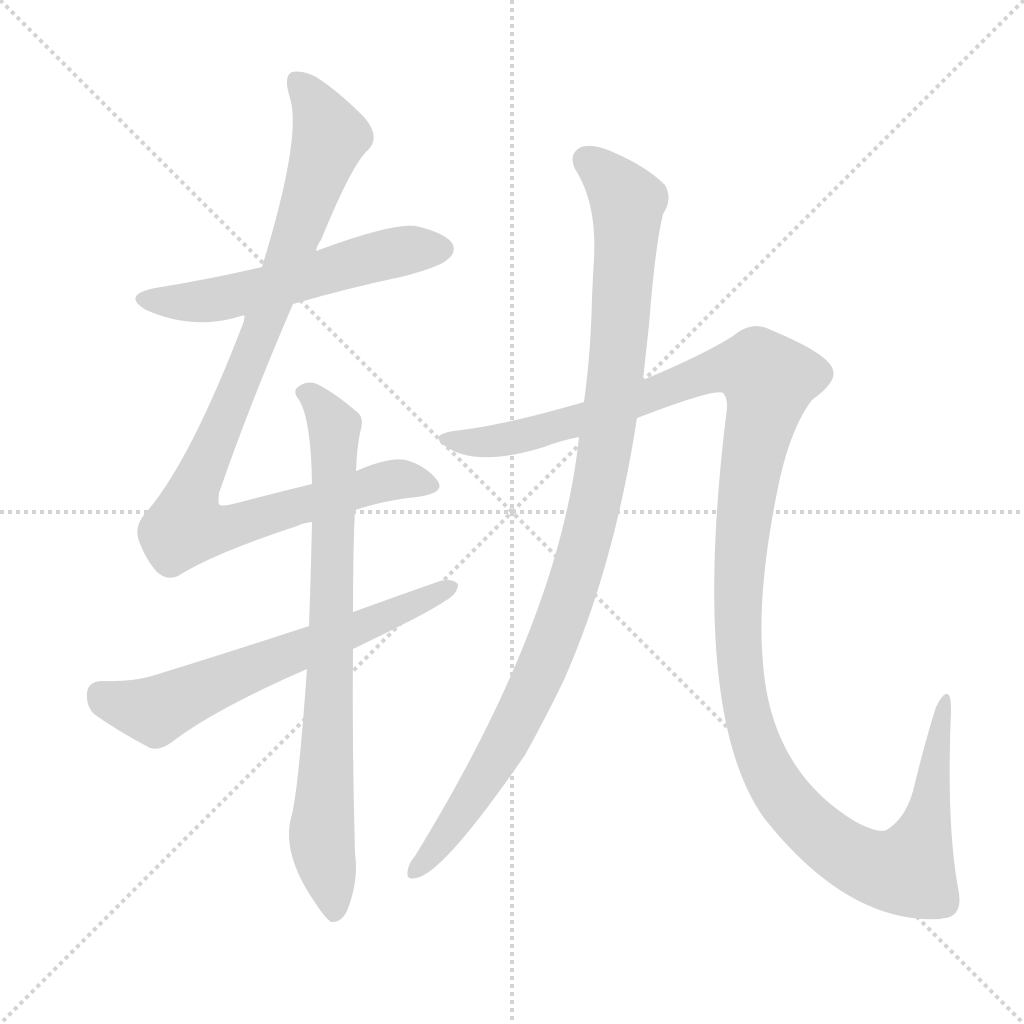
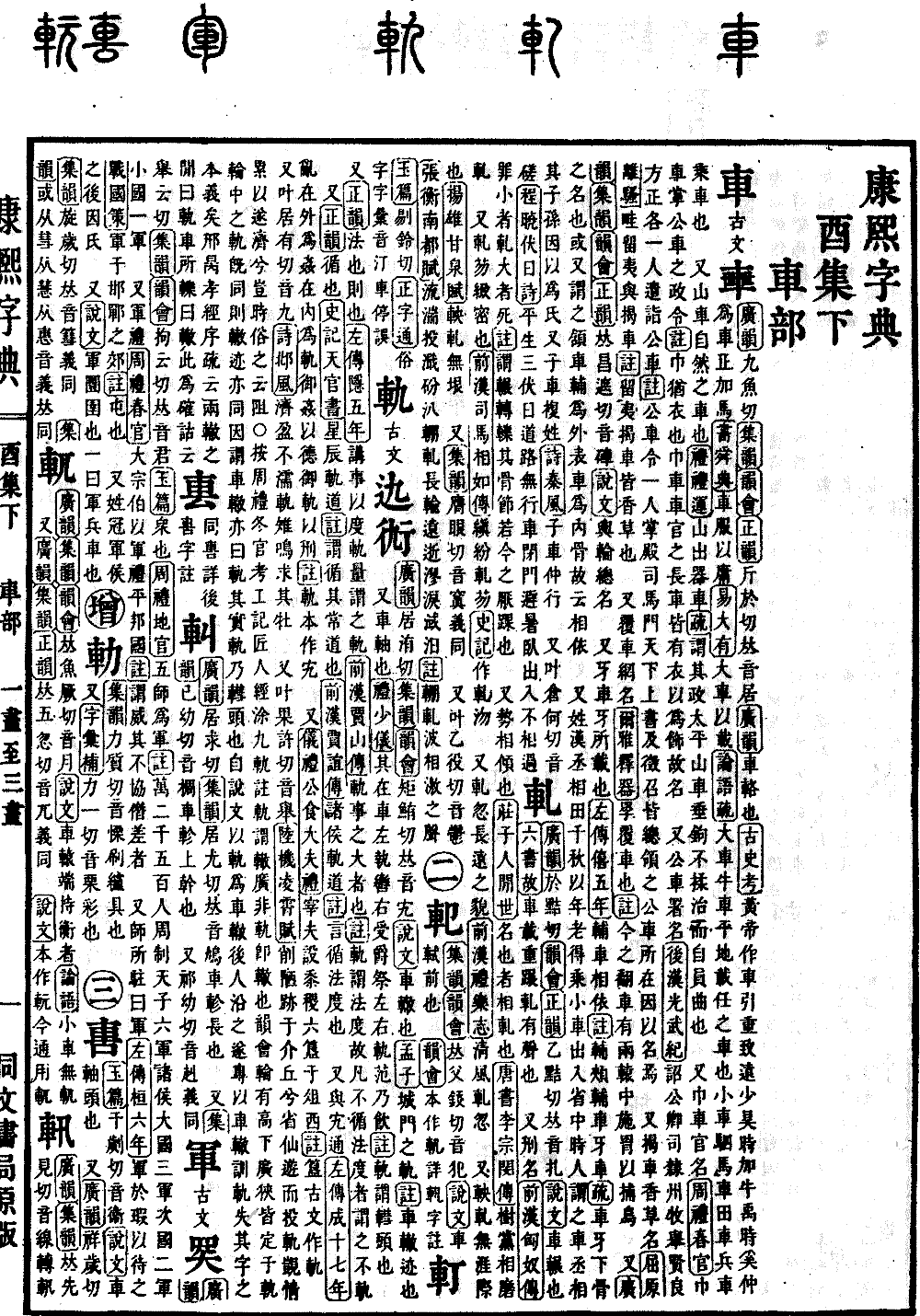
You Collection, Lower Volume
Radical: Carriage (chē)
Kangxi Strokes: 9
Page 1239, Entry 01
Pronounced gui.
According to the Analytical Dictionary of Characters (Shuowen Jiezi), it refers to wheel ruts.
In the Mencius (Mengzi), it states the ruts of the city gate. The commentary notes that it refers to the marks left by wheel ruts. It also refers to a carriage axle.
In the Book of Rites (Liji), specifically the Lesser Ceremonial (Shaoyi) chapter, it states that when in a carriage, one holds the reins with the left hand and receives the goblet with the right, making offerings to the left and right wheel hubs before drinking. The commentary notes that the term refers to the ends of the axle.
Furthermore, in the Correct Rhymes (Zhengyun), it means law or standard.
In the Zuo Tradition (Zuozhuan), during the fifth year of Duke Yin, it mentions discussing affairs to determine standard measures, which is called gui.
In the History of the Former Han (Qianhan Shu), biography of Jia Shan, it says that gui represents the most significant of affairs. The commentary notes that gui refers to laws and measures; thus, anyone who does not follow laws and measures is described as violating the gui.
Additionally, in the Correct Rhymes, it means to follow.
In the Records of the Grand Historian (Shiji), Treatise on the Celestial Offices, it refers to the tracks of stars and constellations. The commentary notes that this refers to following their regular paths.
In the History of the Former Han (Qianhan Shu), biography of Jia Yi, it speaks of the feudal lords following the path. The commentary notes that this refers to observing laws and standards.
It is also used interchangeably with gui (meaning wicked/rebellious).
In the Zuo Tradition (Zuozhuan), during the seventeenth year of Duke Cheng, it states that chaos caused from outside is called jian, and inside is called gui. Govern the wicked with virtue and govern the rebellious with... The commentary notes that the original text for gui was written as gui (the variant form).
Furthermore, in the Book of Etiquette and Ceremonial (Yili), in the Ritual for Feeding the Senior Official, the chef sets out six gui vessels of millet on the west side of the offering table. The commentary notes that the ancient form of the character gui was written as gui.
It also rhymes with jiu. In the Book of Odes (Shijing), Odes of Bei, it mentions that even if the water is full, it does not wet the axle, and the pheasant cries to seek its mate.
It also rhymes with ju. In Lu Ji's Rhapsody on Soaring to the Heavens (Lingxiao Fu), it mentions carving away humble tracks at the Jie Hill, omitting immortal travels and setting upon the track. Expecting emotional burdens to be resolved to achieve salvation, how could the ways of the world be considered an obstruction?
According to the Rites of Zhou (Zhouli), in the Winter Section on the Craftsmen, it mentions that the main road is nine tracks wide. The commentary states that gui refers to the width of the tracks, though this is not entirely accurate. Gui is simply the rut. The Rhyme Compilation (Yunhui) notes that wheels have varying heights and widths, all of which are determined by the axle. Since the axles within the wheels are the same, the ruts left behind are also the same; thus, the wheel ruts are also called gui. In reality, gui refers to the ends of the axle. Since the Analytical Dictionary of Characters identified gui as wheel ruts, later generations followed this interpretation, ultimately using it exclusively to define wheel ruts, thereby losing the original meaning of the character. Xing Bing's preface to the Classic of Filial Piety (Xiaojing) commentary states: The space between two ruts is called the gui, and where the wheels crush the ground is called the zhe (rut). This is the precise definition.