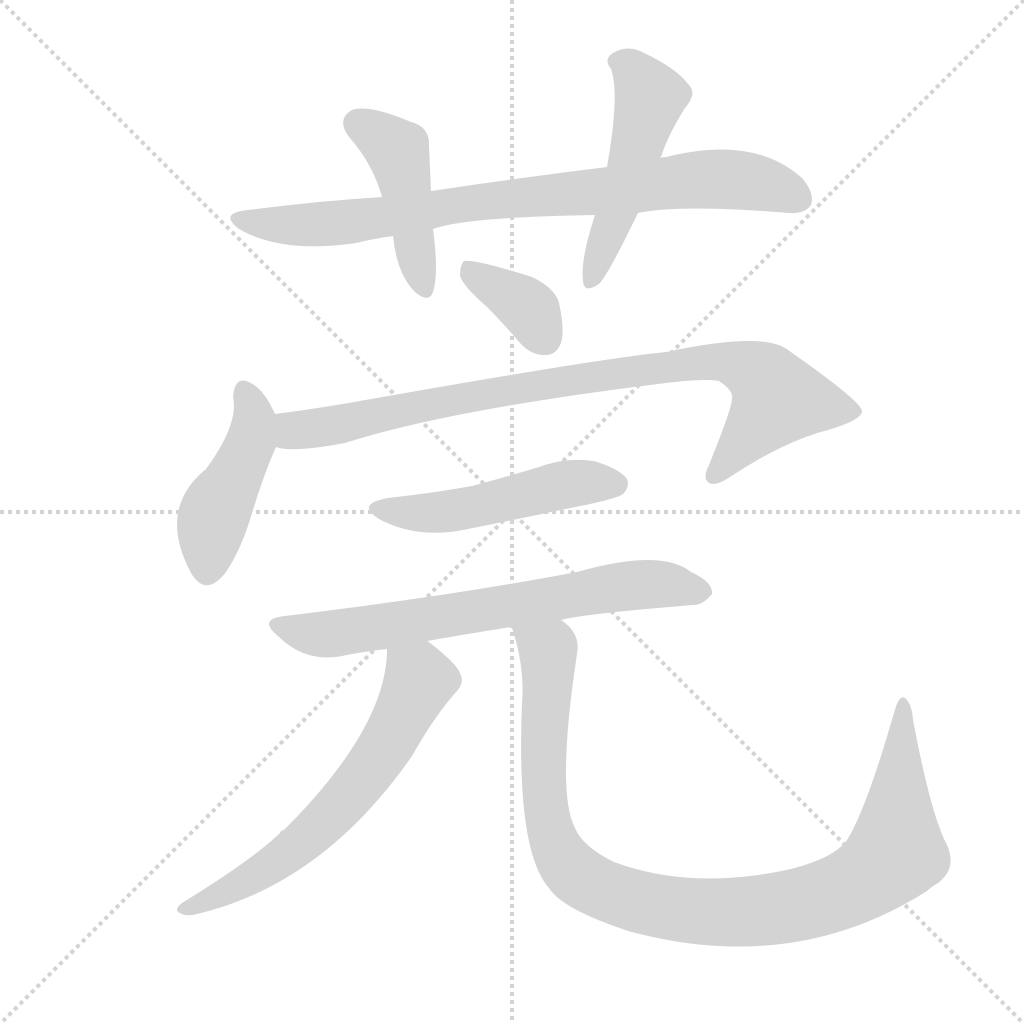
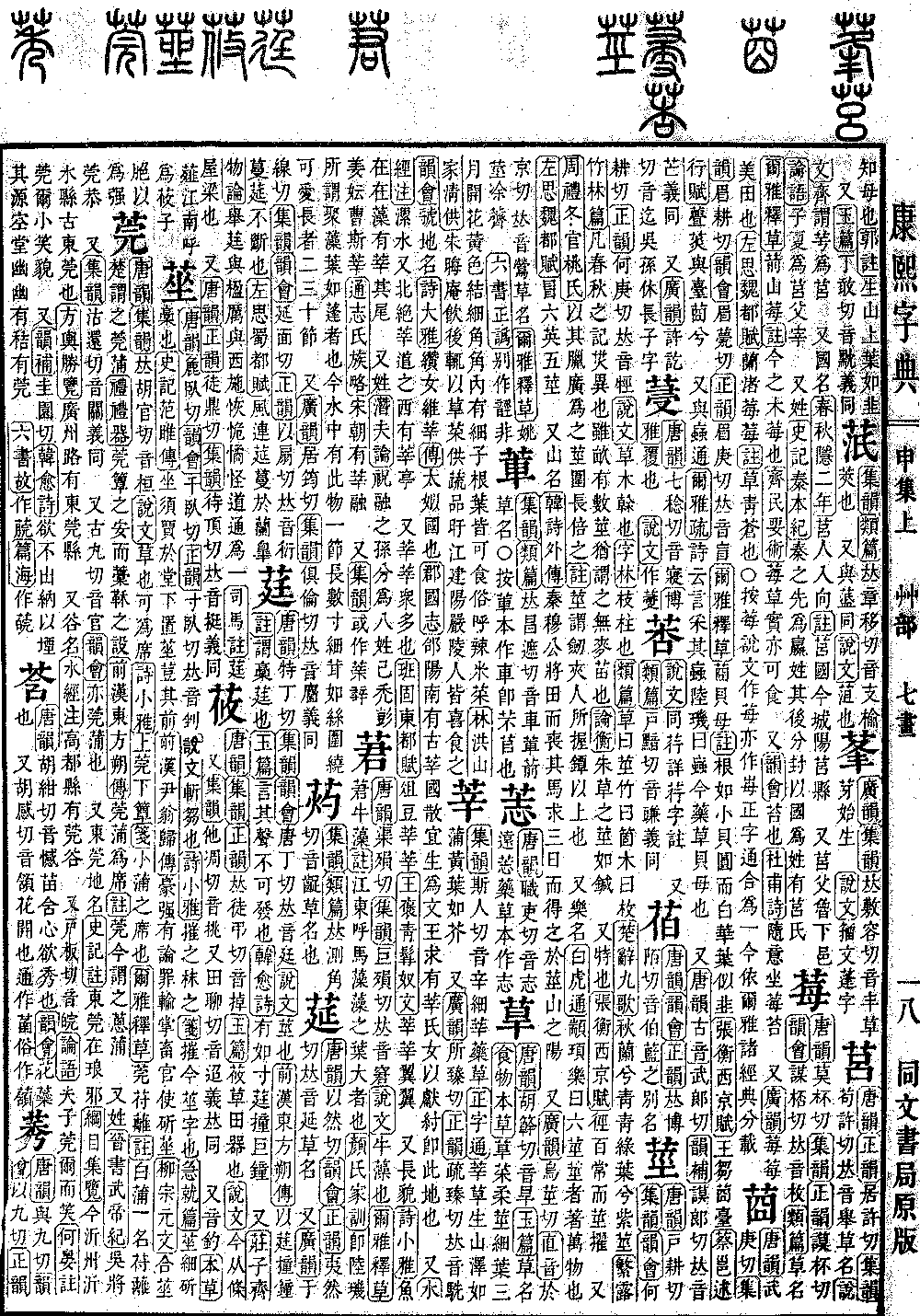
Shen Collection, Upper Volume
Radical: Grass (cǎo)
Kangxi Strokes: 13
Page 1034, Entry 20
Pronounced huan.
According to the Explaining Graphs and Analyzing Characters (Shuowen Jiezi), it is a type of grass that can be used to make mats.
In the Book of Odes (Shijing), it is written: Lower layer of grass mats, upper layer of fine bamboo mats.
The commentary states it refers to a mat made of small rushes.
In the Erya (Approaching Elegance), it is recorded that the guan plant is called fuli.
The commentary notes it is a white rush, also known as fuli, which the people of Chu call guanpu.
In the Book of Rites (Liji), it is written: The comfort of grass and bamboo mats, and the provision of straw and coarse mats.
In the History of the Former Han (Qianhan Shu), specifically in the Biography of Dongfang Shuo, it mentions grass and rush mats.
The commentary states that guan is what is now called congpu.
Also a surname. In the Book of Jin (Jin Shu), specifically the Annals of Emperor Wu, it mentions the Wu general Guan Gong.
Also pronounced guan. Meaning is the same.
Also pronounced guan.
The Collection of Rhymes (Yunhui) notes it also refers to the guanpu rush.
Also Dongguan, a place name.
The Notes to the Records of the Grand Historian (Shiji Zhu) state that Dongguan is in Langye.
The Comprehensive Review of the Outline of History (Gangmu Jilan) states that it is the present-day Yishui County in Yizhou, anciently known as Dongguan.
The Magnificent Survey of Geography (Fangyu Shenglan) states that the Guangzhou Circuit has a Dongguan County.
Also the name of a valley. The Commentary on the Water Classic (Shuijing Zhu) states that Gaodu County has Guan Valley.
Also pronounced wan.
In the Analects of Confucius (Lunyu), it is written: The Master smiled faintly.
He Yan's commentary states that waner signifies the appearance of a faint smile.
Also pronounced gui.
In the poetry of Han Yu: Wishing not to go out or enter, so as to block its source. In the empty hall, quiet and still, there are stalks and there are guan.
The Six Writings Explained (Liushu Gu) writes it as a variant.
The Collection of Characters (Pianhai) writes it as a variant.
Textual research: The Book of Odes (Shijing) originally reads upper layer of fine bamboo mats, lower layer of grass mats. It has been corrected to lower layer of grass mats, upper layer of fine bamboo mats according to the original text.