Hai Collection, Middle Volume
Radical: Bird (niǎo)
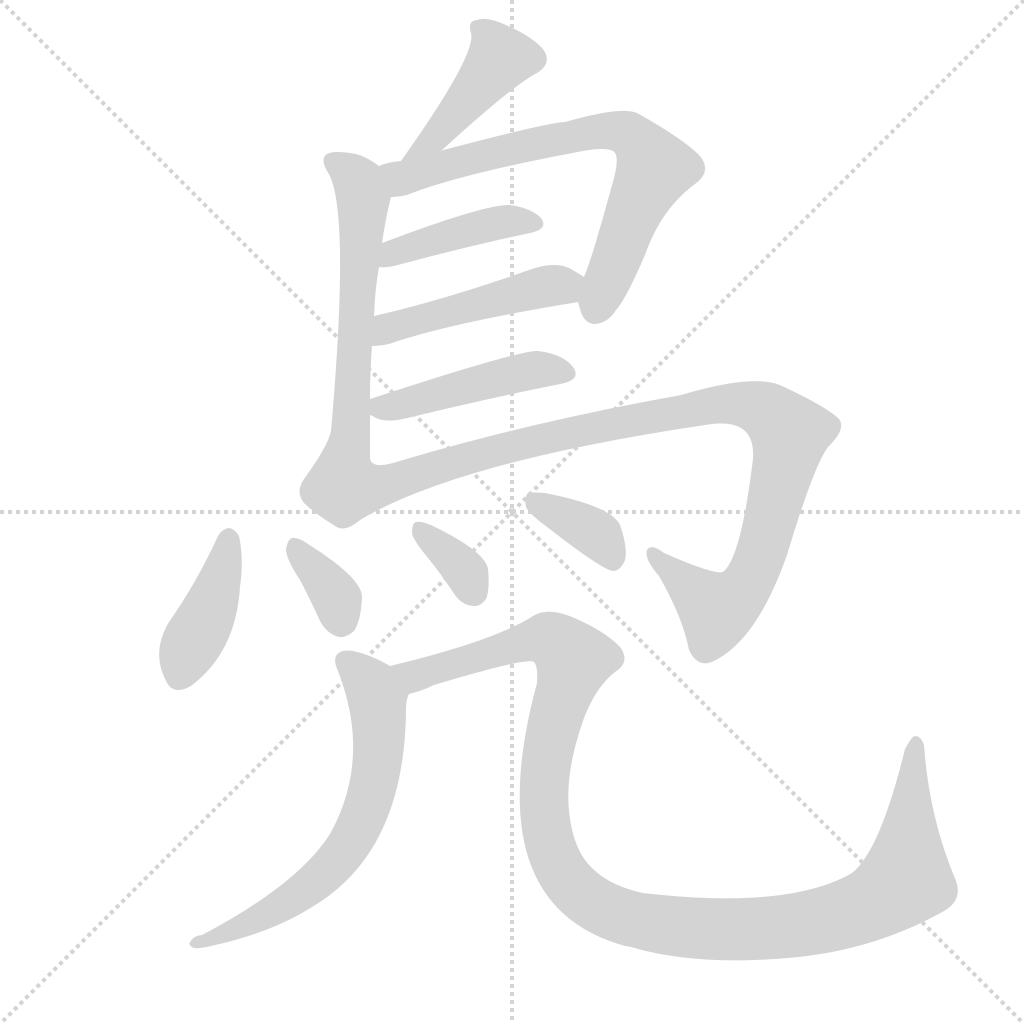
Fu
Kangxi brush strokes: 13
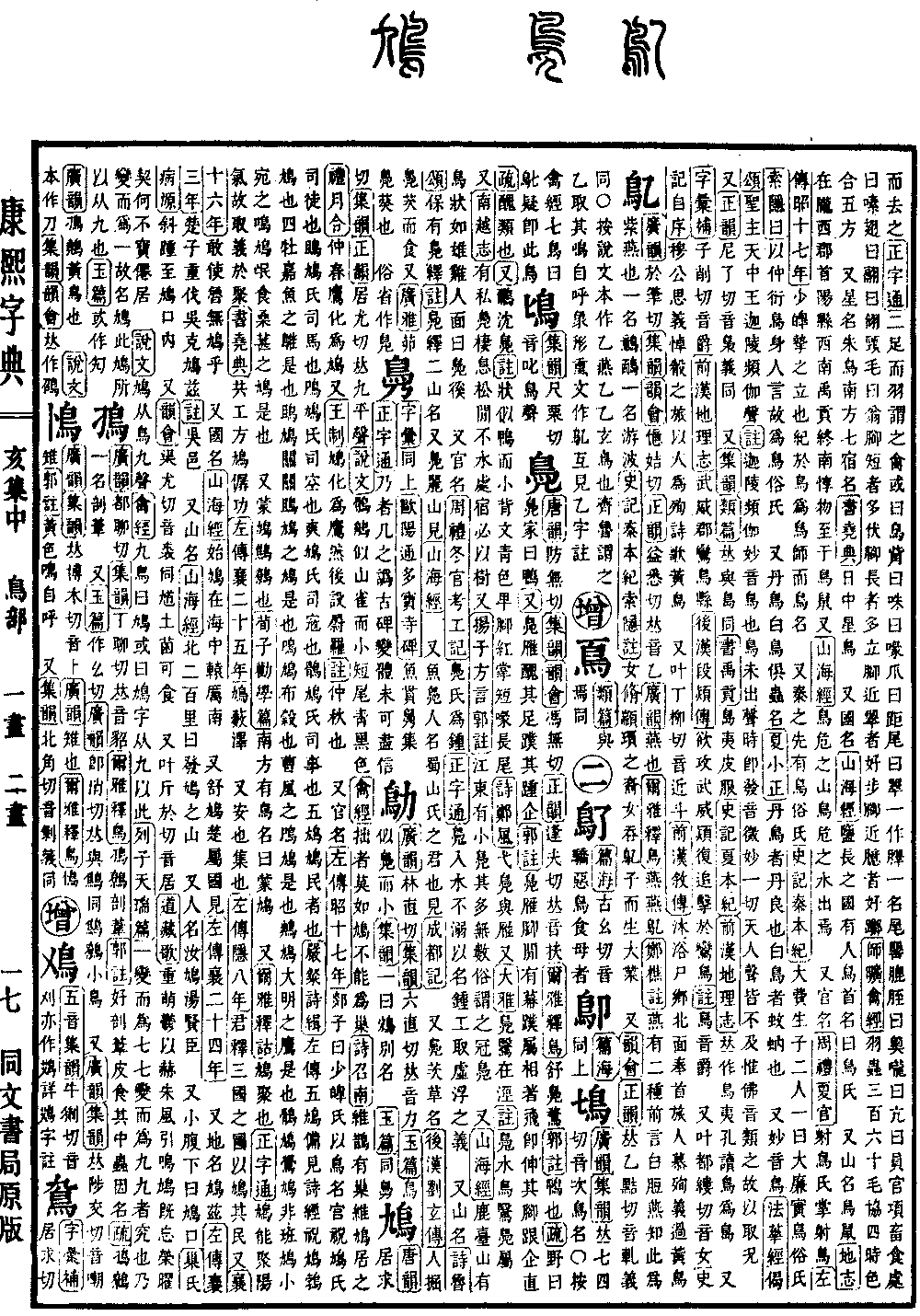
Page 1481, Entry 07
Pronounced fu
Book of Literary Sounds (Tangyun): Pronounced fu. Collected Rimes (Jiyun) and Collection of Rimes (Yunhui): Pronounced fu. Corrected Rimes (Zhengyun): Pronounced fu.
Approximations of Rimes (Erya): Explaining Birds: The wild duck is called wu. Commentary by Guo: It is a duck. Commentary by Shu: Wild ones are called fu, domesticated ones are called ya. Also: The fu is of the same category as the wild goose; its feet are webbed and its heels are erect. Commentary by Guo: The space between the toes of the fu and the wild goose has a membrane that connects them; when they fly, they extend their heels straight. Commentary by Shu: They belong to the same category. Also: The mi is a diving fu. Commentary: It is shaped like a duck but smaller, with a blue-patterned back, red feet and palms, a short beak, and a long tail.
Book of Odes (Shijing), Zheng Airs: Shoot the wild ducks and the wild geese. Also, Great Odes (Daya): The wild ducks and the mallards are on the Jing River. Commentary: The fu is a water bird. The yi is of the fu category.
Also, Southern Yue Records (Nanyuezhi): There is a private duck that dwells among pine trees and does not reside in the water, and when it sleeps it must be in a tree.
Also, Commentary by Guo to the Dialects of Master Yang (Yangzi Fangyan): In the Jiangdong region there are small ducks, and their numbers are countless; the common people call them robber ducks.
Also, Classic of Mountains and Seas (Shanhaijing): On Lu Tai Mountain there is a bird, shaped like a rooster with a human face, called the fu xi.
Also, a name for an official post. Rites of Zhou (Zhouli), Winter Bureau, Records of Craftsmen (Kaogongji): The fu clan makes bells. Corrected Character Comprehensive (Zhengzitong): The fu enters the water without drowning; taking this as the name for the bell maker signifies the meaning of being empty and buoyant.
Also, a mountain name. Book of Odes (Shijing), Lu Eulogies (Lusong): Preserving Fuyi. Commentary: Fuyi are the names of two mountains. Also, Fuli Mountain, see the Classic of Mountains and Seas (Shanhaijing).
Also, Yufu, a person's name. The ruler of the Shushan clan, see the Chengdu Records (Chengduji).
Also, fuci, a plant name. History of the Later Han (Houhan), Biography of Liu Xuan: People dug for fuci to eat.
Also, Broad Rimes (Guangyun): Maofu is a mallow. Commonly written in the simplified form fu.
Approximations of Rimes (Erya): Explaining Birds: The mi is a diving fu.
Explanation of Writing (Shuowen): Under the bird radical: The fu is a wild duck, the wu. It is formed from the bird radical, using the sound component.
Textual research: In the Commentary by Guo to the Dialects of Master Yang (Yangzi Fangyan), it mentions small ducks in Jiangdong in countless numbers, commonly called robber ducks. According to the original text, corrected from crown duck to robber duck.