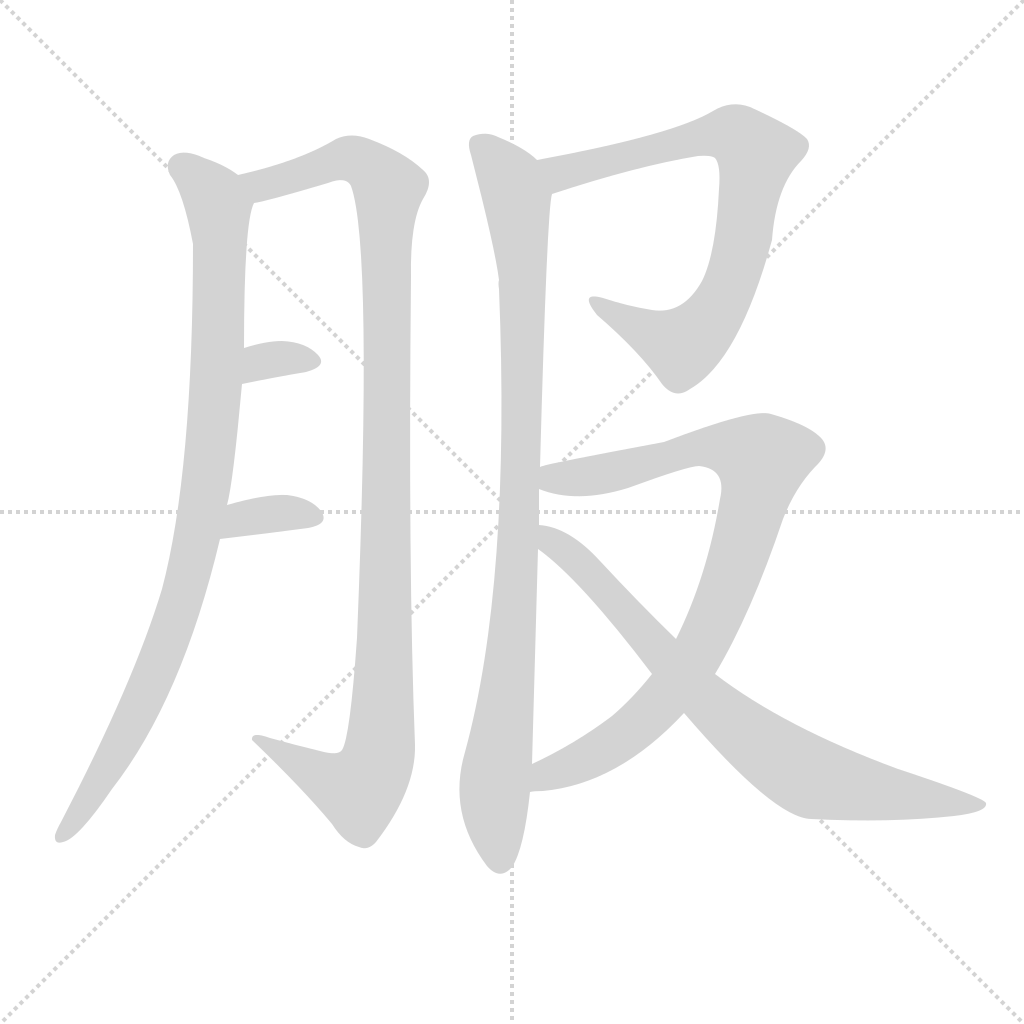
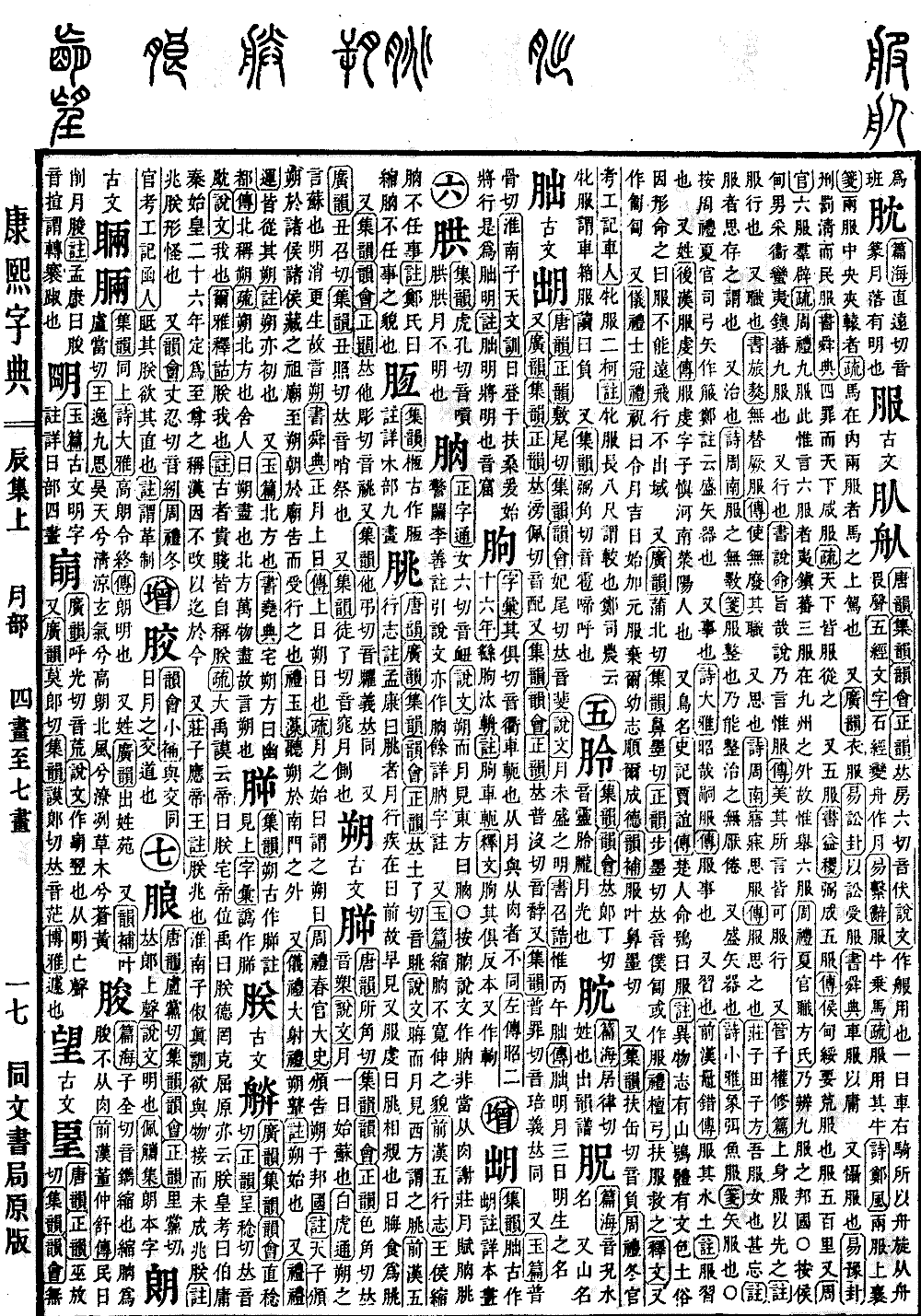
Chen Collection, Upper Volume
Radical: Moon (yuè)
Kangxi Strokes: 7
Page 505, Entry 02
Classical form. Pronounced fu.
Shuowen Jiezi (Shuowen): To use. Also, the position of the rider to the right of the carriage who assists in turning. Derived from boat (zhōu), phonetically modified.
Wujing Wenzi (Wujing Wenzi): The Stone Classics (Shijing) changed the component boat to moon.
Book of Changes (Yijing), Xici: Using oxen and riding horses.
Sub-commentary: Utilizing their oxen.
Book of Odes (Shijing), Zheng Feng: Two side-horses pulling the carriage.
Commentary: The two side-horses (fu) are those harnessed beside the central shaft.
Sub-commentary: The horses on the inside, which are the two side-horses, are harnessed above the carriage.
Also, clothing and accessories.
Book of Changes (Yijing), Song Gua: To receive punishment for litigation.
Book of Documents (Shujing), Shun Dian: Carriages and clothing awarded for merit.
Also, to submit or be overawed.
Book of Changes (Yijing), Yu Gua: Penalties are clear and the people submit.
Book of Documents (Shujing), Shun Dian: The four criminals were punished and the world all submitted.
Sub-commentary: The whole world submits to them.
Also, the five domains of service (wufu).
Book of Documents (Shujing), Yiji: Assisted in establishing the five domains of service.
Commentary: These are the hou, dian, sui, yao, and huang domains, extending five hundred miles each.
Also, the six domains of service for various lords mentioned in the Zhou Guan.
Sub-commentary: The Rites of Zhou (Zhouli) mentions nine domains. The reason only six are mentioned here is that the yi, zhen, and fan domains lie outside the nine provinces, hence only six are cited.
Rites of Zhou (Zhouli), Xia Guan, Zhifangshi: Distinguishing the states of the nine domains. Note: These are the hou, dian, nan, cai, wei, man, yi, zhen, and fan, which constitute the nine domains.
Also, to act or practice.
Book of Documents (Shujing), Shuoming: Excellent is your speech, may it be practiced.
Commentary: Praising his words as all being worthy of practice.
Guanzi, Quanshu Chapter: The ruler leads by example.
Note: Fu means to act.
Also, duties.
Book of Documents (Shujing), Lü'ao: Do not neglect your duties.
Commentary: Do not abandon these duties.
Also, to think or remember.
Book of Odes (Shijing), Zhou Nan: Awake or asleep, I think of you.
Commentary: Fu means to think of someone.
Zhuangzi, Tian Zifang: My remembering you is very deep.
Note: Fu refers to keeping someone in one's thoughts.
Also, to govern or put in order.
Book of Odes (Shijing), Zhou Nan: Govern them without weariness.
Commentary: Fu means to put in order. It refers to being able to manage them without tiring.
Also, a quiver for arrows.
Book of Odes (Shijing), Xiao Ya: Ivory ends and fish-skin quiver.
Commentary: A container for arrows. Note: In the Rites of Zhou (Zhouli), Xia Guan, Sigungshi, this is written as fu (箙). Zheng's note says: A vessel for containing arrows.
Also, service or affairs.
Book of Odes (Shijing), Da Ya: How glorious is the inherited legacy.
Commentary: Fu means affairs.
Also, to be accustomed to.
Biography of Chao Cuo, Former Han History (Hanshu): To become accustomed to the climate and soil.
Note: Fu means to be accustomed to.
Also, a surname.
Biography of Fu Qian, Later Han History (Hou Hanshu): Fu Qian, courtesy name Zishen, from Xingyang, Henan.
Also, a bird name.
Biography of Jia Yi, Records of the Grand Historian (Shiji): The people of Chu call the owl fu.
Note: The Yiwuzhi states there is a mountain owl with patterned feathers. The locals name it fu based on its appearance; it cannot fly far and its movements do not extend beyond its territory.
Also, pronounced pu. Variant of the word pu (crawling).
Rites (Liji), Tanjong: Supported and carried him to save him.
Shiwen: Also written as pudu (crawling).
Also, from the Rites (Yiji), Shiguangli: The priest says: On this auspicious month and lucky day, the cap is first added; cast off your childish ways and follow your developed virtues.
Yunbu: Fu is used here as a rhyming word, pronounced pu.
Also, pronounced fu.
Rites of Zhou (Zhouli), Dongguan Kaogongji, Cheren: The carriage box (pinfu) is two chi.
Note: Pinfu, eight feet long, refers to the side-boards of the carriage. Zheng Sinong said: Pinfu refers to the carriage box. Fu is read as fu (burden).
Also, pronounced bao. To cry or wail.