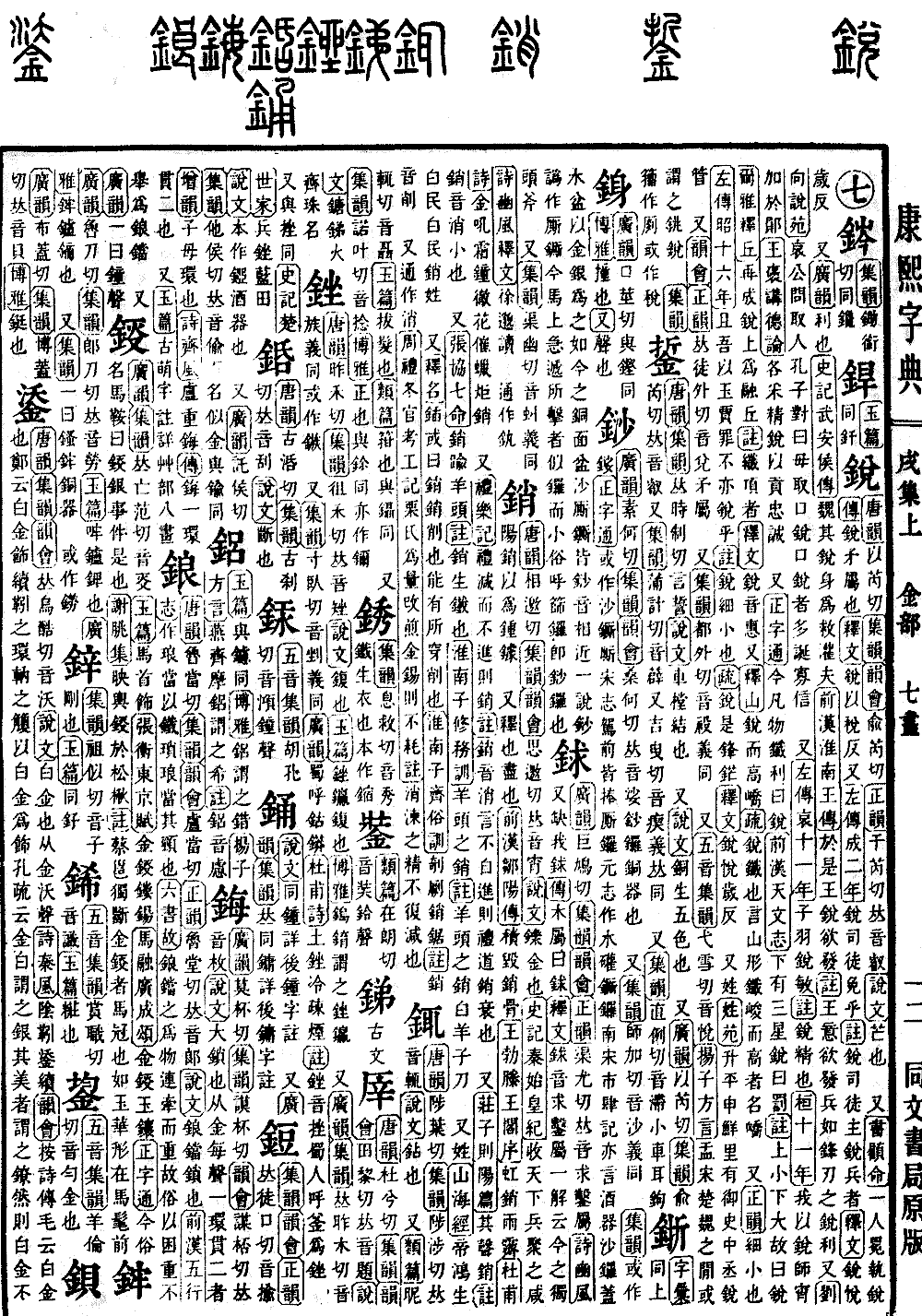
Xu Collection, Upper Volume
Radical: Metal (jīn)
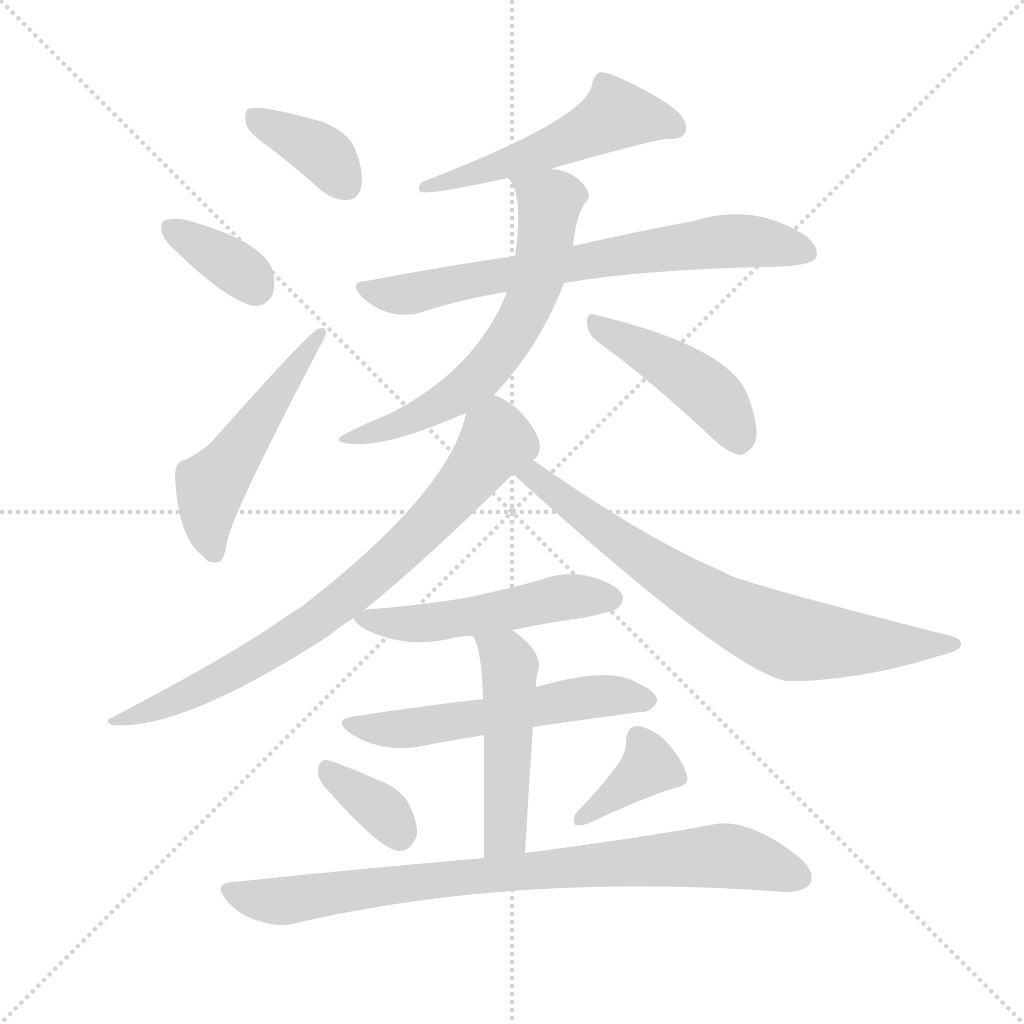
Wu
Kangxi stroke count: 15
Page 1306, Entry 29
Pronounced wo.
Shuowen Jiezi (Shuowen) states it is white metal. Derived from the radical for metal, with the sound element wo.
Book of Odes (Shijing), Qin Feng section: The inner traces are adorned with white metal (wu).
Rhyme Collection (Yunhui): According to the commentaries on the Book of Odes, Mao states it is white metal. Zheng states it is a white metal ornament for the rings of the traces and the buckles of the bridle; it is a decoration made of white metal. Kong Yingda states in his sub-commentary that white metal is called silver, and its finest variety is called liao. Thus, white metal itself is not termed wu. Saying it is wu refers to melting white metal and pouring it to plate the rings of the traces; it does not define wu simply as white metal. Gold, silver, copper, and tin are collectively called metal, and it is not necessarily the case that they are all white silver. Examining the Book of Odes, where it mentions wu for the traces and wu for the ferrules, it suggests that the base material is iron, and it is plated on the outside with other metals; they are collectively called wu. This is similar to how people today use silver as a base and plate it with gold on the outside, which is collectively called gilding. Zheng’s interpretation of the wu-adorned traces does not define the rings as being made of white metal, but rather that white metal is used to decorate them; this is still not entirely clear. Today, when people make door rings, they generally use iron as a base and plate it with tin; perhaps this is what the ancients called wu.
Also, Rhyme Collection (Yunhui): Pronounced huo.
Also: Pronounced e. The meaning is the same.