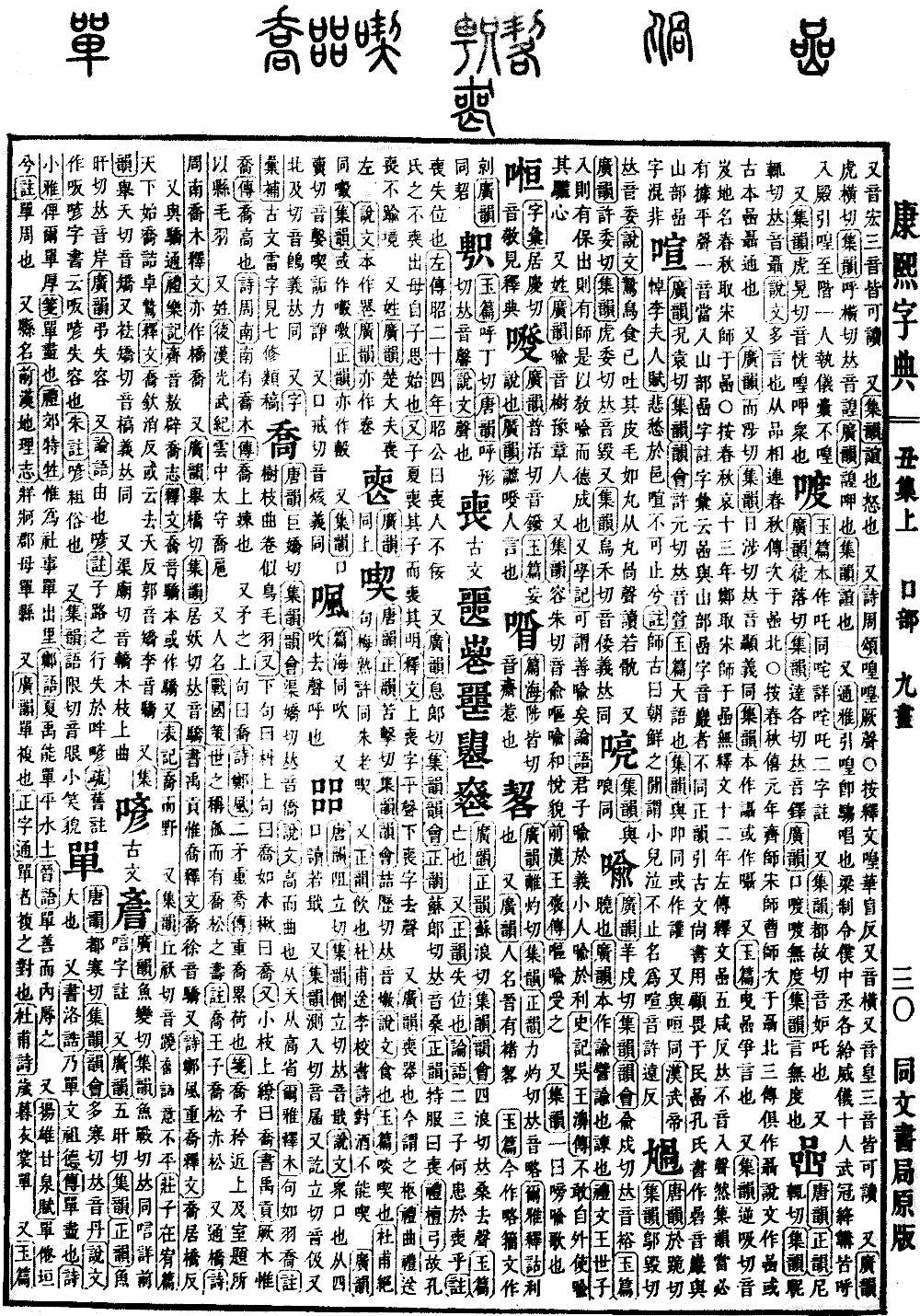
Chou Collection, Upper Volume
Radical: Mouth (kǒu)
Kangxi Strokes: 12
Page 200, Entry 25
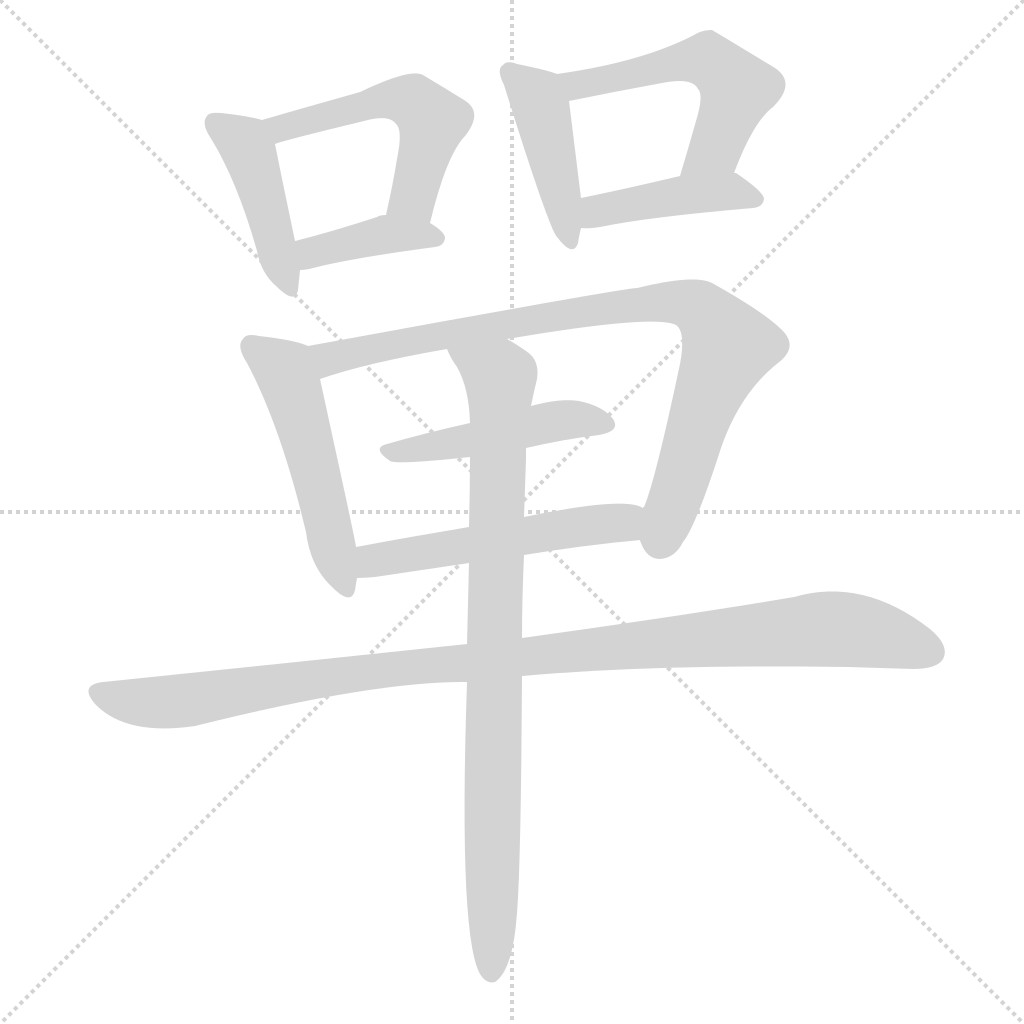
Pronounced dan.
According to the Shuo Wen Jiezi (an early dictionary of characters), it means large.
In the Book of Documents (Shangshu), section Luo Gao: "Thereby exhausting (dan) the moral virtues of the cultural ancestors." The commentary states: "Dan means to exhaust."
In the Book of Odes (Shijing), section Xiao Ya: "Granting you exhaustiveness (dan) and generosity." The commentary states: "Dan means to exhaust."
In the Book of Rites (Liji), section Jiao Te Sheng: "Only for the affairs of the soil deity does one exhaustively (dan) leave the village."
In the Discourses of Zheng (Zheng Yu): "Xia Yu was able to completely (dan) pacify the waters and the land."
In the Discourses of Jin (Jin Yu): "Completely (dan) good, yet inwardly bringing disgrace upon oneself."
Also, in the Gan Quan Fu by Yang Xiong: "Circumscribing (dan) the walls." The commentary states: "Dan means to encircle completely."
Also, it is the name of a county. According to the Book of Han (Hanshu), Geography Treatise, there was a Mu Dan County in Zangke Commandery.
Also, according to the Guang Yun (a rhyme dictionary), it refers to a single layer versus multiple layers (dan, meaning single).
According to the Zheng Zi Tong (a dictionary), dan is the opposite of double (fu).
In the poetry of Du Fu: "At the end of the year, my clothes are thin (dan)."
Also, according to the Yu Pian (a dictionary), it means one, or only.
In the Book of Odes (Shijing), section Da Ya: "Their army had three divisions (dan)." The commentary states: "In the system of the great states, those soldiers beyond the three divisions serve as reserves; a single (dan) division has no reserves."
In the Book of Rites (Liji), section Li Qi: "In sacrifices to spirits, use a single (dan) mat."
In the Records of the Grand Historian (Shiji), Biography of Lord Xinling: "Now arriving with a single (dan) carriage to replace him."
In the Book of the Later Han (Hou Hanshu), Biography of Geng Gong: "With a single (dan) troop, I firmly defended the isolated city."
Also, in the Biography of Gao Biao: "Family lineage is humble (dan) and cold."
Also, it is a surname. According to the Guang Yun, the Keshan clan later changed to the Dan clan.
Pronounced tan.
Also a surname. A grand master of the State of Zheng in Li City was Dan Bo. Commonly written as tan.
Pronounced chan.
According to the Guang Yun, it refers to "chanyu" (the title of the ruler of the Xiongnu).
In the Book of Han (Hanshu), Treatise on the Xiongnu: "The term chanyu refers to vastness. It is said to symbolize the heavens; thus, the chanyu is as such."
Also, according to the Er Ya (an ancient dictionary), the year of Tai Sui in the Mao year is called "danyu."
The Shi Wen (a commentary) notes: "Dan is pronounced chan, also pronounced dan, or pronounced shan."
Pronounced shan.
According to the Yu Pian, it means large.
Also the name of a county. According to the Book of Han (Hanshu), Geography Treatise, there was a Danfu County in Shanyang Commandery. The commentary by Yan Shigu states: "Pronounced shanfu."
Also a surname. According to the Guang Yun, it is a descendant of Dan Xiang Gong.
In the Records of the Grand Historian (Shiji), Biography of Confucian Scholars: "Huan Sheng Dan Ci." The commentary notes: "Dan is pronounced shan; the surname is Dan, and the personal name is Ci."
Also a personal name. In the Book of Documents (Shangshu) Preface: "Jiu Dan made the Ming Ju." The commentary states: "Jiu Dan is the name of a minister who was an official in charge of land." The note says: "Dan is pronounced shan."
Pronounced chan.
Identical to the character chan. See the detailed entry for the character chan later.
Pronounced dan.
In the Ji Yun (a rhyme dictionary), this is the original form of the character dan, meaning abundant grain. Another interpretation suggests it means sincere or thick.
In the Book of Documents (Shangshu), section Luo Gao: "Thereby sincerely (dan) documenting the moral virtues of the cultural ancestors." The Shi Wen notes: "Dan is pronounced dan, or pronounced dan, meaning sincere."
In the Book of Odes (Shijing), section Xiao Ya: "Granting you sincerity (dan) and generosity." The commentary states: "Dan means sincere or generous." The Shi Wen notes: "Dan is pronounced dan (rising tone) according to Mao, and dan according to Zheng Xuan."
Also, in the Book of Odes (Shijing), section Zhou Song: "Sincere (dan) in his heart." The commentary states: "Dan means thick/generous." The Shi Wen notes: "Pronounced dan (rising tone)."
Also commonly used for the character dan (a variant).
In the Records of the Grand Historian (Shiji), Calendar Treatise: "The second year of Duan Meng Dan E." The commentary notes: "Dan E is also written as Dan An."
Pronounced dan (falling tone).
Also the name of a town, identical to the character dan.
Pronounced zhan.
"Dan zhi" refers to a rash and reckless manner.
Pronounced shan.
Danfu is the name of a town. Also a surname.