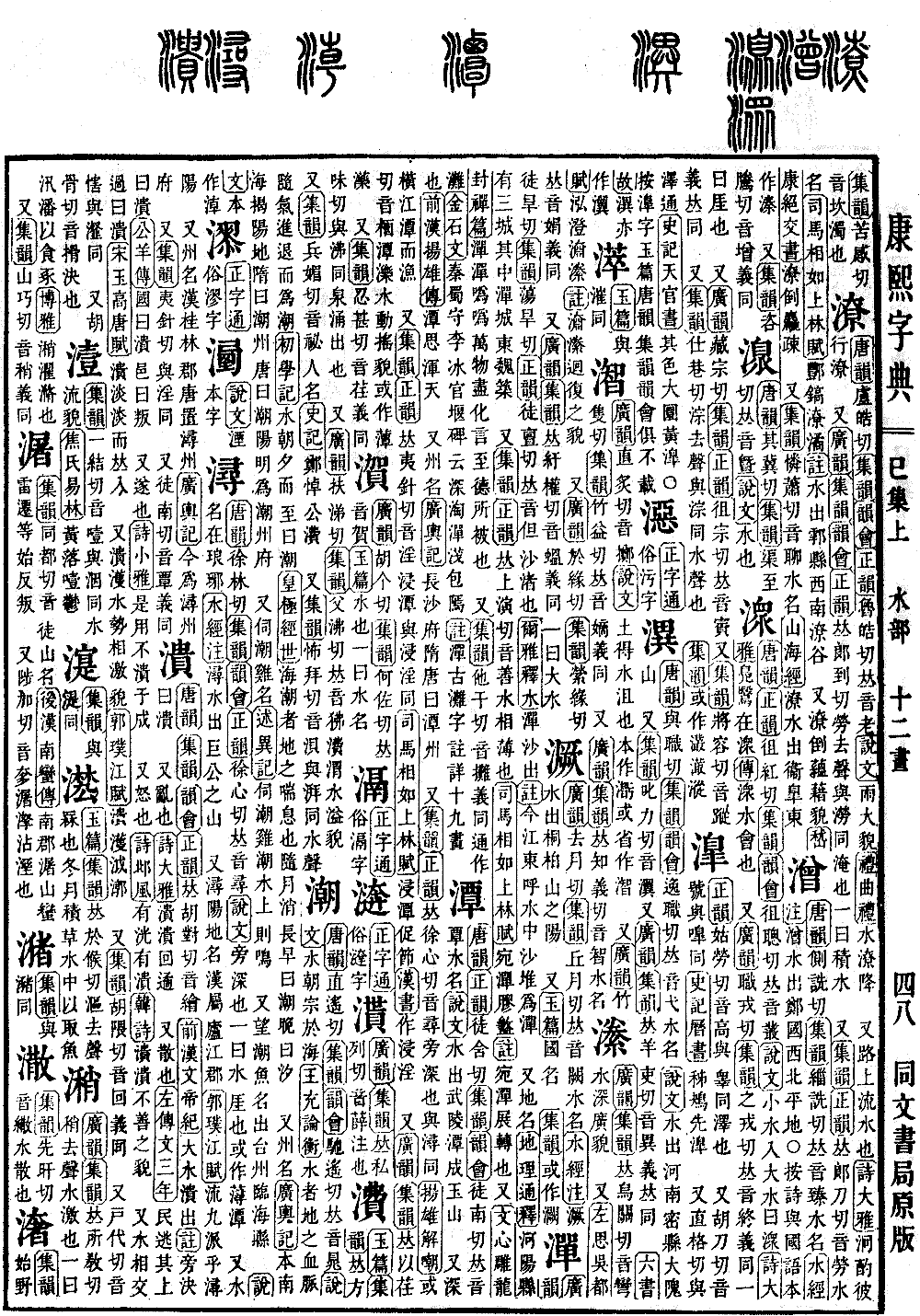
Si Collection, Upper Volume
Radical: Water (shuǐ)
Tan
Kangxi stroke count: 16
Page 650, Entry 12
Pronounced dan. A sandbank. Book of Literary Expositor (Erya), Chapter on Explaining Water: Sandbanks emerge from water. Commentary: In the region east of the Yangtze River, a pile of sand in the water is called a tan.
Also a place name. General Explanation of Geography (Dilì Tōngshì): Heyang County has three cities; among them, Tancheng was built by the Eastern Wei.
Pronounced shan. Water surging and swirling. Sima Xiangru, Rhapsody on the Shanglin Park (Shanglin Fu): Receding and surging, twisting and tangled. Commentary: Wan-tan refers to turning and rolling.
Also, from The Literary Mind and the Carving of Dragons (Wenxin Diaolong), Chapter on Imperial Sacrifices: Tantan huihui, all things are transformed, referring to the influence of supreme virtue.
Pronounced tan. Same meaning. Commonly written as the character for a shallow or rapid in a river (tan). Inscription on metal and stone: Regarding the official weir of Li Bing, Governor of Shu during the Qin Dynasty: Deeply dredge the sandbanks and embankments. Commentary: Tan is the ancient form of the character for a shallow or rapid in a river. Detailed notes are provided under the nineteen-stroke entry. The character is formed by the water radical combined with the component for zuo.