Mao Collection, Upper Volume
Radical: Heart (xīn)
Kangxi stroke count: 15
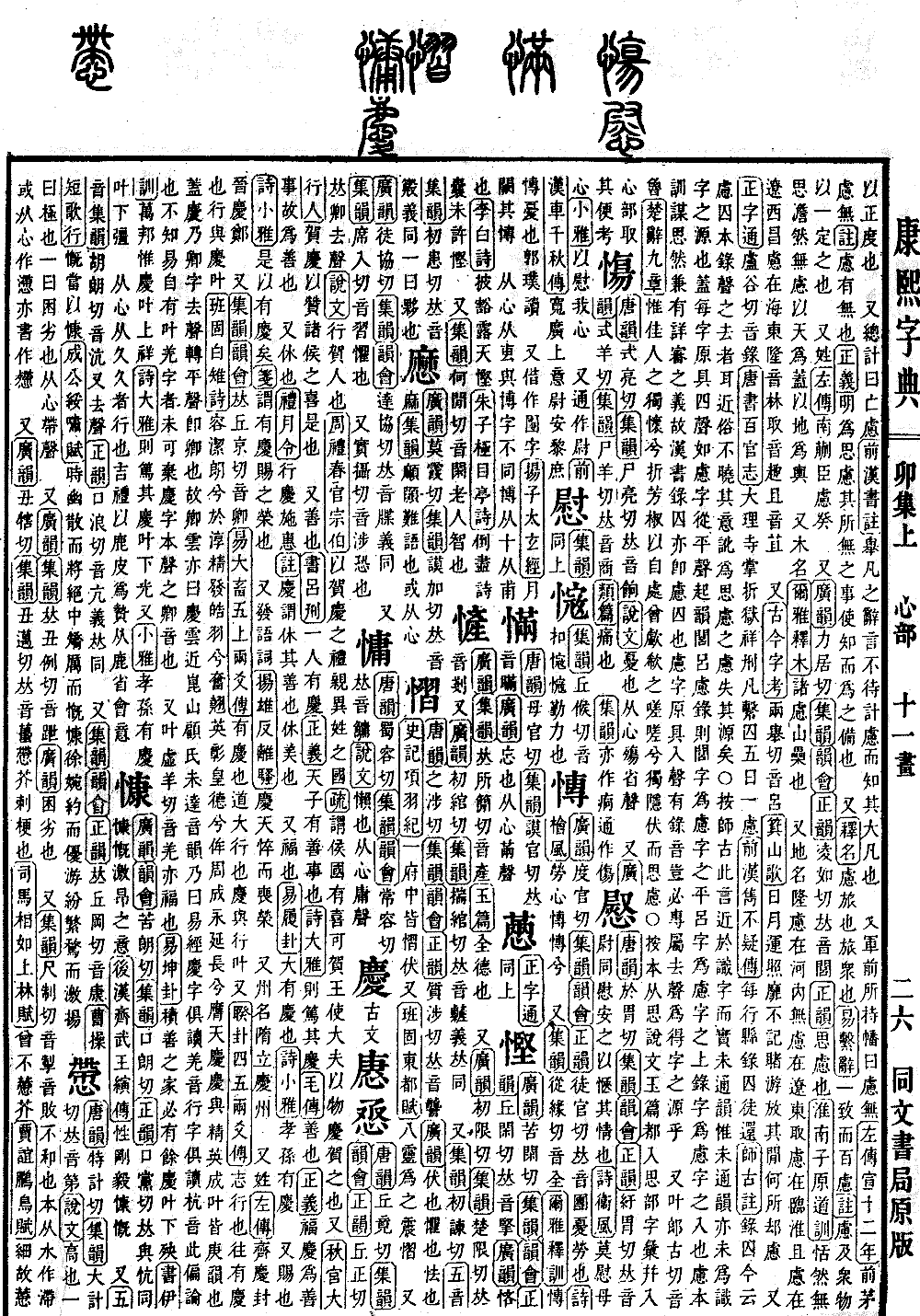
Page 400, Entry 17
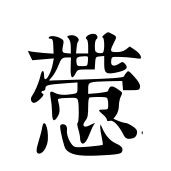
Pronounced te (falling tone). Pronounced di (falling tone). According to the Shuowen Jiezi (Explaining Graphs and Analyzing Characters), it means high. Another source says it means extreme. Another source says it means exhausted or weak. The character is formed with the heart radical and the sound component dai.
Also pronounced yi (falling tone). According to the Guangyun (Broad Rhymes) and Jiyun (Collected Rhymes), it means exhausted or weak.
Also pronounced che (falling tone). It refers to a musical tone that is spoiled or dissonant. Originally written with the water radical as zhi. Sometimes written with the heart radical as chi, or also written in other variant forms.
Also pronounced chai (falling tone). The term di jie refers to a prickle, obstruction, or blockage. In the Zixu Fu (Rhapsody on Sir Fantasy) by Sima Xiangru, it is written as bu jie. In the Peng Niao Fu (Rhapsody on the Peng Bird) by Jia Yi, it is written as xi gu jie. Sometimes written in the variant form di ji.
Textual research: In the original text, the Shanglin Fu (Rhapsody on the Shanglin Park) by Sima Xiangru was changed to Zixu Fu (Rhapsody on Sir Fantasy). Note: The original book text has been corrected to refer to the Zixu Fu.