Si Collection, Upper Volume
Radical: Water (shuǐ)
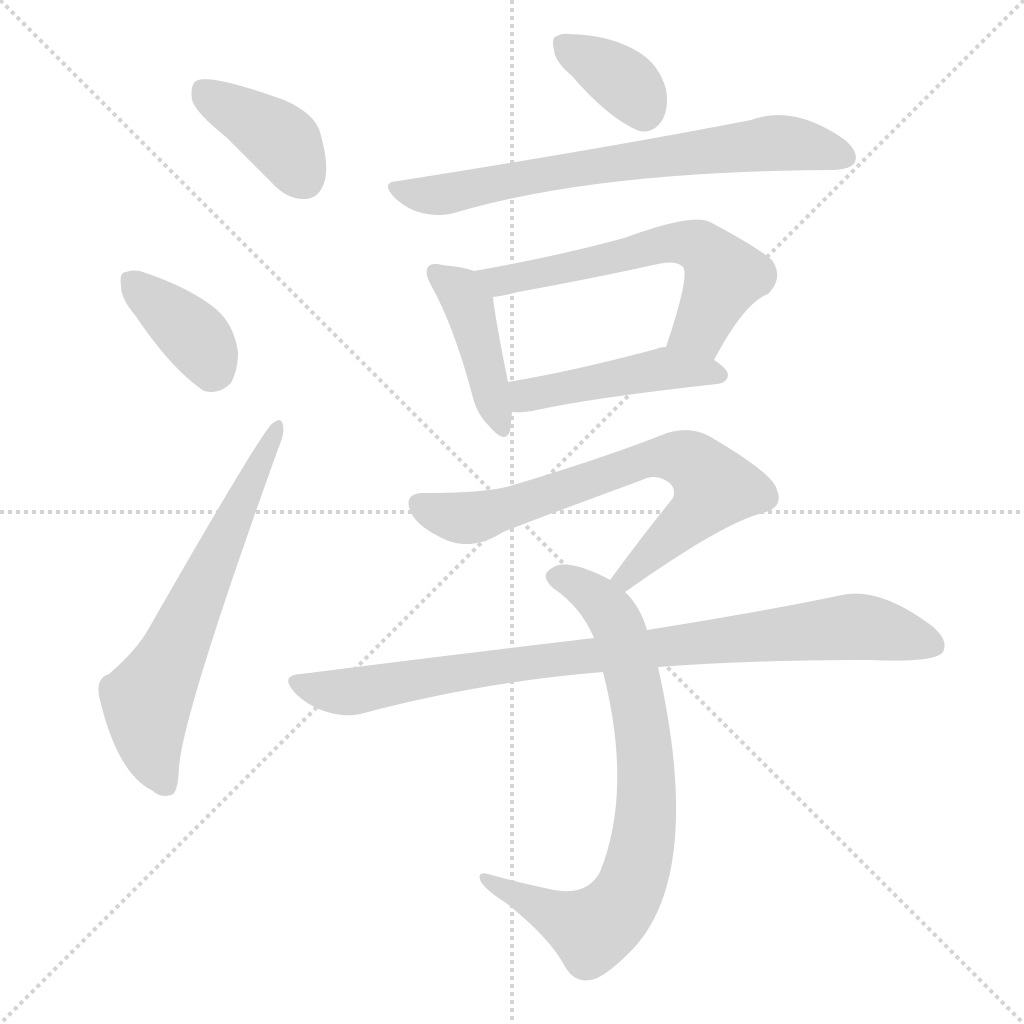
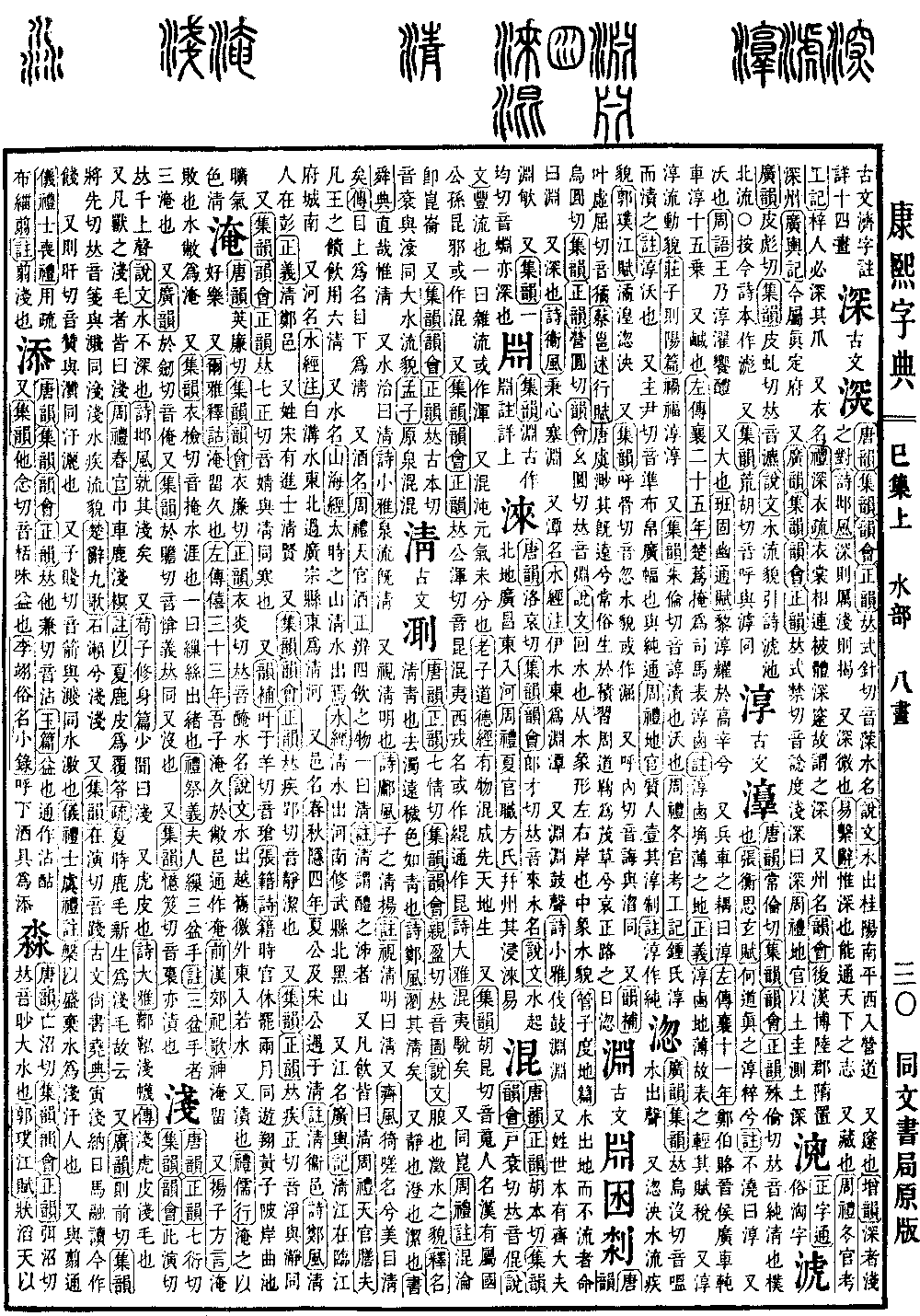
淳
Kangxi strokes: 12
Page 632, Entry 05
Ancient form.
According to Tang Rhymes (Tangyun), pronounced chun. According to Collected Rhymes (Jiyun), Rhymes Compilation (Yunhui), and Correct Rhymes (Zhengyun), pronounced chun. Clear; simple.
In Zhang Heng’s Thinking Rhapsody (Si Fu): How true and pure is the way.
Commentary: That which is not artificial is called chun.
Also, to wash.
In Discourses of the States (Guoyu): The king then washed and prepared sweet wine.
Also, great.
In Ban Gu’s Rhapsody on Hidden Communication (Youtong Fu): Li shone greatly upon Gaoxin.
Also, a pair of war chariots is called a chun.
In Zuo Commentary (Zuozhuan), 11th year of Duke Xiang: The Earl of Zheng bribed the Marquis of Jin with fifteen pairs of wide and covered chariots.
Also, salty.
In Zuo Commentary (Zuozhuan), 25th year of Duke Xiang: Chu Weiyan served as the Marshal to survey the salty and barren lands.
Commentary: Chunlu refers to thin, infertile soil.
Orthodox Meaning: Because the soil is thin, it is surveyed to lighten its taxation.
Also, chun-chun, the appearance of flowing.
In Zhuangzi, Zeyang Chapter: Misfortune and fortune flow in succession.
Also, according to Collected Rhymes (Jiyun), pronounced zhun. To soak; to wash.
In Rites of Zhou (Zhouli), Winter Officials, Record of Tradesmen: The bell-maker soaks and cleans it.
Commentary: Chun means to wash.
Also, pronounced zhun. The width of cloth or silk. Interchangable with the character for pure (chun).
In Rites of Zhou (Zhouli), Earth Officials: The quality inspector standardizes their width measurements.
Commentary: The original text uses chun, which functions as pure.