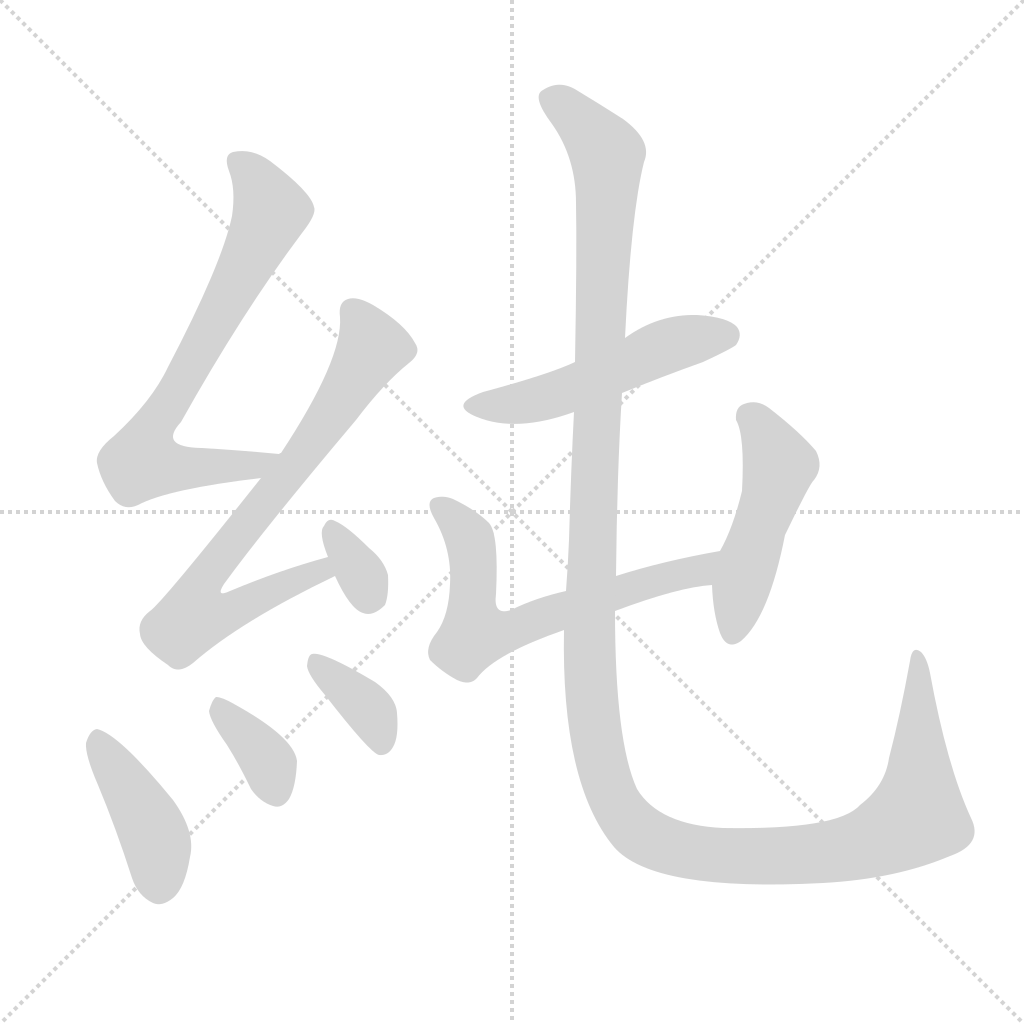
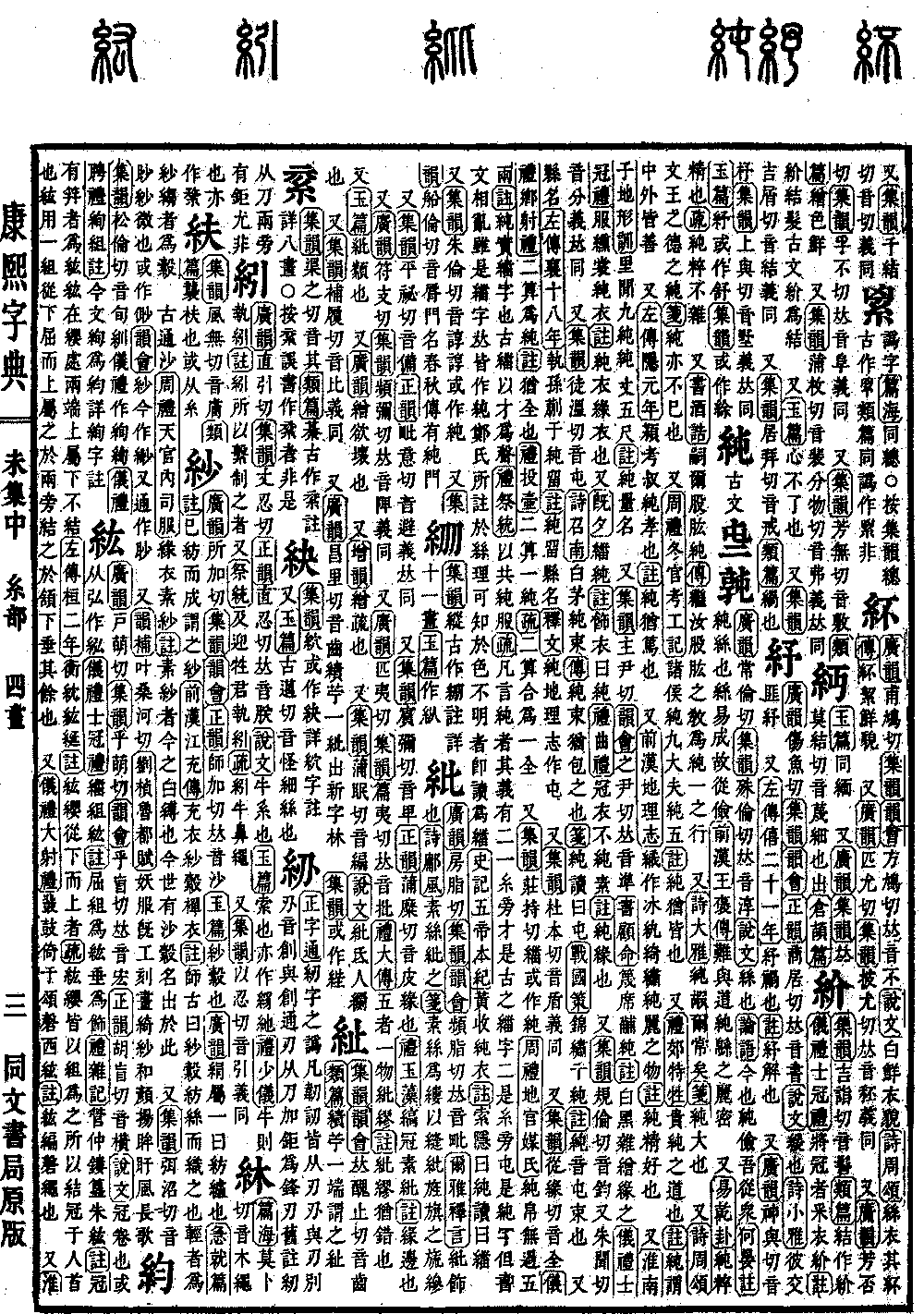
Wei Collection, Middle Volume
Radical: Silk (mì)
Kangxi Strokes: 10
Page 917, Entry 06
According to Broad Rhymes (Guangyun), it is pronounced chun; according to Collected Rhymes (Jiyun), it is pronounced chun. According to Explaining Graphs and Analyzing Characters (Shuowen), it refers to silk. In the Analects (Lunyu), it is stated: "Today, simplicity and thrift are the standard; I follow the multitude." The commentary by He Yan notes: "This refers to silk. Silk is easy to process, hence it denotes thrift." In the History of the Former Han (Qianhan Shu), Biography of Wang Bao, it is written: "It is difficult to speak of the beauty and density of silk and cotton."
Also, in the Book of Changes (Yijing), Hexagram Qian, it refers to purity and essence. The commentary states: "Pure and refined, not mixed."
Also, in the Book of Documents (Shangshu), Announcement on Wine (Jiu Gao), it says: "Continue your limbs and keep them pure." The commentary explains: "Continue your duty and the teachings of your ancestors, acting with pure and single-minded conduct."
Also, in the Book of Odes (Shijing), Greater Odes, it says: "Great blessings are yours forever." The commentary notes: "Here, it means great."
Also, in the Book of Odes (Shijing), Eulogies of Zhou, it says: "The virtue of King Wen is pure." The commentary notes: "Here, it also means unceasing."
Also, in the Rites of Zhou (Zhouli), Winter Official, Artificer's Record, it says: "For feudal lords, a set of nine; for senior officials, a set of five." The commentary notes: "Here, it means all."
Also, in the Book of Rites (Liji), Record of the Extraordinary Sacrifice at the Suburban Altar, it says: "Valuing the way of purity." The commentary notes: "This means that both the inner and outer aspects are good."
Also, in the Zuo Commentary (Zuozhuan), First Year of Duke Yin, it says: "Ying Kaoshu is purely filial." The commentary notes: "Here, it means sincere."
Also, in the History of the Former Han (Qianhan Shu), Treatise on Geography, it says: "Weaving ice-like fine silks and embroidered, pure, and beautiful objects." The commentary notes: "Here, it means refined and good."
Also, in the Huainanzi, Treatise on Topography, it says: "Between the villages are nine measures, each measure being five feet." The commentary notes: "Here, it is a unit of measurement."
Also, according to Collected Rhymes (Jiyun), it is pronounced zhun; according to Rhyme Compilation (Yunhui), it is pronounced zhun. In the Book of Documents (Shangshu), Testamentary Charge (Gu Ming), it says: "Woven mats with embroidered edges." The commentary notes: "These are borders made of mixed black and white silk." In the Ceremonial Rites (Yili), Rites of Capping for Scholars, it refers to wearing red skirts and trimmed garments. The commentary notes: "Trimmed garments refer to garments with borders." Also, in the Rites for the Evening, it mentions black borders. The commentary notes: "Decorative clothing is called border." In the Book of Rites (Liji), Record of Music, it says: "Caps and garments should not be trimmed with plain white." The commentary notes: "Here, it means an edge or border."
Also, according to Collected Rhymes (Jiyun), it is pronounced jun.
Also, according to Collected Rhymes (Jiyun), it is pronounced zhun. The meaning is the same.
Also, according to Collected Rhymes (Jiyun), it is pronounced tun. In the Book of Odes (Shijing), Odes of Zhao, it says: "Bound with white cogon grass." The commentary notes: "A bundle, meaning to wrap it." The supplementary note states: "Here, it is pronounced as tun." In the Intrigues of the Warring States (Zhanguoce), it says: "A thousand bundles of brocade." The commentary notes: "Pronounced tun, meaning a bundle."
Also, it is the name of a county. In the Zuo Commentary (Zuozhuan), Eighteenth Year of Duke Xiang, it says: "Captured Sun Kuai at Chunliu." The commentary notes: "Chunliu is the name of a county." The Explanation of Terms notes: "In the Treatise on Geography, it is written as Tun."
Also, according to Collected Rhymes (Jiyun), it is pronounced dun. The meaning is the same.
Also, according to Collected Rhymes (Jiyun), it is pronounced quan. In the Ceremonial Rites (Yili), Rites of Archery for Local Gentry, it says: "Two counting rods make one unit." The commentary notes: "Similar to full or complete." In the Book of Rites (Liji), Pitch-pot Game, it says: "Two rods make one unit." The commentary notes: "Two rods combined make one whole."
Also, according to Collected Rhymes (Jiyun), it is pronounced zhuang. Sometimes written in a variant form. In the Rites of Zhou (Zhouli), Earth Official, Official of Matchmakers, it says: "Silk cloth not exceeding five liang." The commentary notes: "This character is actually the character for black silk. In ancient times, the component for black silk derived its sound from the phonetic element for talent." In the Book of Rites (Liji), Record of Sacrificial Rites, it says: "To provide the black-trimmed clothing." The commentary notes: "Whenever the term is used, there are two meanings: first, the character with the silk radical and talent component is the ancient form for black silk; second, the character with the silk radical and tun component is the character for pure. However, since the texts are confused, even where it should be the character for black silk, they are all written as the character for pure. Wherever Zheng Xuan notes that the texture of the silk is identifiable but the color is unclear, it should be read as black silk." In the Records of the Grand Historian (Shiji), Basic Annals of the Five Emperors, it says: "Yellow robes and black-trimmed clothing." The commentary of Suoyin notes: "The character for pure is read as black silk."
Also, according to Collected Rhymes (Jiyun), it is pronounced zhun. Sometimes written as a variant of the character meaning to instruct.
Also, according to Collected Rhymes (Jiyun), it is pronounced chun. It is the name of a gate. In the Spring and Autumn Commentary (Chunqiu Zhuan), there is the Chun Gate.