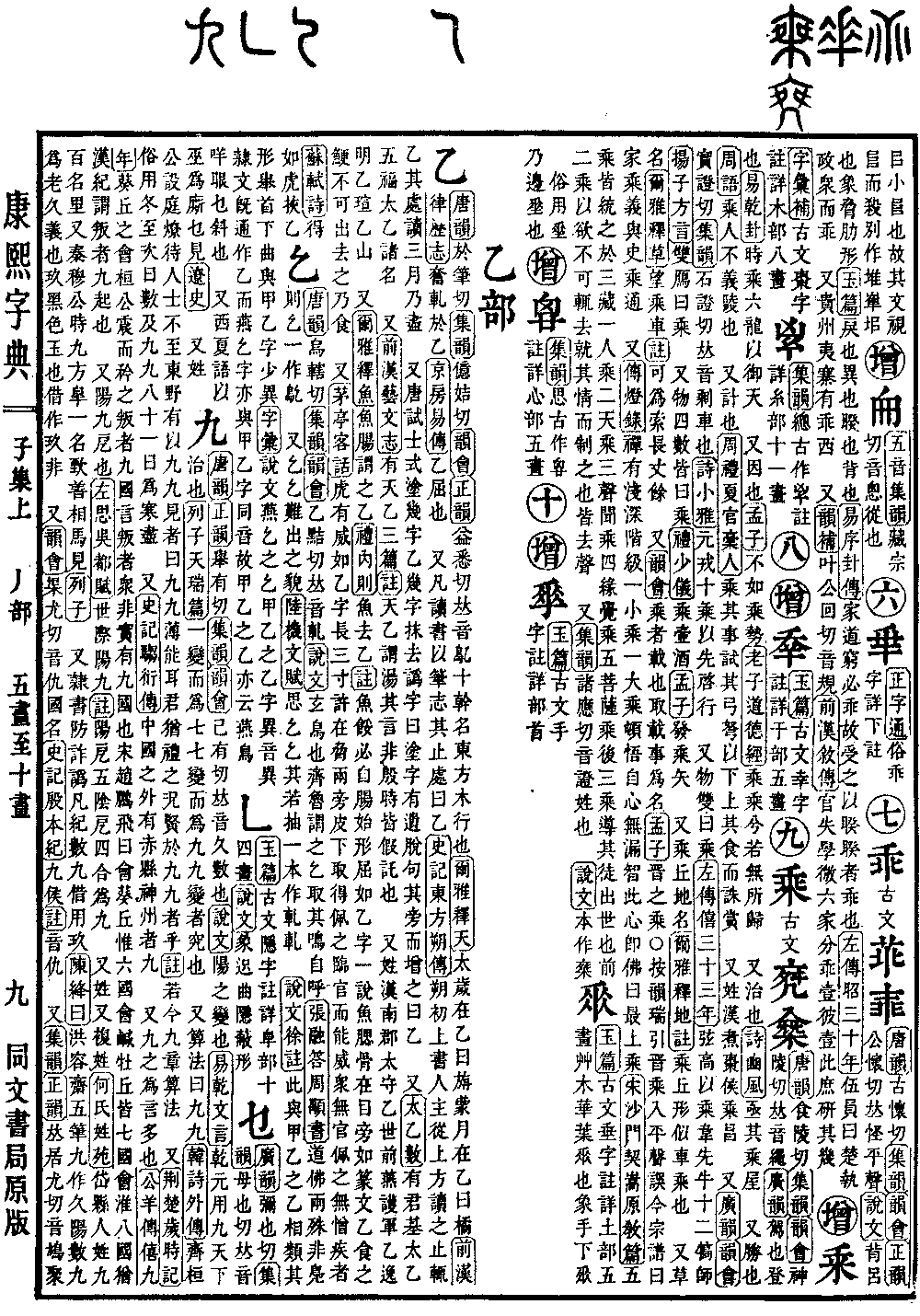
Zi Collection, Page Position: Upper
Radical: Slash (piě)
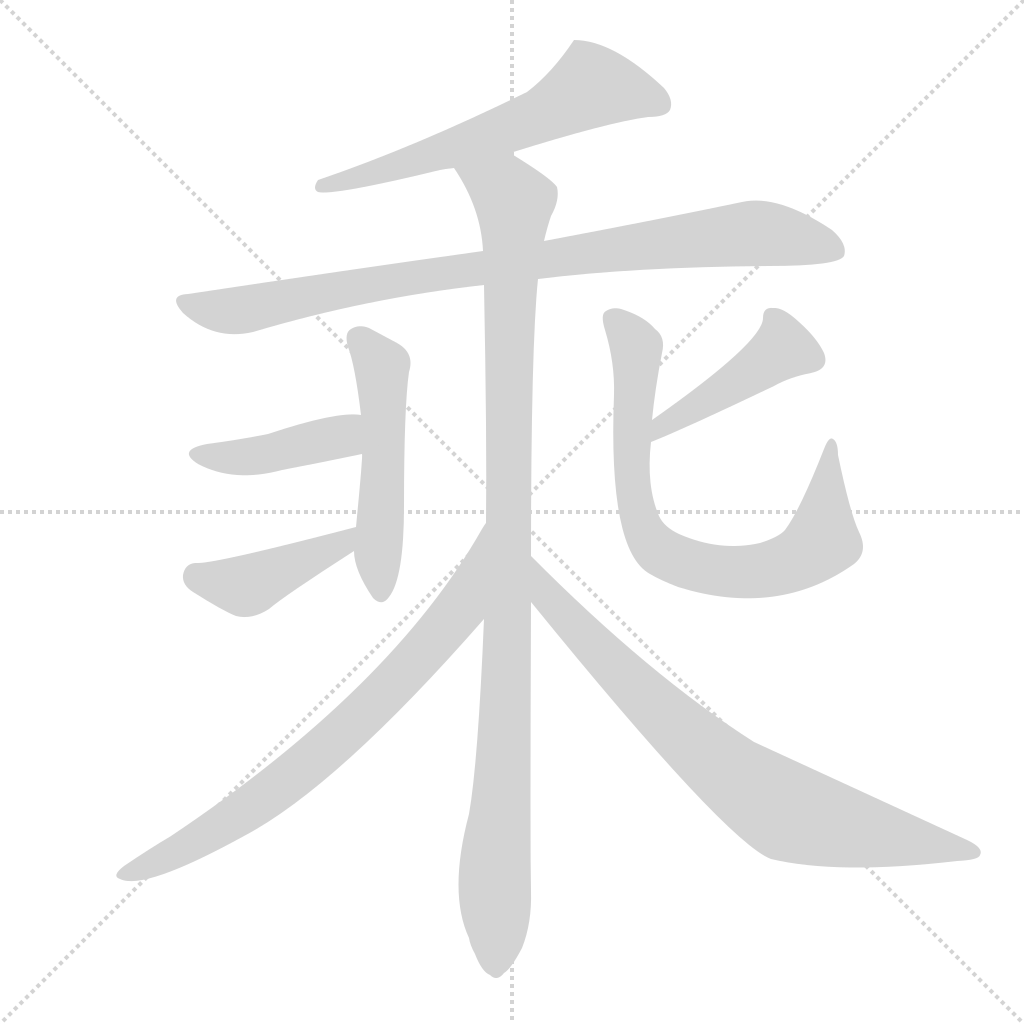
Character: 乘
Kangxi Dictionary Strokes: 10 strokes
Page Number: Page 83, Column 9
Ancient writing style: In the Tang Dynasty Rimes (Tangyun), the pronunciation is indicated by the fanqie characters shí and líng. In the Collected Rimes (Jiyun) and the Rime Assembly (Yunhui), the pronunciation is indicated by the fanqie characters shén and líng. It is pronounced the same as the character shéng. In the Broad Rimes (Guangyun), the definition is to drive or to mount and ascend. In the Book of Changes (Yijing), it states: At the proper time, he mounts the six dragons to drive through the heavens — Hexagram Qian. It also means to rely on or to utilize. In the Mencius (Mengzi), it states: It is better to take advantage of the circumstances. In the Laozi (Daodejing), it states: Drifting as if having nowhere to return. It also means to manage or repair. In the Book of Odes (Shijing), it states: Hasten to repair the roof — Odes of Bin. It also means to overcome or surpass. In the Discourses of the States (Guoyu), it states: To take advantage of another's unrighteousness is to oppress — Discourses of Zhou. It also refers to calculating or assessing. In the Rites of Zhou (Zhouli), it states: Assess their tasks, test their bows and crossbows, and adjust their rations or award punishments accordingly — Summer Officials, Gao Ren. It is also a surname. During the Han Dynasty, there was Cheng Chang, the Marquis of Zhuzao.
Furthermore, in the Broad Rimes and the Rime Assembly, the pronunciation is indicated by the fanqie characters shí and zhèng. In the Collected Rimes, the pronunciation is indicated by the fanqie characters shí and zhèng. It is pronounced the same as the character shèng. It refers to a vehicle or carriage. In the Book of Odes, it states: Ten great war chariots lead the way — Minor Odes. It also refers to items in pairs. In the Zuo Commentary (Zuozhuan), it states: Xian Gao presented four tanned hides and twelve oxen to reward the army — 33rd Year of Duke Xi. In Yangzi's Dialects (Fangyan), a pair of wild geese is called a shèng. Additionally, any set of four items can be called a shèng. In the Book of Rites (Liji), it states: Four jars of wine — Lesser Etiquette. In the Mencius, it states: Dispatched four arrows. Chengqiu is also a place name. In the Commentary to the Erya (Erya), it states: Chengqiu is shaped like a carriage. It is also the name of a plant. In the Erya, it is listed as wangchenghu. The note states that this grass can be used to make ropes and grows over ten feet long.
In the Rime Assembly, it is noted that the character carries the meaning of to carry or contain, named after the concept of carrying things. In the Mencius, it refers to the Records of Jin. Note: The Rime Treasure (Yunrui) cites the Records of Jin as being pronounced in the level tone, which is incorrect. Current family genealogies are called family records (jiāshèng), and the meaning is the same as the historical records. In the Transmission of the Lamp (Chuandeng Lu), Zen Buddhism has levels of depth: one is the Lesser Vehicle and the other is the Great Vehicle. Sudden enlightenment of one's own mind and stainless wisdom, where the mind is the Buddha, is called the Supreme Vehicle. In the Original Teachings by the Song Dynasty Monk Qisong (Song Shamen Qisong Yuanjiao Pian), the Five Vehicles all return to the Tripitaka. The first is the Human Vehicle, the second is the Heavenly Vehicle, the third is the Hearer Vehicle, the fourth is the Solitary Realizer Vehicle, and the fifth is the Bodhisattva Vehicle. The latter three guide their followers to transcend the world. The first two, because human desires cannot be easily removed, provide constraints based on those desires. All the above pronunciations are in the departing tone.
In the Collected Rimes, the pronunciation is also indicated by the fanqie characters zhū and yìng, pronounced the same as zhèng. It is a surname. In the Explaining Graphs and Analyzing Characters (Shuowen Jiezi), the original form of the character is written in a variant form pronounced chéng.