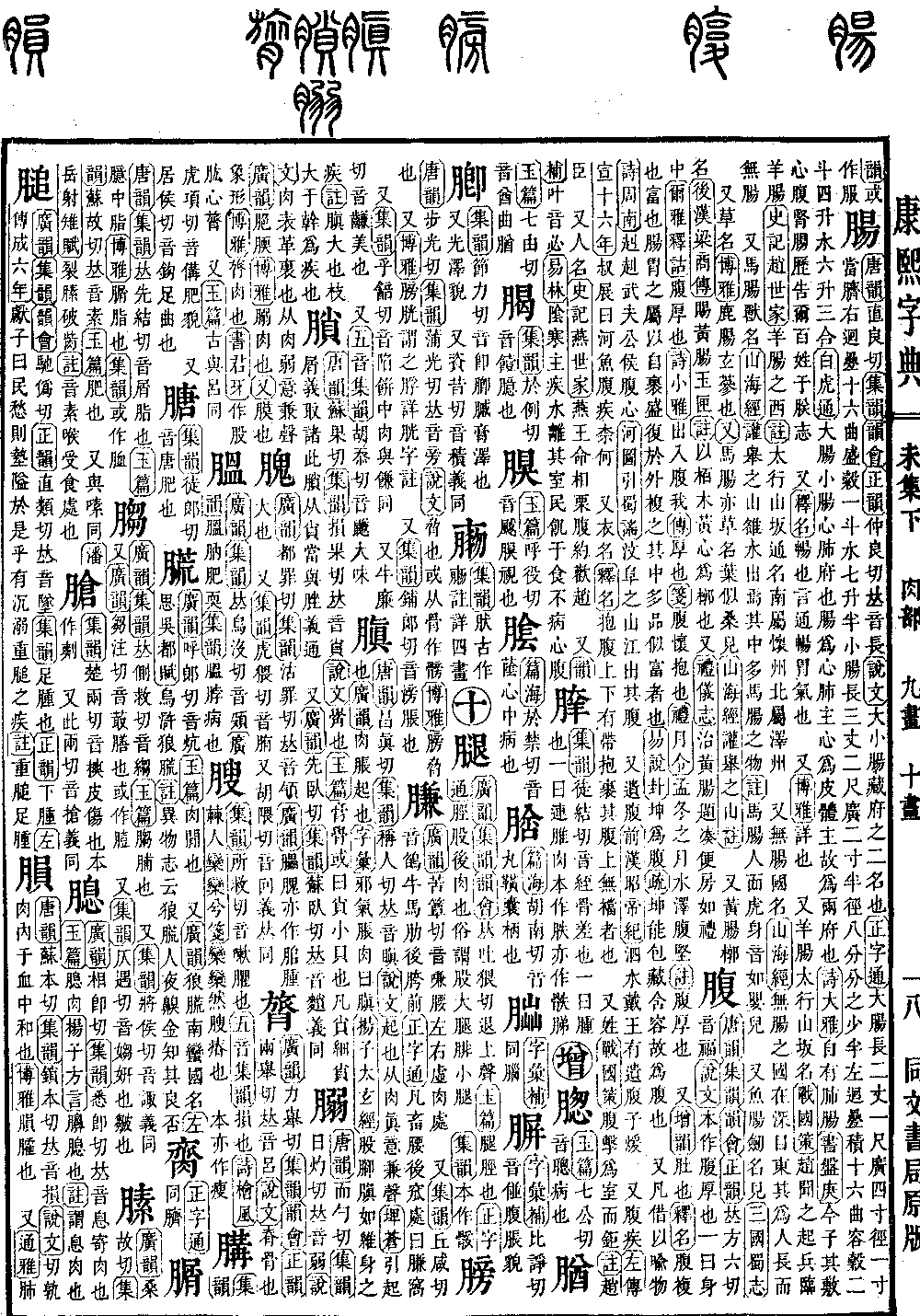
Wei Collection, Lower Volume
Radical: Meat (ròu)
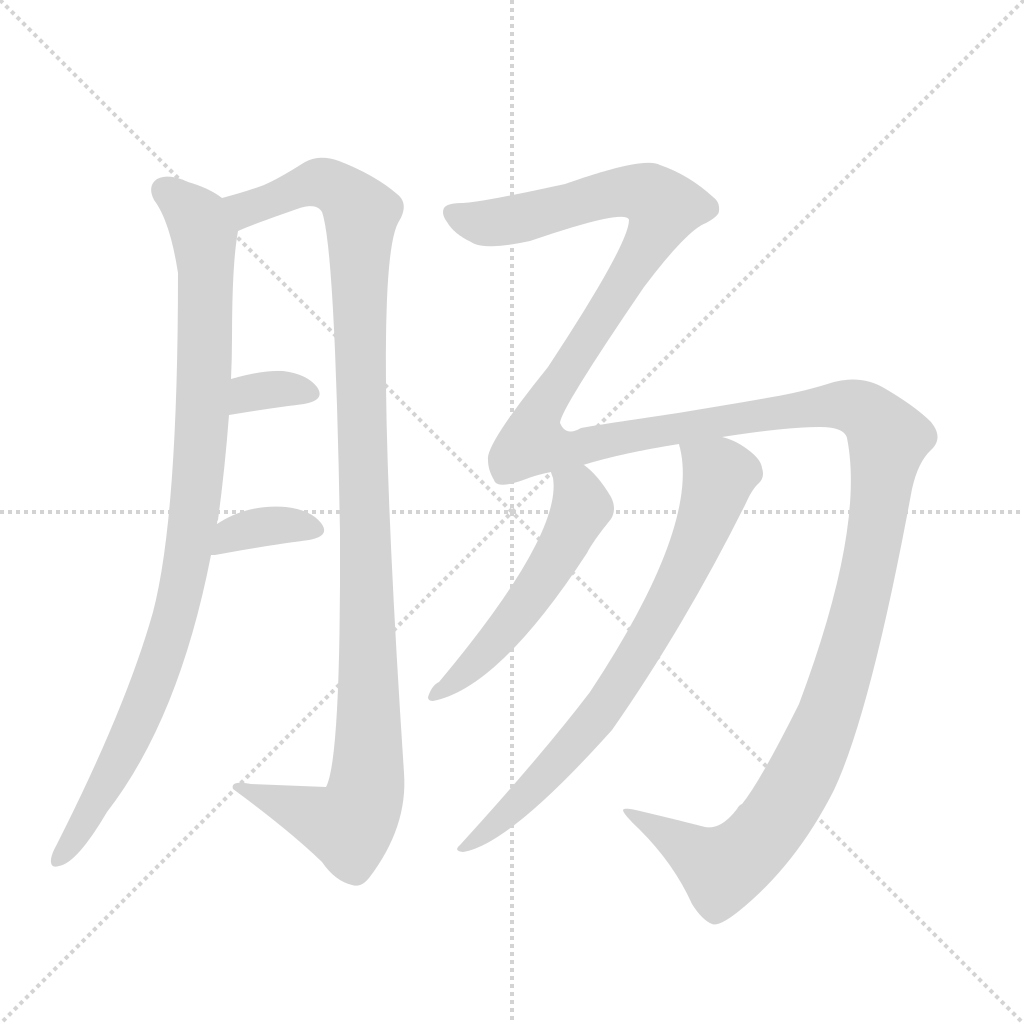
Entry: Intestine
Kangxi stroke count: 15
Page 990, Entry 01
Pronounced chang
Shuowen Jiezi (Explanation of Graphs and Analysis of Characters): The large intestine and small intestine, names for two of the internal organs.
Zhengzitong (Comprehensive Compilation of Characters): The large intestine is twenty-one feet long, four inches wide, with a diameter of one inch; it is located to the right of the navel and folded into sixteen turns, holding one dou of food and seven and a half sheng of water. The small intestine is thirty-two feet long, two and a half inches wide, with a diameter of eight-tenths of an inch and a small fraction; it is located to the left and folded into sixteen turns, holding twenty-four sheng of food and six sheng and three he of water.
Baihu Tong (Comprehensive Discussions in the White Tiger Hall): The large and small intestines are the storehouses of the heart and lungs. The intestines are governed by the heart and lungs; the heart governs the skin and body, thus they are the two storehouses.
Book of Odes (Shijing): Naturally having lungs and intestines.
Book of Documents (Shangshu): Now I will pour out my heart and lungs, stripping away my liver and gall to tell you, my people, my thoughts one by one.
Also, according to Shiming (Explanation of Names): It means to flow freely, saying it enables the stomach qi to circulate unobstructed.
Also, according to Boya (Broad Glossary): It means to be thorough.
Also, Yangchang (Sheep Intestines): The name of a mountain slope in the Taihang Mountains.
Strategies of the Warring States (Zhan Guo Ce): Zhao heard this and dispatched troops to arrive at Yangchang.
Records of the Grand Historian (Shiji): West of Yangchang. Commentary: This is the general name for the slopes of the Taihang Mountains. The south belongs to Huaizhou and the north belongs to Zezhou.
Also, Wuchang (No Intestines): The name of a country.
Classic of Mountains and Seas (Shanhai Jing): The Country of No Intestines is east of the Country of Deep Eyes; the people there are tall but have no intestines.
Also, Machang (Horse Intestines): The name of a beast.
Classic of Mountains and Seas (Shanhai Jing): Mount Huanju, where the Luo River originates; there are many of these Machang animals in the water. Commentary: Machang has a human face, a tiger's body, and a cry like a baby.
Also, Yuchang (Fish Intestines): The name of a sword. See Records of the Three Kingdoms, Shu (Sanguo Shuzhi).
Also, the name of a plant. Boya: Luchang (Deer Intestines) is ginseng.
Also, Machang is also a plant name, with leaves like those of a mulberry tree. See the commentary on the flora of Mount Huanju in the Classic of Mountains and Seas.
Also, Huangchang (Yellow Intestines): The name of an outer coffin.
Book of the Later Han (Hou Hanshu): Bestowed a yellow-intestine jade casket. Commentary: This is an outer coffin made from the yellow heartwood of the cypress.
Also, Book of Rites (Liji): Constructed a yellow-intestine arrangement of logs for the funeral chamber, all in accordance with ritual regulations.