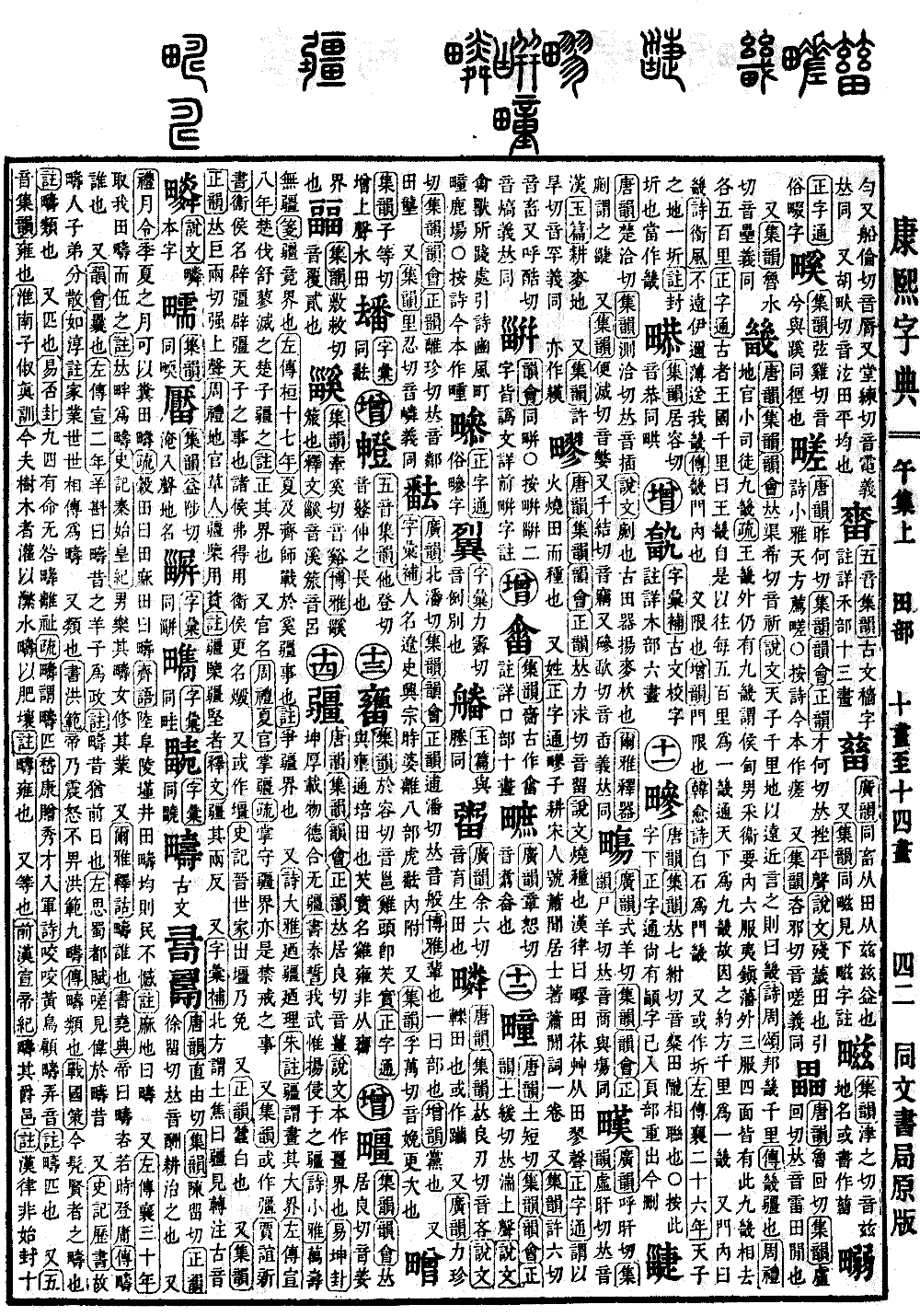
Wu Collection, Upper Volume
Radical: Field (tián)
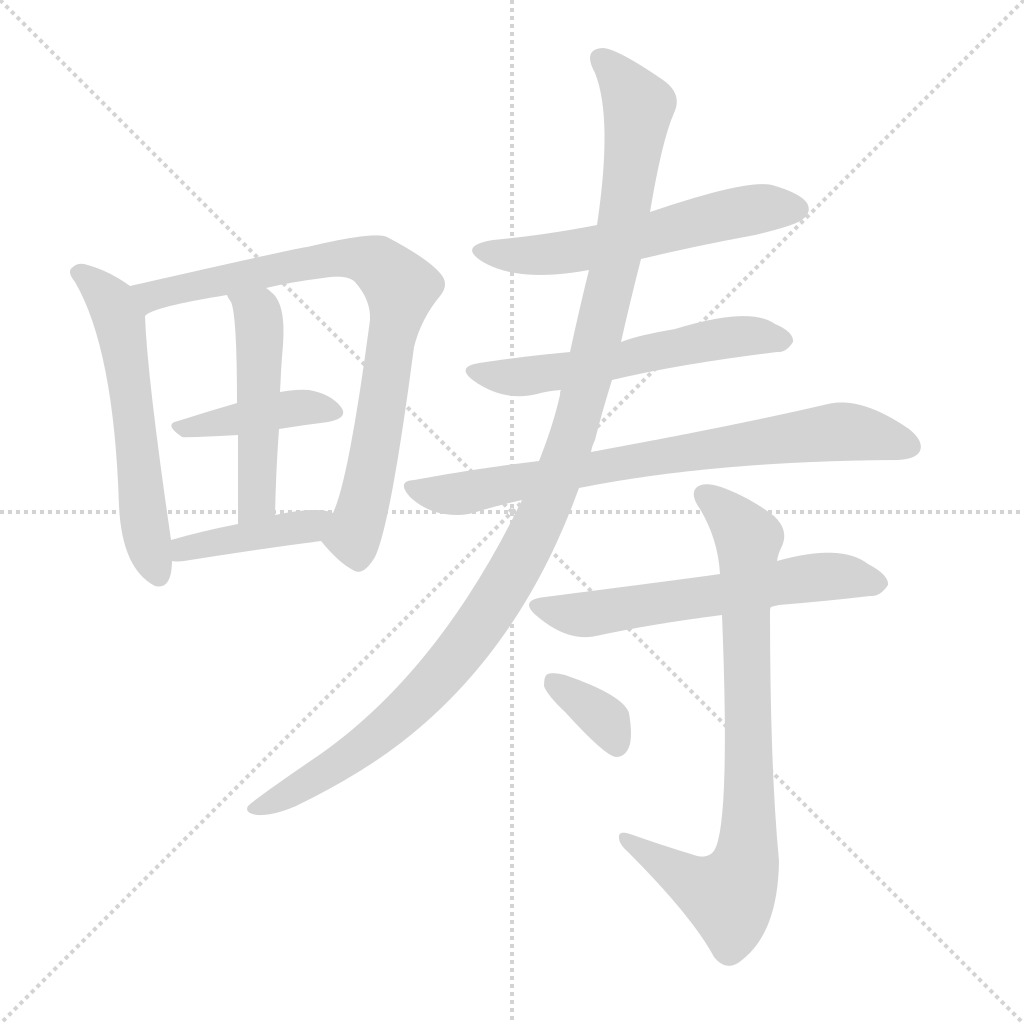
Chou
Kangxi strokes: 19
Page 766, Entry 01
Ancient character form. Pronounced chou. The cultivation and management of land.
Also from Book of Rites (Liji), Monthly Ordinances (Yueling): In the final month of summer, one may manure the fields and cultivated lands. The commentary states: Grain fields are called tian, hemp fields are called chou. From Discourses of the States (Qiyu): On high, elevated, and damp land, the well-field system and the cultivated lands are equitable, thus the people have no grievances. The commentary states: Hemp land is called chou.
Also from Zuo Tradition (Zuozhuan), 30th year of Duke Xiang: They took our fields and cultivated lands and divided them into groups of five. The commentary states: The boundaries are called chou. From Records of the Grand Historian (Shiji), Annals of Qin Shi Huang: Men find joy in their fields, women cultivate their crafts.
Also from Er Ya, Explanation of Words (Shigu): Chou means who. From Book of Documents (Shangshu), Canon of Yao: The Emperor said: Who can inquire and accord with the times to ascend and be employed? The commentary states: Chou means who.
Also from Rhyme Collection (Yunhui): Formerly. From Zuo Tradition (Zuozhuan), 2nd year of Duke Xuan: Yang Zhen said: The mutton of the day before yesterday was provided by you. The commentary states: Chouxi means like the day before yesterday. From Zuo Si, Rhapsody on the Capital of Shu (Shudu Fu): Sighing that one has seen greatness greater than in days of old.
Also from Records of the Grand Historian (Shiji), Treatise on the Calendar: Therefore, the families of the astronomers were scattered. Ru Chun comments: Families whose professions are passed down through generations are called chou.
Also means category. From Book of Documents (Shangshu), Great Plan (Hongfan): The Emperor was then震怒, and did not grant the Great Plan with its nine categories. The commentary states: Chou means category. From Strategies of the Warring States (Zhanguoce): Now, Chun is in the category of the virtuous. The commentary states: Chou means category.
Also means peer. From Book of Changes (Yijing), Hexagram of Stagnation (Pi): Nine in the fourth place, having a mandate and no blame, the peer receives blessings. The commentary states: Chou refers to a peer. From Ji Kang, Poem Gifted to the Talented Scholar Entering the Army: The yellow birds chirp, looking for their peers to play with their notes. The commentary states: Chou means peer.
Also from Five Tone Rhyme Collection (Wuyin Jiyun): To heap up. From Masters of Huainan (Huainanzi), Treatise on True Nature (Chuzhen Xun): Now, as for trees, one irrigates them with plentiful water and heaps up rich soil around them. The commentary states: Chou means to heap up.
Also means equal. From History of the Former Han (Qianhan), Annals of Emperor Xuan: Equate their titles and fiefs. The commentary states: According to the Han statutes, those not among the original enfeoffments had their titles reduced by two parts. Chou means equal, stating that they would not be reduced again. From History of the Later Han (Houhan), Biography of Ji Zun: Chou means equal. It states that the descendants of meritorious officials inherited titles equal to their ancestors.
Also the name of a marsh. From Masters of Huainan (Huainanzi), Treatise on the Origins (Benjing Xun): Yao sent Yi to execute the Tooth-Chiseler in the fields of Chouhua. The commentary states: Chouhua is the name of a marsh in the south.
Also the name of a state. From Discourses of Zhou (Zhouyu): It was the state of Zhi and Chou, originating from Tai Ren. The commentary states: Zhi and Chou are the names of two states.
Also a surname. Descendants of Zhi and Chou. From Zuo Tradition (Zuozhuan), 13th year of Duke Ai: Chou Wuyu and Ou Yang came from the south. The commentary states: These two men were officials of the state of Yue.
Also from Rhyme Supplement (Yunbu): Rhymes with chu, pronounced chu. From Han Yu, Inscription for Wang Hongzhong: Located within his jurisdiction, prohibiting the Buddhists. Wind and rain are compliant and easy, rice crops fill the fields.