Wu Collection, Upper Volume
Radical: Field (tián)
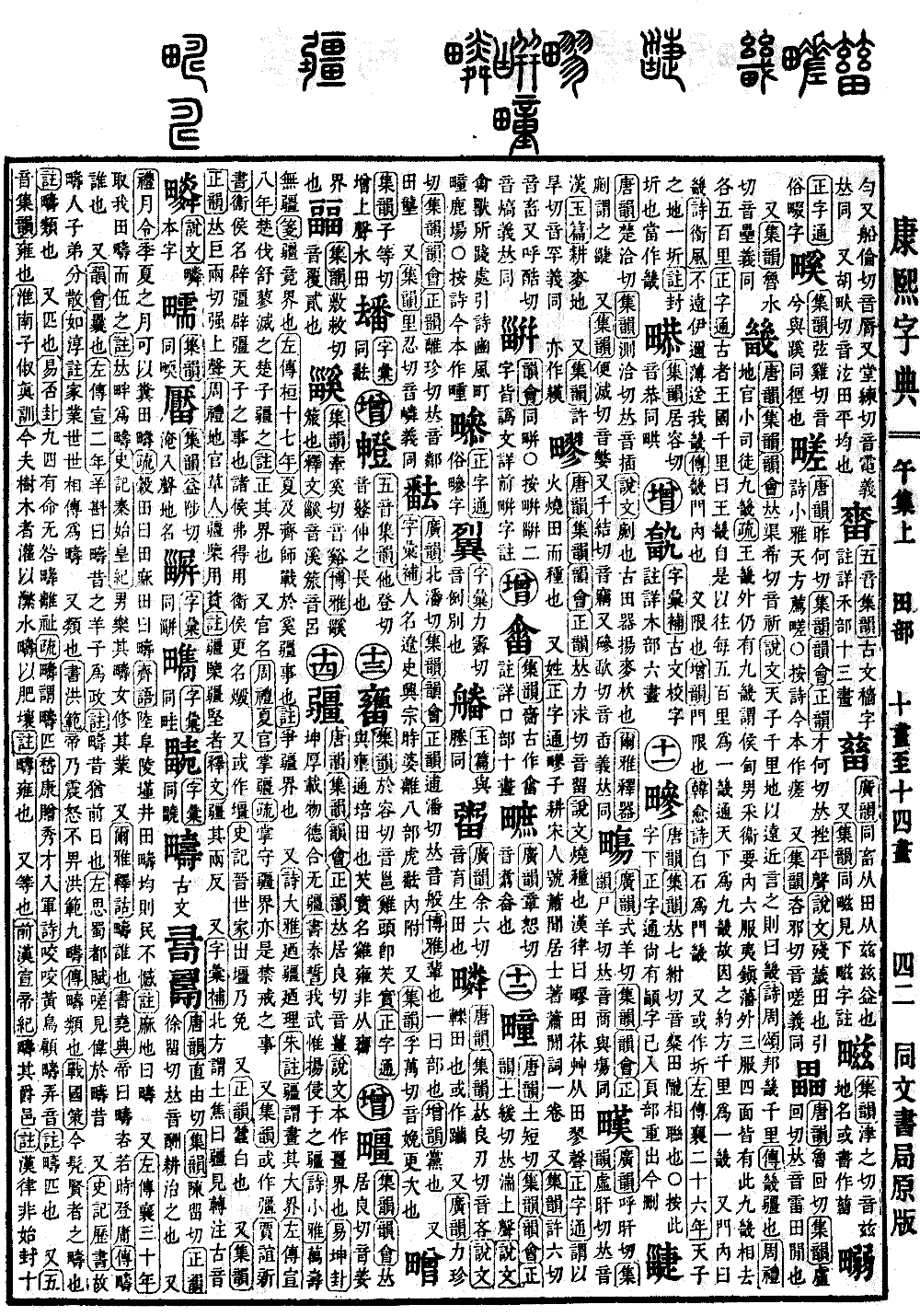
Chou; Kangxi Dictionary strokes: 19; Page 766, Entry 40
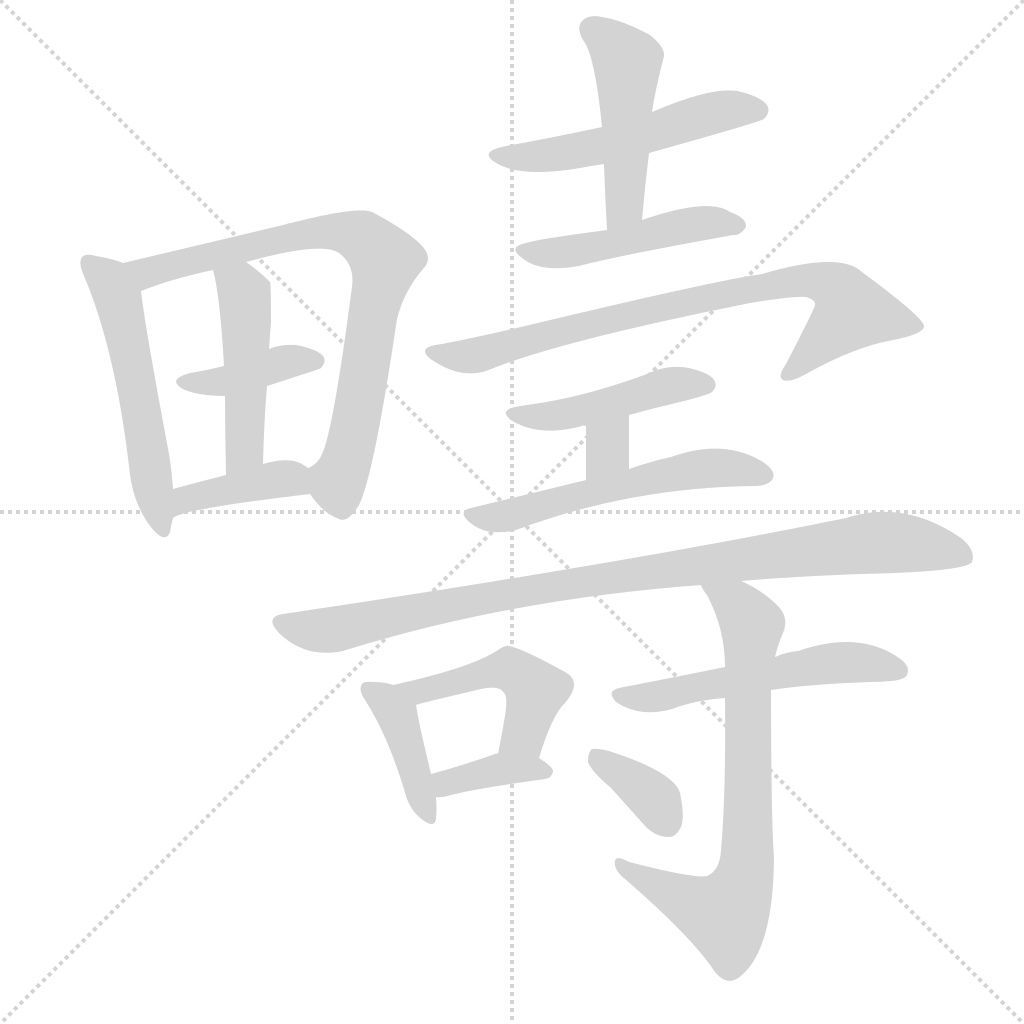
Pronounced chou. The act of cultivating and managing fields.
Also, Book of Rites (Liji), Monthly Ordinances (Yueling): In the final month of summer, one may apply fertilizer to the fields. Commentary: Land used for grain is called tian, land used for hemp is called chou. Discourses of the States (Guoyu): Mountain lands, hills, plains, marshes, well-fields, and hemp-fields were distributed evenly, so the people had no grievances. Note: Hemp fields are called chou.
Also, Zuo Tradition (Zuo Zhuan), 30th Year of Duke Xiang: Seizing our fields and redividing them. Note: Field ridges are called chou.
Records of the Grand Historian (Shiji), Annals of Qin Shi Huang: Men found joy in cultivating the fields, and women were diligent in spinning and weaving.
Also, Literary Expositor (Erya), Explanations of Ancient Terms (Shi Gu): Chou means who. Book of Documents (Shangshu), Canon of Yao (Yao Dian): Emperor Yao said: Who can comply with the times and be promoted to office? Commentary: Chou means who.
Also, Collection of Rhymes (Yunhui): Means formerly or in the past. Zuo Tradition (Zuo Zhuan), 2nd Year of Duke Xuan: Yang Zhen said: Formerly, you were the one in charge. Note: Chouxi is like saying the previous day. Zuo Si, Rhapsody on the Capital of Shu (Shudu Fu): Sighing over the great deeds of the past.
Also, Records of the Grand Historian (Shiji), Treatise on the Calendar (Lishu): Therefore, the descendants of those who studied the calendar for generations (chouren) were scattered. Ru Chun’s Note: Family occupations passed down through generations are called chou.
Also, means category or type. Book of Documents (Shangshu), The Great Plan (Hongfan): The Heavenly Emperor was thus enraged and did not grant him the nine categories of the Great Law for governing. Commentary: Chou means category. Strategies of the Warring States (Zhan Guo Ce): Now Chunyu Kun is a person of the same category as the virtuous. Note: Chou means category.
Also, means a match or a companion. Book of Changes (Yijing), Hexagram of Obstruction (Pi Gua), Nine in the fourth place: Having the mandate of Heaven, there is no disaster; those of the same group (or companions) will all receive blessings. Commentary: Chou refers to those of the same group or companions. Ji Kang, Poem for the Scholar Entering the Army: The yellow bird sings, watching its companion as it calls out. Note: Chou means companion.
Also, Five Sounds Collection of Rhymes (Wuyin Jiyun): Means to block with earth or to bank with soil. Huainanzi, Training in True Nature (Chuzhen Xun): Nowadays, those who plant trees irrigate them with flowing water and bank them with fertile soil. Note: Chou means to bank with soil.
Also, means to be equal to. Book of Han (Hanshu), Annals of Emperor Xuan: Let his rank and fief be equal to those of his ancestor. Note: According to Han law, for marquises who were not the original founders, the fief was reduced by two-tenths with each passing generation. Chou means equal, indicating it was no longer to be reduced. Book of the Later Han (Houhanshu), Biography of Ji Zun: Chou means equal. It means that the meritorious officials' descendants inherited titles equal to those of their ancestors.
Also, name of a marsh. Huainanzi, Training in the Fundamentals (Benjing Xun): Yao then sent Yi to the wilds of Chouhua to execute the Tooth-Chiseler. Note: Chouhua is the name of a marsh in the south.
Also, name of a state. Discourses of the States (Guoyu), Discourses of Zhou (Zhouyu): They are the states of Zhi and Chou, both descended from Tai Ren. Note: Zhi and Chou are two state names.
Also, a surname. Descendants of the states of Zhi and Chou. Zuo Tradition (Zuo Zhuan), 13th Year of Duke Ai: Chou Wuyu and Ou Yang came from the south. Note: These two people were grand masters of the state of Yue.
Also, Rhyme Supplement (Yunbu): Rhymes with the sound chu. Han Yu, Inscription for Wang Hongzhong: Governing the region under his jurisdiction, he prohibited the Buddhist religion. Winds and rains were favorable, and the fields were filled with non-glutinous rice.