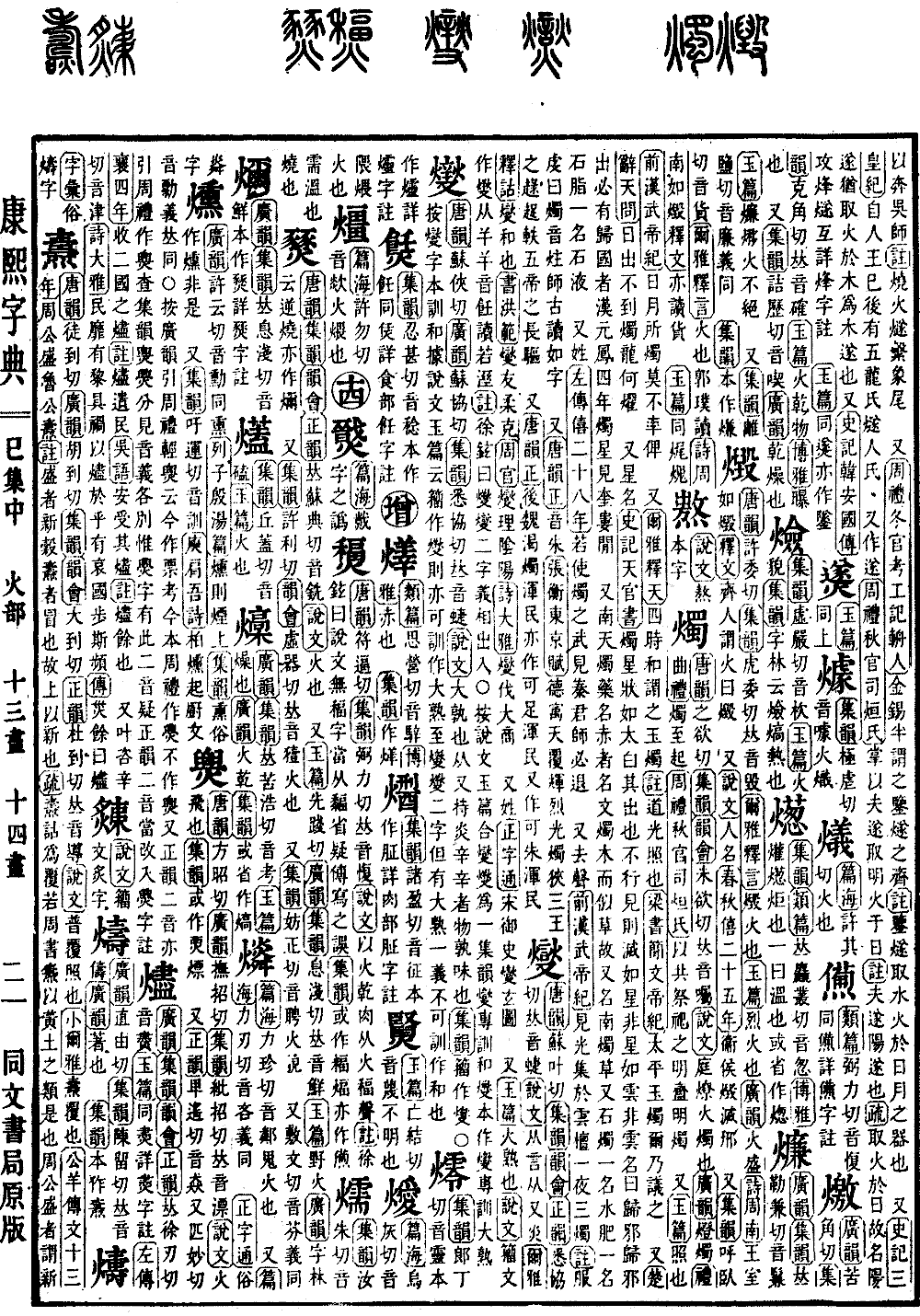
Si Collection, Middle Volume
Radical: Fire (huo)
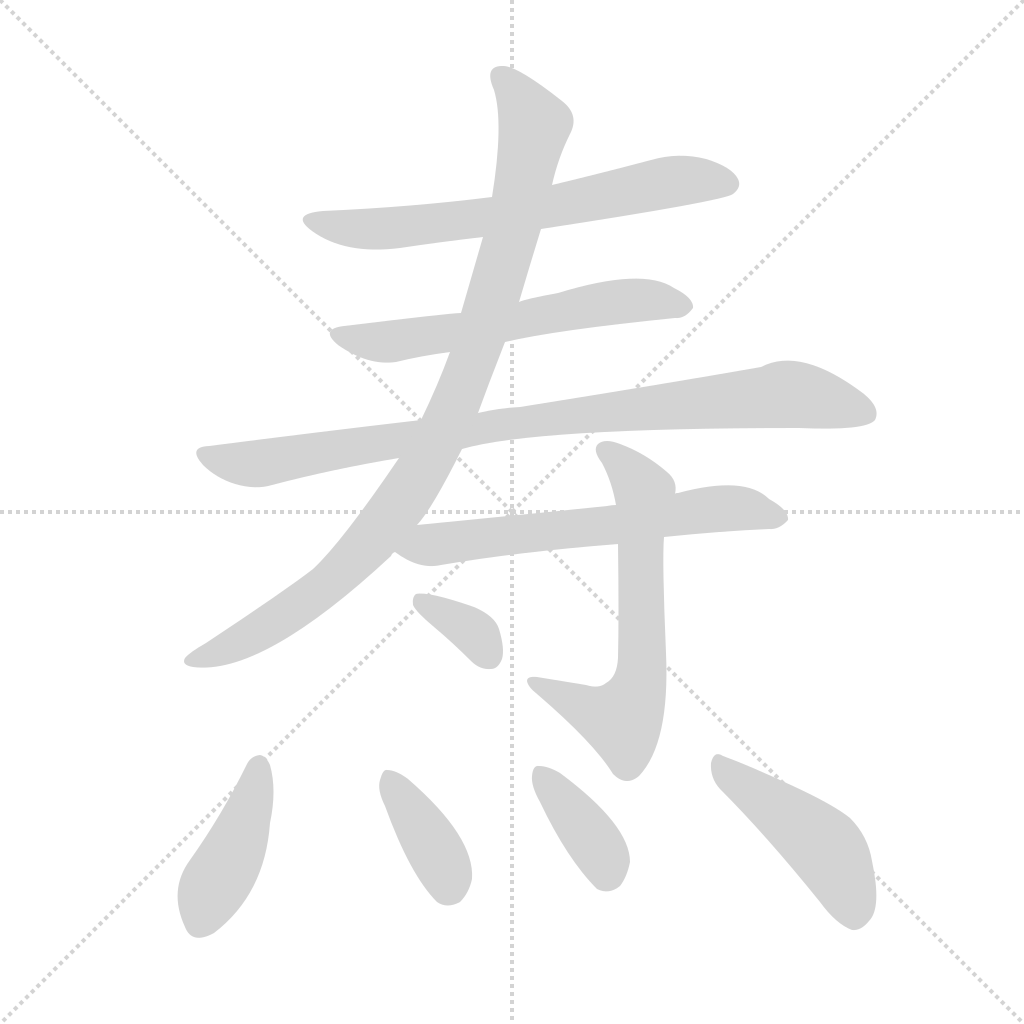
Character: Dao
Kangxi stroke count: 18
Page 685, Entry 01
Pronounced dao (falling tone). Same pronunciation as the character for guide.
Shuowen (Explaining Graphs and Analyzing Characters): Means to cover or illuminate universally.
Xiao Erya (Small Erya): Dao means to cover.
Gongyang Commentary (Gongyang Zhuan) on the thirteenth year of Duke Wen: Recorded as Duke of Zhou fills, Duke of Lu covers.
Commentary: Fills refers to new grain, covers means to put a lid on it. Therefore, one uses new things on top.
Sub-commentary: Dao is explained as to cover. It is similar to the Book of Zhou (Zhou Shu) usage where it says to cover with yellow earth. Duke of Zhou fills means the new grain fills the vessel. Duke of Lu covers means spreading old things below and adding new things on top, just enough to level it.
Explanation of Text: Dao, pronounced dao (falling tone). Some versions are written as the character for waves. The pronunciation is the same.
Guangyun (Broad Rhymes): Same as the character for a canopy or veil.
Jiyun (Collection of Rhymes): Sometimes written in a variant form.
Also used as a loan word for the character meaning honest or thick. The commentary on the Rites of Zhou (Zhou Li), Spring Officials, Supervisor of Mats and Rests, which mentions every honest table, states that the character for honest is pronounced the same as dao. It means to cover.
Also, according to Guangyun, Jiyun, and Yunhui, pronounced tao (level tone). The meaning is the same.
Also, according to Jiyun, pronounced chou (rising tone). The meaning is the same.
Jiyun: Sometimes written as a variant form.
Zhengzitong (Correction of Characters): Additionally, there is a form using the cloth radical, written as a variant form.