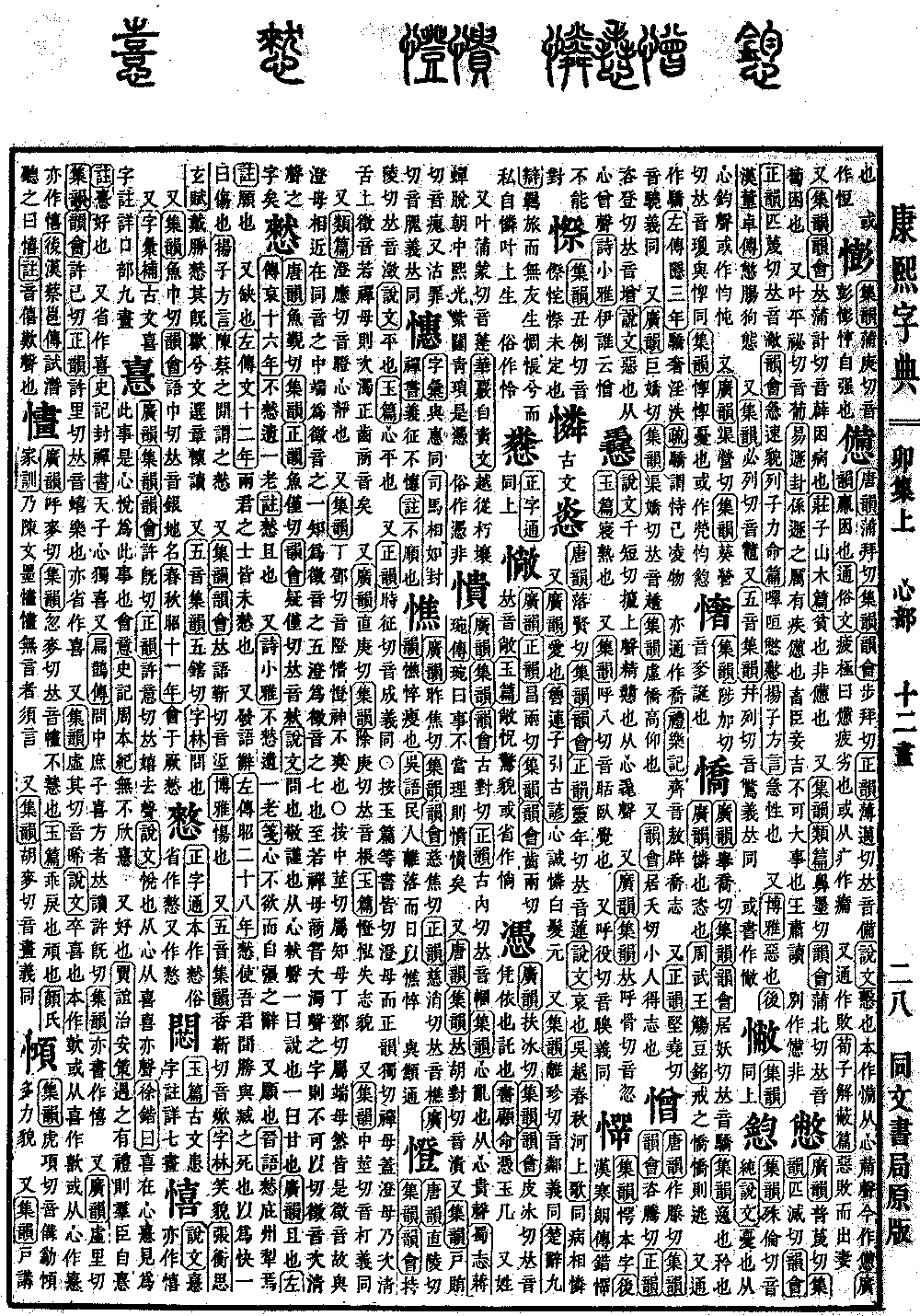
Mao Collection, Upper Volume
Radical: Heart (xīn)
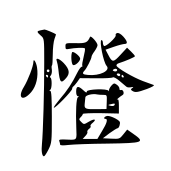
Character: cheng
Kangxi Stroke Count: 16
Page 402, Entry 20
Pronounced cheng.
Shuowen Jiezi (Explanation of Simple and Compound Characters): To be level.
Yupian (Jade Chapters): A leveled heart.
Also pronounced cheng.
Zhengyun (Correct Rhymes): Note that books such as the Yupian categorize this with the cheng initial, whereas the Zhengyun categorizes it with the chan initial. This is because the cheng initial is a secondary clear, tongue-up, zhi-note sound, while the chan initial is a secondary muddy, tooth-front, shang-note sound.
Also pronounced cheng.
Guangyun (Broad Rhymes) and Jiyun (Collected Rhymes): The appearance of being frustrated or losing one's resolve.
Also pronounced cheng.
Meaning is the same as the above.
Also pronounced deng.
A heart that is still.
Also pronounced deng.
Meng cheng, the state of one's spirit being unclear or dazed.
Note: The reading cheng (as in the entry for zhong jing) belongs to the zhi initial, and the reading deng (as in the entry for ding deng) belongs to the duan initial. Both are zhi-note sounds and are therefore phonetically close to the cheng initial. Among the phonetic groupings, duan is the first of the zhi-note sounds, zhi is the fifth, and cheng is the seventh. As for characters with the chan initial and shang-note secondary muddy sounds, they should not be used to represent characters with the cheng initial and zhi-note secondary clear sounds.