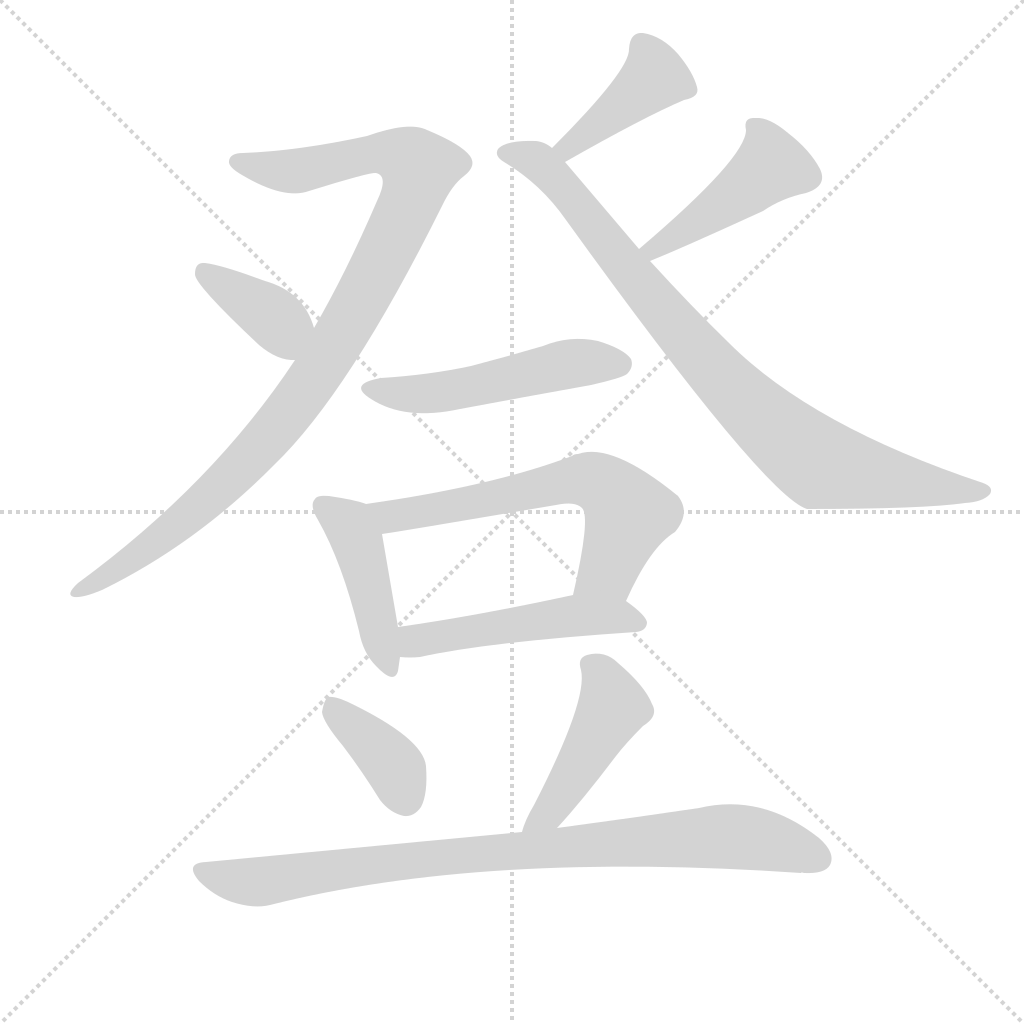
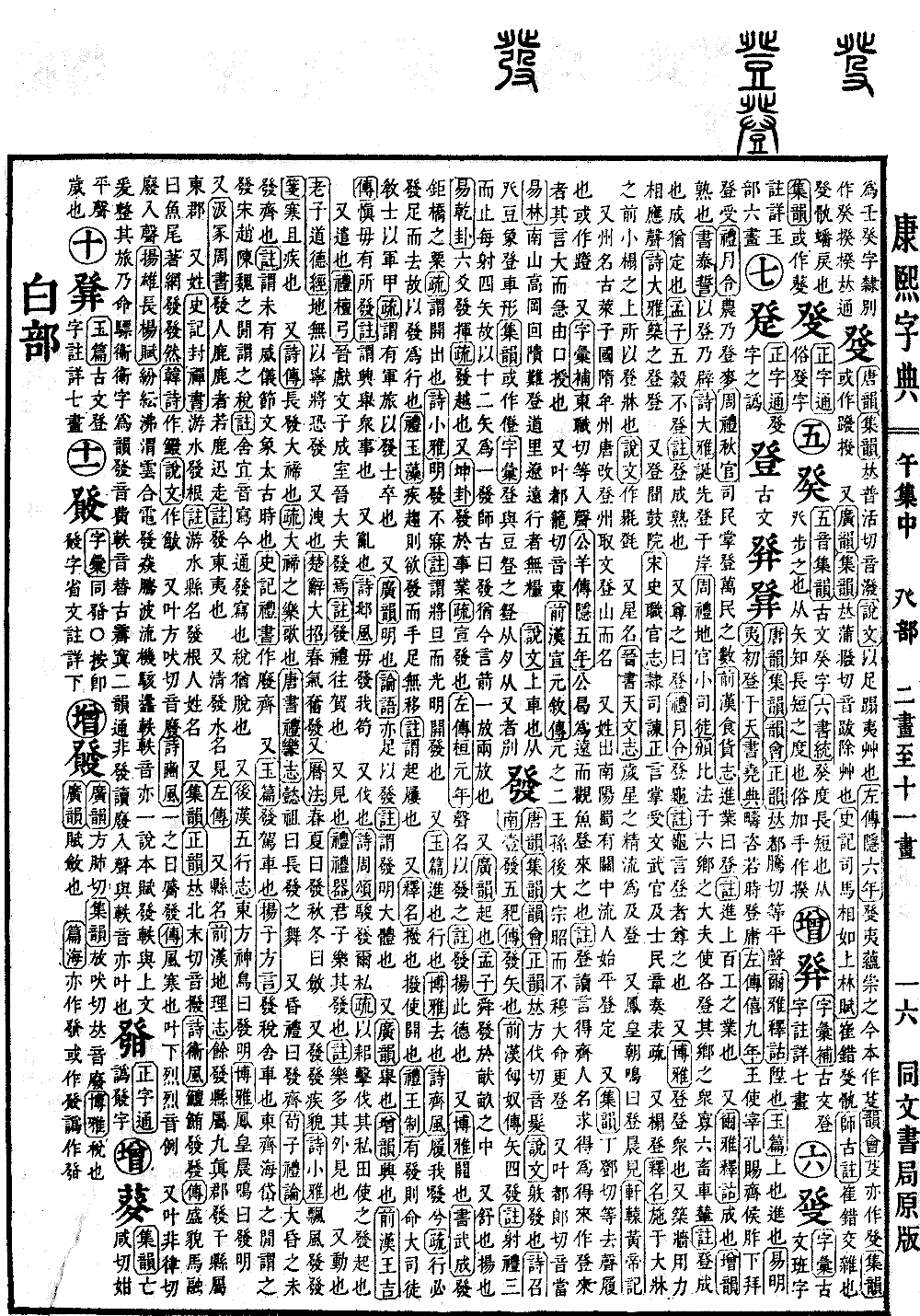
Wu Collection, Middle Volume. Radical: Footsteps (bō). Kangxi strokes: 12. Page 784, Entry 07.
Ancient form. Pronounced deng (level tone).
Book of Rites of the Tang Dynasty (Tangyun), Collection of Rimes (Jiyun), Rime Compendium (Yunhui), and Correct Rimes (Zhengyun).
Approaching of Needs (Erya): To ascend.
Jade Chapters (Yupian): To go up. To advance.
Book of Changes (Yijing): First ascending to the heavens.
Book of Documents (Shangshu): Inquire into those who are suitable to be elevated and employed.
Zuo Commentary (Zuo Zhuan): The King sent the minister Kong to bestow sacrificial meat upon the Marquis of Qi; he bowed low, ascended, and received it.
Book of Rites (Liji): The farmers harvest the wheat.
Rites of Zhou (Zhouli): The Minister of the Multitude is responsible for recording the numbers of the population.
History of the Former Han Dynasty (Qian Hanshu): Advancing one's professional work is called deng. Note: This refers to presenting the output of craftsmen to superiors.
Also: To complete.
Supplemented Rimes (Zengyun): To ripen.
Book of Documents (Shangshu): Thereby assisting your sovereign.
Book of Odes (Shijing): First ascending the bank.
Rites of Zhou (Zhouli): Distributing the laws of household registration to the officials of the six districts, so that each may report the number of people, livestock, and carriages in their district. Note: Deng means to complete. Completing is the same as settling.
Mencius: The five grains did not ripen. Note: Deng means to mature.
Also: To honor something is called deng.
Book of Rites (Liji): Venerating the tortoise. Note: Referring to the tortoise as deng is to honor it.
Also: Extensive (Boya): Deng-deng means a great multitude.
Also: The sound of building a wall with concerted effort.
Book of Odes (Shijing): Building with a resonant thud.
Also: The Bureau of Appeals.
History of the Song Dynasty (Songshi): Subordinate to the Office of Remonstrance, it was responsible for receiving petitions and memorials from officials and citizens.
Also: A footstool.
Explanation of Names (Shiming): Placed in front of a large bed, it is a small stool used for climbing onto the bed.
Analytical Dictionary of Characters (Shuowen): Originally written as a variant form.
Also: A star name.
History of the Jin Dynasty (Jinshu): The essence of the planet Jupiter flows and becomes a star.
Also: The morning cry of the phoenix is called deng-chen. See Records of the Yellow Emperor (Xuanyuan Huangdi Ji).
Also: A prefecture name. Ancient State of Lai; in the Sui Dynasty it was Mou Prefecture, and in the Tang Dynasty, it was renamed Deng Prefecture, named after Mount Deng.
Also: A surname. Originating from Nanyang; there were refugees in Shu, such as Deng Ding from Shiping.
Also: Pronounced deng (falling tone). To step on. Sometimes written as a variant form (deng).
Also: Pronounced de (entering tone).
Gongyang Commentary (Gongyang Zhuan): Why did the Duke go far to watch the fishing? It is an expression of seeking and attaining. Note: Deng is read as de. People of Qi call seeking something de, so it is written as deng-lai; the speech is emphatic and urgent, passed down by word of mouth.
Also: Rhyming with dong (level tone).
History of the Former Han Dynasty (Qian Hanshu): The two kings of the Yuan dynasty, descendants of the great ancestral line. The order of generations not in harmony, the great mandate passes to another.
Also: Rhyming with dang (level tone).
Forest of Changes (Yilin): The high ridge of the southern mountain, winding and crumbling, hard to ascend. The path is long and distant, the traveler has no provisions.
Analytical Dictionary of Characters (Shuowen): To board a carriage. Composed of the radicals for footsteps and a bean vessel, depicting the shape of climbing into a carriage.
Collection of Rimes (Jiyun): Sometimes written as a variant form (deng).
Dictionary Compendium (Zihui): Deng is distinct from the vessel-based character deng, which is composed of the radicals for moon and hand.