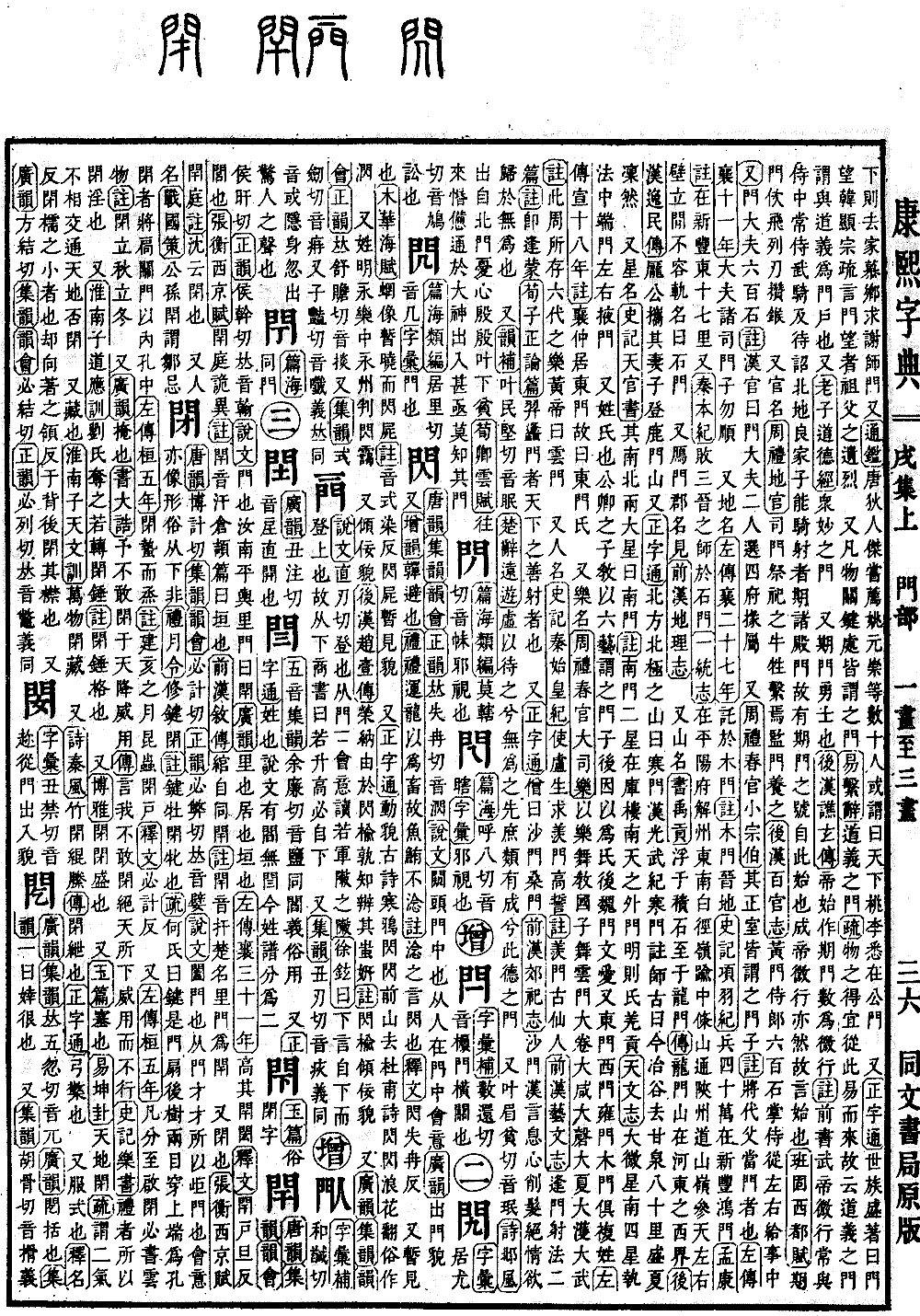
Xu Collection, Upper Volume
Radical: Door (mén)
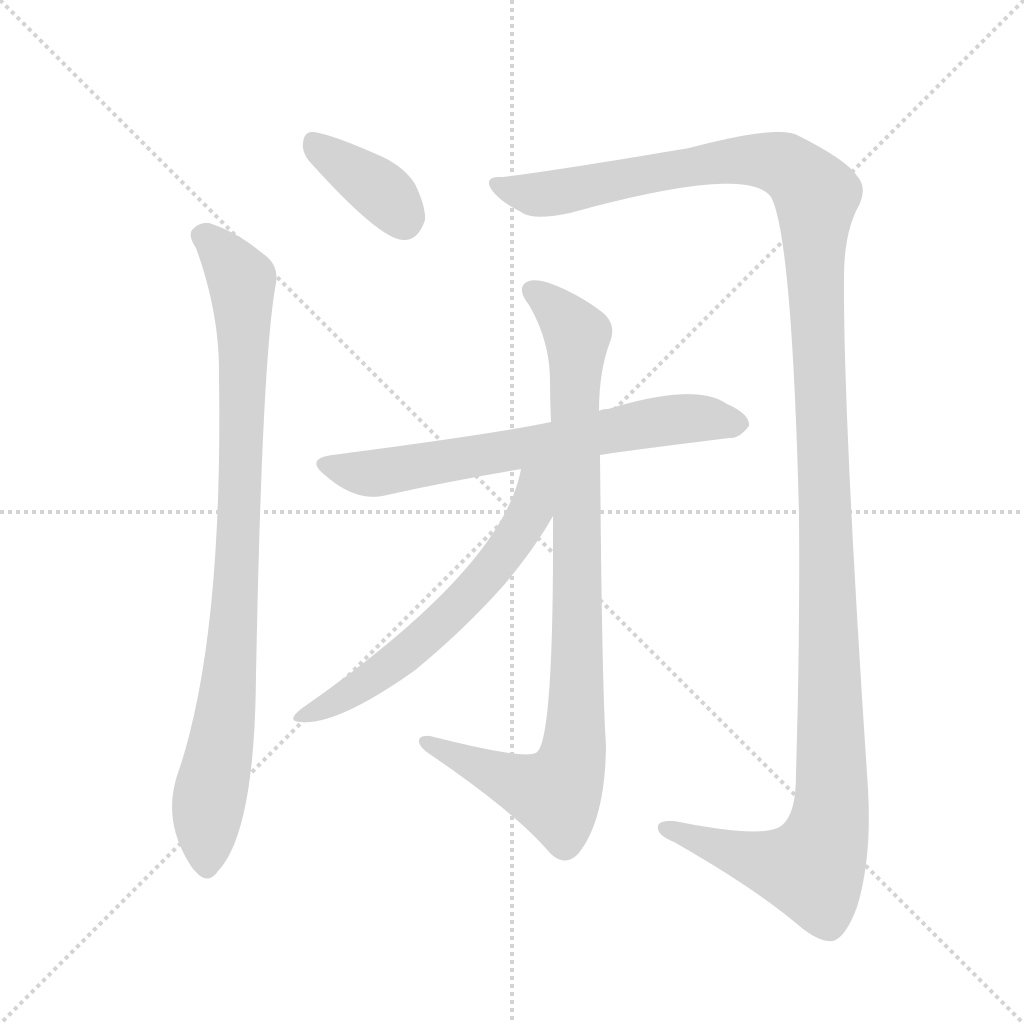
閉
Kangxi brush strokes: 11
Page 1330, Entry 06
Pronounced bi (falling tone)
According to the Analytical Dictionary of Characters (Shuowen Jiezi), it means to close a door. It is composed of the radical for door and the character for talent (cai), as talent is what bars the door. It is an ideogram and also a pictograph. Common usage incorrectly uses the character for down; this is incorrect.
In the Book of Rites (Liji), specifically the Monthly Ordinances (Yueling) chapter, it states: Repair the latches and bolts. The commentary explains: The bolt is the male part, and the latch is the female part. The sub-commentary states: Master He says the bolt is the door panel; behind it, two pieces of wood are set up, with a hole bored through the upper end. The latch is used to bar the door by placing it into the hole.
In the Zuo Tradition (Zuo Zhuan), in the fifth year of Duke Huan, it states: The insects close their doors and go into hibernation. The commentary explains: In the tenth month of the lunar calendar, insects close their entrances. The Explanations of Characters (Shiwen) says: Pronounced bi (falling tone).
Also in the Zuo Tradition (Zuo Zhuan), in the fifth year of Duke Huan, it states: Whenever the equinoxes and solstices, the openings and closings occur, the celestial phenomena must be recorded. The commentary explains: The closings refer to the beginning of autumn and the beginning of winter.
According to the Expanded Rhymes (Guangyun), it means to cover.
In the Book of Documents (Shangshu), in the Great Announcement (Dagao) chapter, it states: I dare not block the divine authority sent down by Heaven. The commentary explains: It means I dare not block or sever the divine authority sent by Heaven and prevent it from being carried out.
In the Records of the Grand Historian (Shiji), in the Treatise on Music (Yueshu), it states: Ritual is that which is used to block licentiousness.
In the Huainanzi, in the Dao Ying Xun chapter, it states: The Liu clan seized it, just like rotating a locking pin. The commentary explains: A locking pin is a restraint.
According to the Erya (Boya), bi-bi means flourishing.
According to the Jade Chapters (Yupian), it means to block.
In the Book of Changes (Yijing), in the Earth Hexagon, it states: Heaven and Earth are closed. The sub-commentary explains: This refers to the two forces not interacting; Heaven and Earth are blocked and closed off.
Also, it means to hide. In the Huainanzi, in the Astronomical Treatise (Tianwen Xun), it states: All things close and hide away.
In the Book of Odes (Shijing), in the Qin Airs (Qin Feng), it states: Bamboo binding and silk wrappings. The commentary explains: Bi refers to the ties.
The Correction of Characters (Zhengzitong) says: It refers to a bow stretcher.
Also, it refers to a type of clothing style. The Explanations of Names (Shiming) says: A fanbi is a small undergarment; it is worn backwards, with the collar folded behind the back to close the lapels.
According to the Expanded Rhymes (Guangyun), pronounced bie (entering tone).
According to the Collected Rhymes (Jiyun) and the Rhyme Compendium (Yunhui), pronounced bie (entering tone).
According to the Standard Rhymes (Zhengyun), pronounced bie (entering tone). The meaning is the same.
Textual Correction: In the Book of Rites (Liji), Monthly Ordinances (Yueling), the commentary regarding the repair of latches and bolts states the bolt is the male part and the latch is the female part; the sub-commentary mentions two pieces of wood. Based on the original text, the two eyes have been corrected to two pieces of wood.