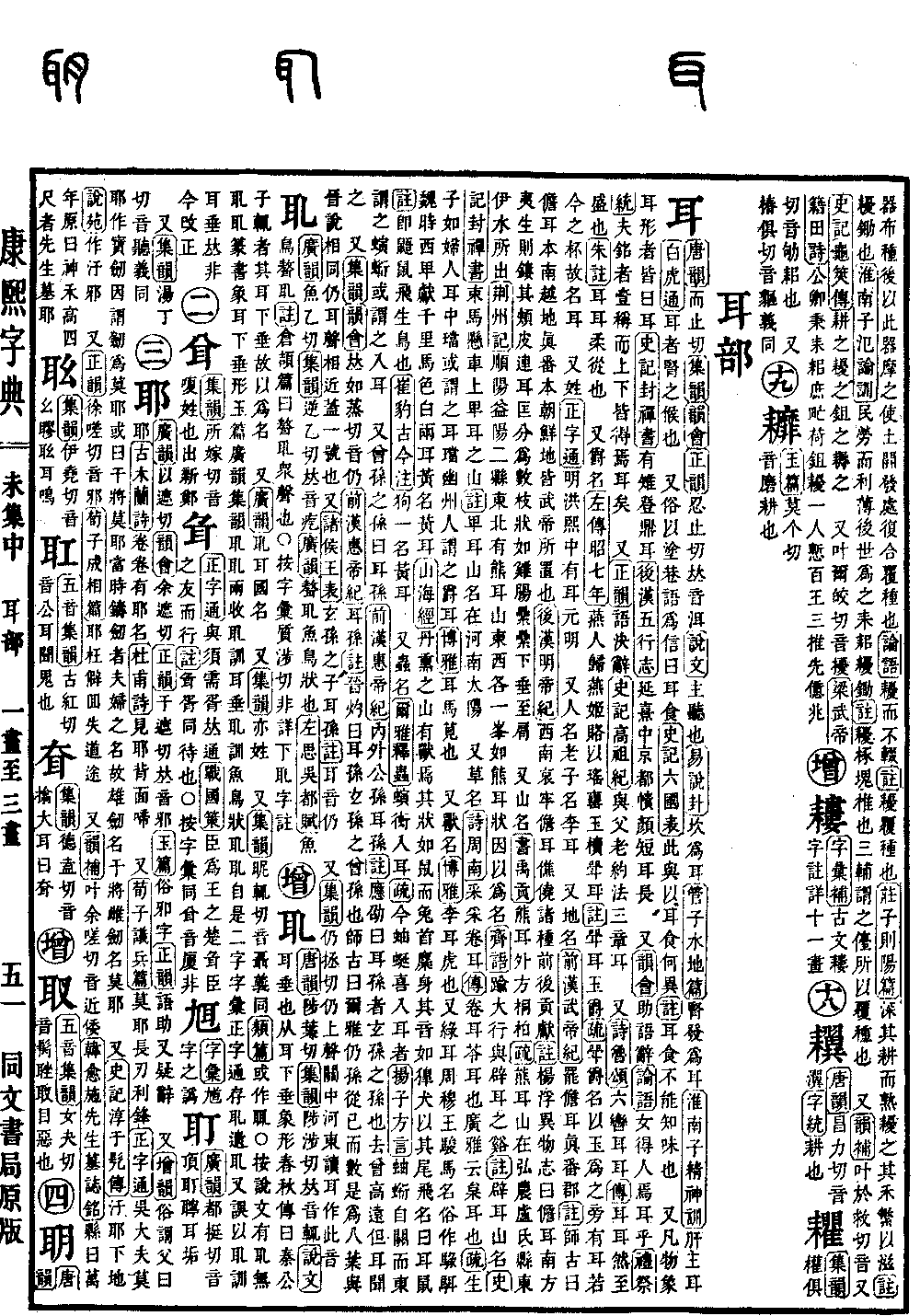
Wei Collection, Middle Volume
Radical: Ear (ěr)
Page 965, Entry 05
Pronounced ěr.
According to the Explaining Graphs and Analyzing Characters (Shuowen Jiezi), it is the organ for hearing.
In the Book of Changes (Yijing), section Discussion of the Trigrams (Shuogua), it says: The Kan trigram represents the ear.
In the Guanzi, chapter Water and Earth (Shuidi), it says: The kidneys manifest as the ears.
In the Huainanzi, chapter Teachings on the Spirit (Jingshen Xun), it says: The liver governs the ears.
In the Comprehensive Discussions in the White Tiger Hall (Baihu Tong), it says: The ears are associated with the kidneys.
Also, colloquial speech refers to accepting hearsay without verification as "ear-eating."
In the Records of the Grand Historian (Shiji), chapter Table of the Six States, it says: How is this any different from "ear-eating"? The commentary states: "Ear-eating" means one cannot discern the true flavor.
Also, anything resembling the shape of an ear is called an ear.
In the Records of the Grand Historian (Shiji), chapter Treatise on the Feng and Shan Sacrifices, it mentions a pheasant landing on the ear of a bronze vessel (ding).
In the History of the Later Han (Hou Hanshu), chapter Treatise on the Five Elements, it says: During the Yanxi reign period, the headgear in the capital had short ribbons and long ear-flaps.
Also, used as a particle.
In the Analects of Confucius (Lunyu), it says: Did you receive anything from people?
In the Book of Rites (Liji), chapter Record of Sacrificial Rites (Jitong), it says: For an inscription, one praises and then everything is complete.
Also, a closing particle.
In the Records of the Grand Historian (Shiji), chapter Annals of Emperor Gaozu, it says: I have only agreed on a law of three articles with the elders.
Also, in the Book of Odes (Shijing), chapter Odes of Lu (Lusong), it says: The six reins are (ěr ěr). The commentary states: (ěr ěr) denotes a state of extreme abundance. The commentary by Zhu Xi notes: (ěr ěr) means yielding and compliant.
Also, the name of a vessel.
In the Zuo Commentary (Zuozhuan), seventh year of Duke Zhao, it mentions: The people of Yan returned the Lady of Yan, bribing them with a jade cauldron and a jade goblet (ji ěr). The commentary explains: (ji ěr) is a jade vessel. The sub-commentary states: (ji) is a type of vessel made of jade with ears on the side, like a modern cup, hence the name.
Also, a surname.
In the Comprehensive Dictionary of Characters (Zhengzitong), it notes: During the Hongxi reign of the Ming dynasty, there was an Ear Yuanming.
Also, a personal name. Laozi was named Li Er.
Also, a place name.
In the History of the Former Han (Hanshu), chapter Annals of Emperor Wu, it says: Abolished the commanderies of Daner and Zhenfan. The commentary by Yan Shigu states: Daner was originally the territory of Nanyue, and Zhenfan was originally the territory of Joseon, both established by Emperor Wu.
In the History of the Later Han (Hou Hanshu), chapter Annals of Emperor Ming, it mentions the various tribes of the southwest such as the Ailao, Daner, and Jiaoyao, who provided tribute. The commentary quotes Yang Fu's Record of Strange Things: The Daner are a southern barbarian tribe; at birth, they carve their cheek skin, connecting it to the ear rim, divided into several branches shaped like chicken intestines, hanging down to their shoulders.
Also, a mountain name.
In the Book of Documents (Shangshu), chapter Yu's Tribute (Yugong), it mentions the Xiong'er and Waifang Tongbai mountains. The sub-commentary states: Mount Xiong'er is located east of Lushi County in Hongnong, where the Yi River originates. The Record of Jingzhou (Jingzhou Ji) states: Northeast of the two counties of Shunyang and Yiyang, there is a Mount Xiong'er; it has two peaks, east and west, shaped like bear ears, hence the name.
In the Discourses of the States (Guoyu), chapter Discourses of Qi (Qiyu), it mentions crossing the Dahang and the Bieri stream. The commentary states: Bieri is a mountain name.
In the Records of the Grand Historian (Shiji), chapter Treatise on the Feng and Shan Sacrifices, it says: Bundling horses and hanging vehicles, ascending Mount Er. The commentary notes: Er is a mountain name located in Taiyang, Henan.
Also, a plant name.
In the Book of Odes (Shijing), chapter Odes of Zhou and the South (Zhounan), it says: Gathering the (juan ěr). The commentary states: (juan ěr) is (ling ěr). The Guangya dictionary states: It is (shi ěr). The sub-commentary states: The seeds grow like the earrings worn by women, sometimes called "ear-pendants"; people in Youzhou call it "magpie ear."
In the Guangya dictionary, it says: (ěr) is the purslane plant.
Also, a beast name.
In the Guangya dictionary, it says: Li Er refers to a tiger.
Also, "Green-Ear" (Lü'er) was the name of one of the eight legendary steeds of King Mu of Zhou, sometimes written as (lü ěr). During the Wei dynasty, a horse from the west was presented; it was white with yellow ears, hence named Yellow Ear.
In the Classic of Mountains and Seas (Shanhaijing), it says: On the mountain of Danxun, there is a beast shaped like a rat with a rabbit's head and deer's body; it makes a sound like a dog and flies using its tail; it is named the Ear-Rat. The commentary notes: This is the flying squirrel, a creature that glides.
In the Book of Past and Present (Gujin Zhu) by Cui Bao, it says: Dogs are also called Yellow Ear.
Also, an insect name.
In the Erya dictionary, chapter Explaining Insects, it mentions the (yǎn) which enters the ear. The sub-commentary states: The present-day centipede often enters the ear. In the Dialect (Fangyan) by Yang Xiong, it says: The (yóu) insect is called (yǎn) east of the Hangu Pass, or sometimes called "ear-enterer."
Also, the great-grandson's grandson is called (ěr sūn).
In the History of the Former Han (Hanshu), chapter Annals of Emperor Hui, it mentions the grandsons and (ěr sūn) of those within and outside the imperial family. The commentary by Ying Shao states: (ěr sūn) means the grandson of a grandson; they are distant from the great-grandfather and grandfather, and one only hears of them by name.
Also, pronounced réng.
In the History of the Former Han (Hanshu), chapter Annals of Emperor Hui, regarding (ěr sūn), the commentary by Jin Zhuo states: (ěr sūn) means the great-grandson of a grandson. Yan Shigu states: In the Erya dictionary, the (réng sūn) is counted from oneself, which is the eighth generation; this matches Jin's theory. "Réng" and "ěr" have similar sounds, so it is likely one name.
Also, in the Table of Feudal Lords and Kings, it mentions the grandson's son as (ěr sūn). The commentary states: (ěr) is pronounced (réng).
Also, pronounced réng (rising tone). People in Guanzhong and Hedong read the character "ear" with this pronunciation.