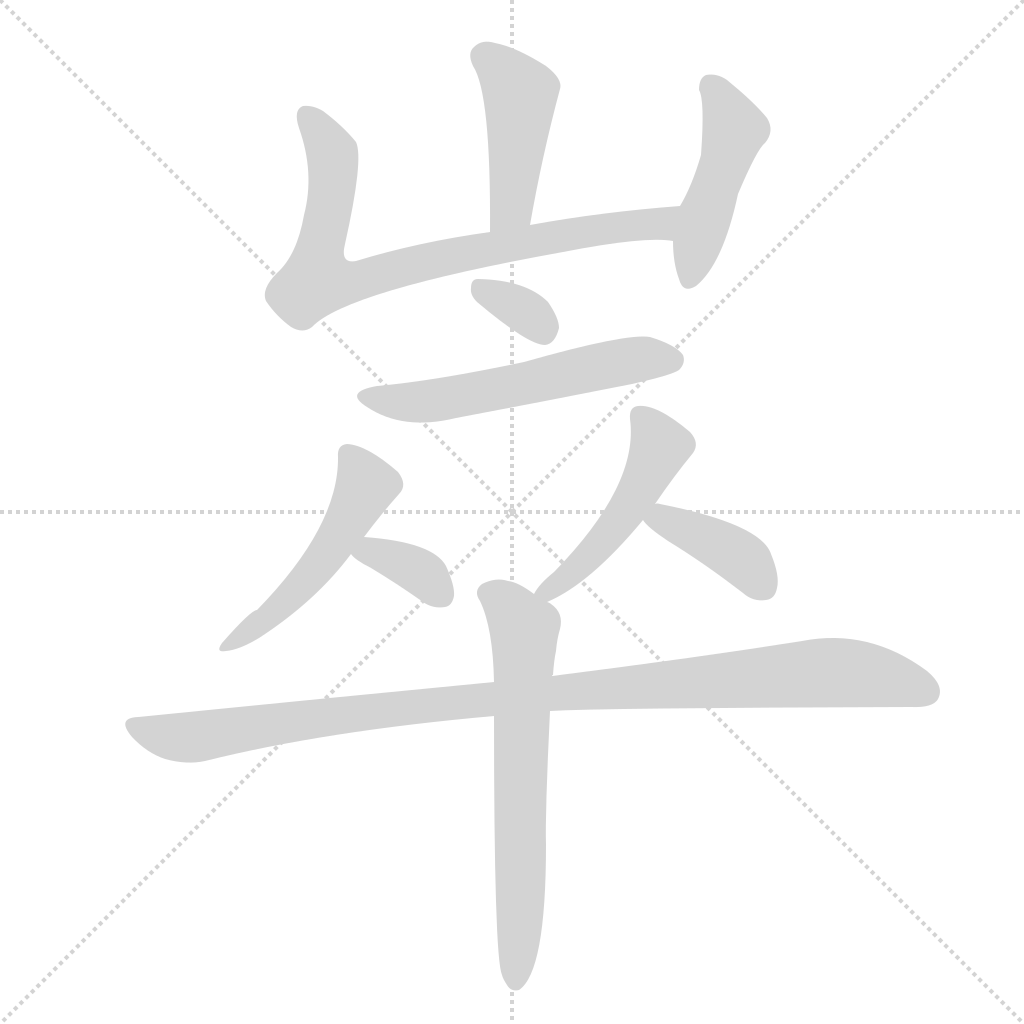
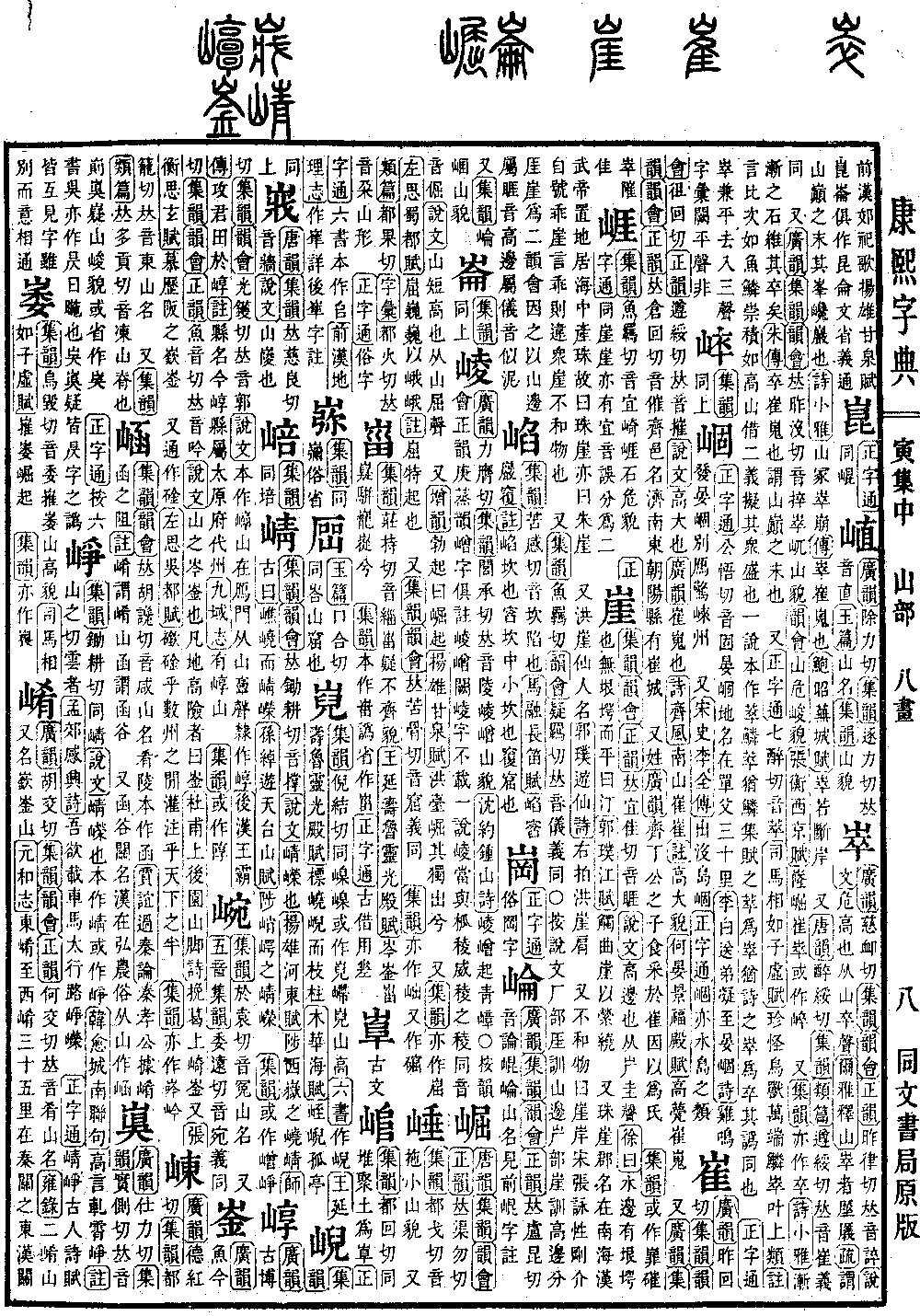
Yin Collection, Middle Volume
Radical: Mountain (shān)
Entry: 11 strokes
Page 314, Entry 03
Guangyun (Comprehensive Rhymes): Pronounced sui (falling tone). Jiyun (Collected Rhymes), Yunhui (Collection of Rhymes), Zhengyun (Correct Rhymes): Pronounced zui (entering tone).
Shuowen (Explaining Graphs and Analyzing Characters): Precipitous and high. From Radical Mountain, phonetic element zu.
Erya (Approaching Elegance), Interpretation of Mountains: The term zu means the tip of a mountain peak, where the summit is jagged and steep.
Book of Odes (Shijing), Lesser Odes: The mountain peak is precipitous and collapses. Commentary: Zu means craggy and towering.
Bao Zhao, Rhapsody on the Ruined City: Precipitous, like a broken bank.
Also, Tangyun (Tang Rhymes): Pronounced sui (level tone). Jiyun, Leipian (Classified Chapters): Pronounced cui (level tone). Meaning is the same.
Also, Guangyun, Jiyun, Yunhui: Pronounced zu (entering tone). Zu-wu, the appearance of a mountain. Yunhui: The appearance of a mountain that is precipitous and steep. Zhang Heng, Rhapsody on the Western Capital: Towering and craggy. Sometimes written in a variant form (zu).
Also, Jiyun: Sometimes written as (zu). Book of Odes (Shijing), Lesser Odes: The protruding stones, they are truly precipitous. Zhu Commentary: (Zu) means craggy and towering. It refers to the tip of a mountain peak.
Also, Zhengzitong (Correct Character Mastery): Pronounced cui (falling tone). Sima Xiangru, Rhapsody on the Sir Fantasy: Rare birds and beasts, ten thousand varieties with scales gathered like mountains. Rhymes with the category above. Note: It means they are arranged like fish scales and piled up high like mountains, borrowing these two meanings to suggest their great number. Another theory states that the original character was (cui), meaning fish scales gathered together like a crowd. Using (zu) for (cui) is like the Book of Odes using (zu) for (zu); it is the same type of orthographic variation. Zhengzitong: The character (zu) encompasses the level, falling, and entering tones. The Dictionary of Chinese Characters (Zihui) omits the level tone, which is incorrect. Included are the variants (zui) and (zui).