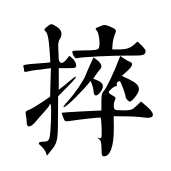
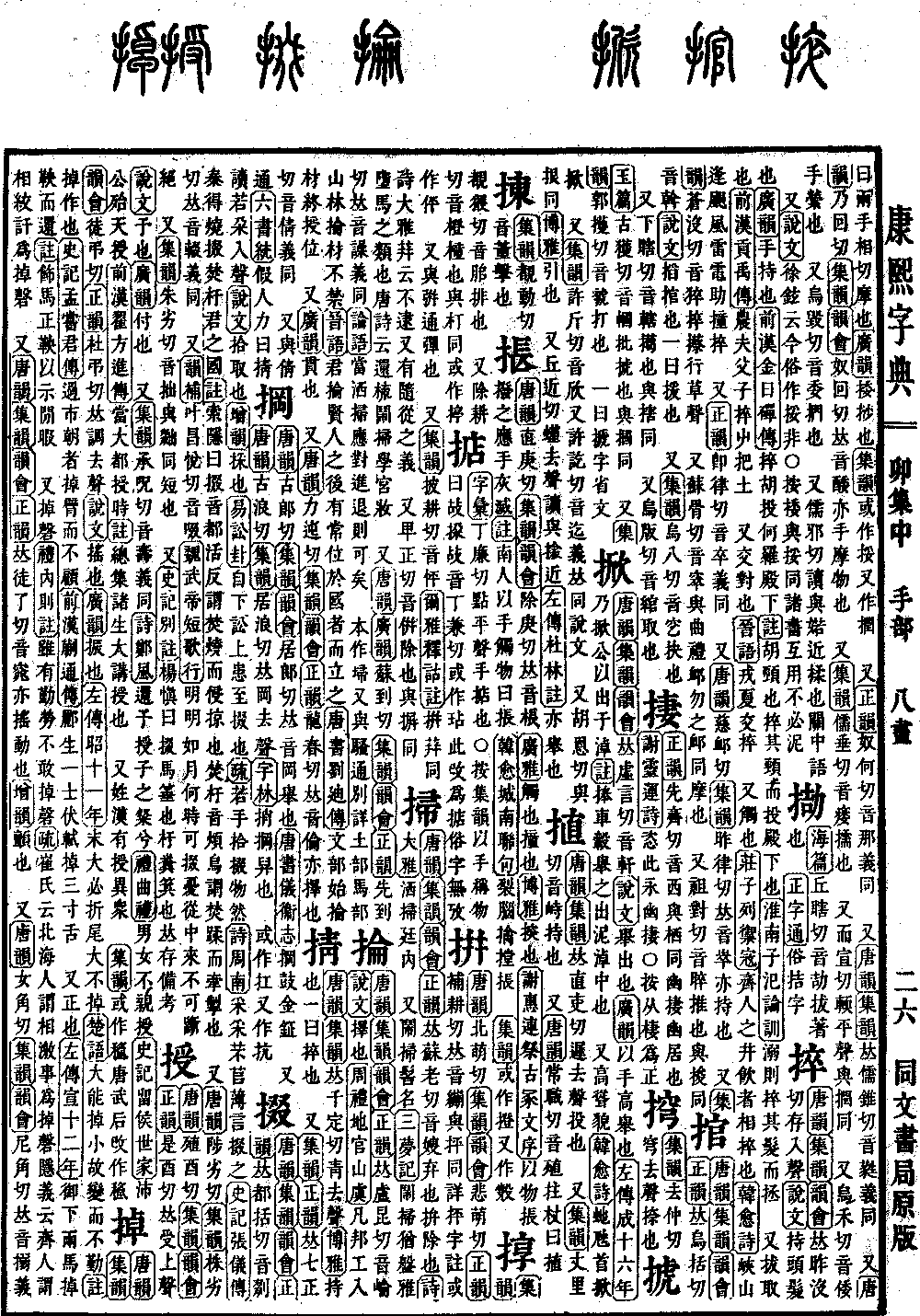
Mao Collection, Middle Volume. Radical: Hand (shǒu). Kangxi stroke count: 12. Page 436, Entry 02.
According to the Tang Rhyme (Tangyun), Collected Rhymes (Jiyun), and Rhyme Compendium (Yunhui), it is pronounced zuo (entering tone). Defined in the Explaining Graphs and Analyzing Characters (Shuowen Jiezi) as grasping by the hair. According to the Broad Rhyme (Guangyun), it means to grasp or hold with the hand. The Biography of Jin Midi in the History of the Former Han (Qian Han Shu) records: He grasped the neck and threw him beneath the palace steps. The commentary notes that the term refers to the neck, meaning he grabbed his neck and threw him under the hall. The Huainanzi states that when drowning, one grabs the hair to provide assistance.
It also means to pluck or pull up. The Biography of Gong Yu in the History of the Former Han mentions peasant fathers and sons pulling up weeds and grasping soil. It also refers to mutual struggle. The Discourses of Jin (Jinyu) records: The Rong and the Xia peoples grappled with one another.
It also refers to colliding or clashing. The Zhuangzi states that when men of Qi dug a well, those who came to drink water grappled with one another. A poem by Han Yu writes: In the gorge mountains, I encountered a typhoon, with thunder and lightning aiding the collision and clashing.
Furthermore, according to the Correct Rhymes (Zhengyun), it is pronounced zu (entering tone). The meaning is the same.
According to the Tang Rhyme (Tangyun), it is pronounced xu (entering tone), and according to the Collected Rhymes (Jiyun), it is pronounced zu (entering tone). It also means to hold or take.
According to the Collected Rhymes (Jiyun), it is pronounced cu (entering tone). The term cu-ca refers to the sound of walking through grass.
It is also pronounced su (entering tone), similar to the character xu in the phrase xu-wu found in the Book of Rites (Liji). It means to rub or chafe.
It is also pronounced zui (falling tone). It means to push, synonymous with the character zun.