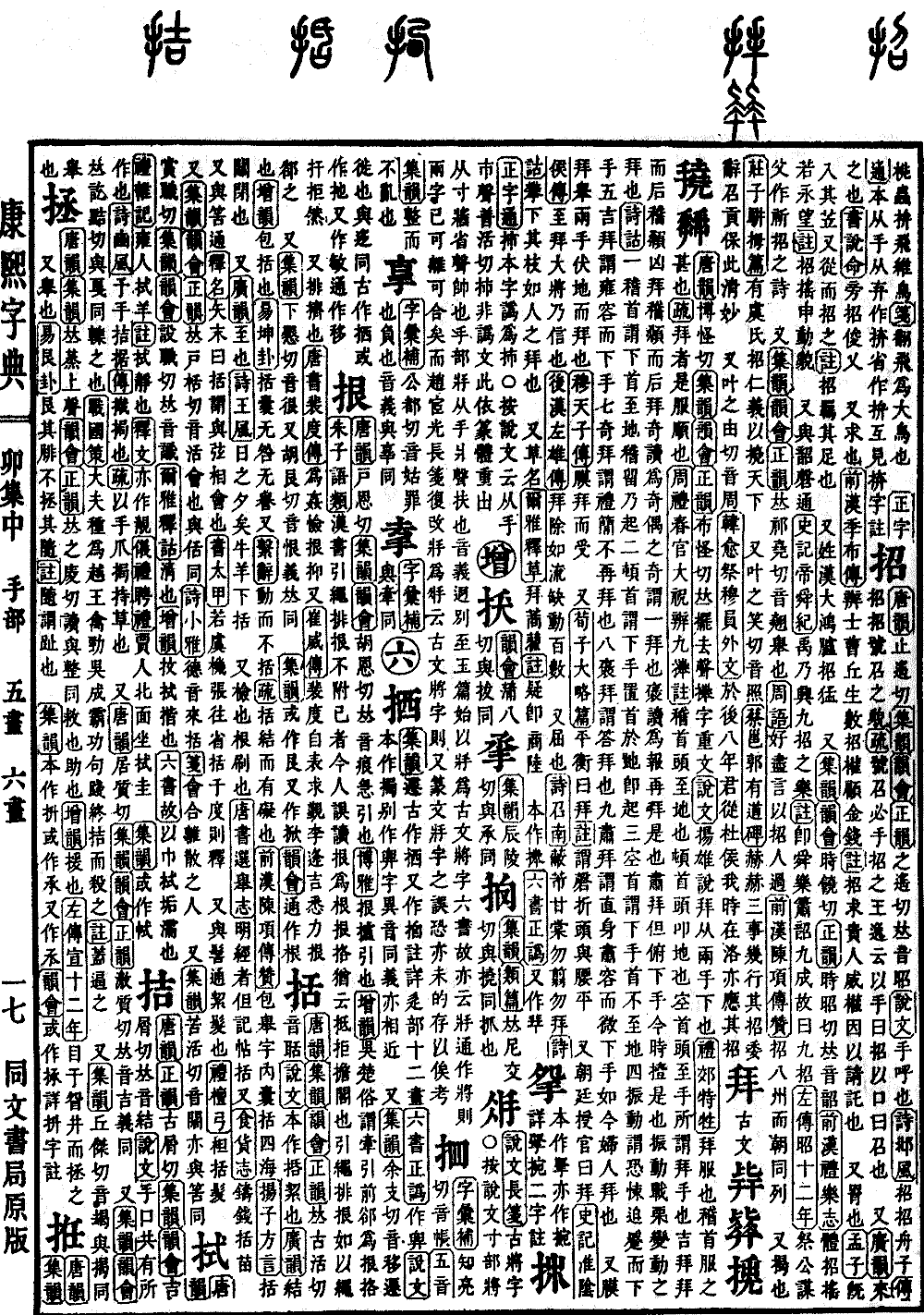
Mao Collection, Middle Volume
Radical: Hand (shǒu)
Page 427, Entry 01
Pronounced zhao. According to the Shuowen Jiezi (Explaining Graphs and Analyzing Characters), it means to summon someone with the hand. In the Book of Odes (Shijing), it says, "Beckoning, the boatman." The commentary explains that this refers to the appearance of summoning. The sub-commentary further explains that when summoning, one must use the hand. Wang Yi stated: using the hand is called zhao, using the mouth is called zhao.
Also defined as causing someone to come. In the Book of Documents (Shangshu), it says, "Widely summon talented and virtuous people."
Also defined as to seek or acquire. The History of the Former Han Dynasty (Qian Hanshu) records the rhetorician Cao Qiusheng repeatedly "seeking power and money." The commentary explains this as seeking the influence of the powerful to facilitate personal requests.
Also defined as to restrain or bind. Mencius says, "Having entered the pen, one then follows to restrain it." The commentary explains this as binding its feet.
Also serves as a surname. For example, in the Han Dynasty, there was a Minister of Ceremonial Rites named Zhao Meng.
Pronounced shao. The History of the Former Han Dynasty (Qian Hanshu) says, "Body swaying, as if gazing into the distance." The commentary explains that "swaying" describes a stretching and swinging motion.
Also interchangeable with shao (the name of an ancient musical piece). The Records of the Grand Historian (Shiji) records, "Yu then initiated the music of the Nine Zhao." The commentary says this refers to the music of Emperor Shun, Xiaoshao, performed nine times, hence it is called "Nine Zhao." The Zuo Commentary (Zuo Zhuan) records that Ji Gong Moufu wrote the poem "Qi Zhao."
Pronounced qiao. Defined as to raise or induce. In the Discourses of the States (Guoyu), it says, "Fond of speaking exhaustively to induce others' faults." The History of the Former Han Dynasty (Qian Hanshu) says, "Summoned the eight states and made their peers come to pay homage."
Also defined as to reveal or raise high. The Zhuangzi says, "The Yu dynasty raised benevolence and righteousness to disturb the world."
Also pronounced zhao (rhyming variant). In Cai Yong's Stele for Guo Youdao, it says, "Glorious are the three ministers, often performing their summon. Resigning from office and refusing tribute, they preserved this pure excellence."
Also pronounced zhou (rhyming variant). In Han Yu's Eulogy for Li Shijun of Chenzhou, it says, "Eight years later, you followed Marquis Du. I was in Luoyang at the time, also responding to its summon."