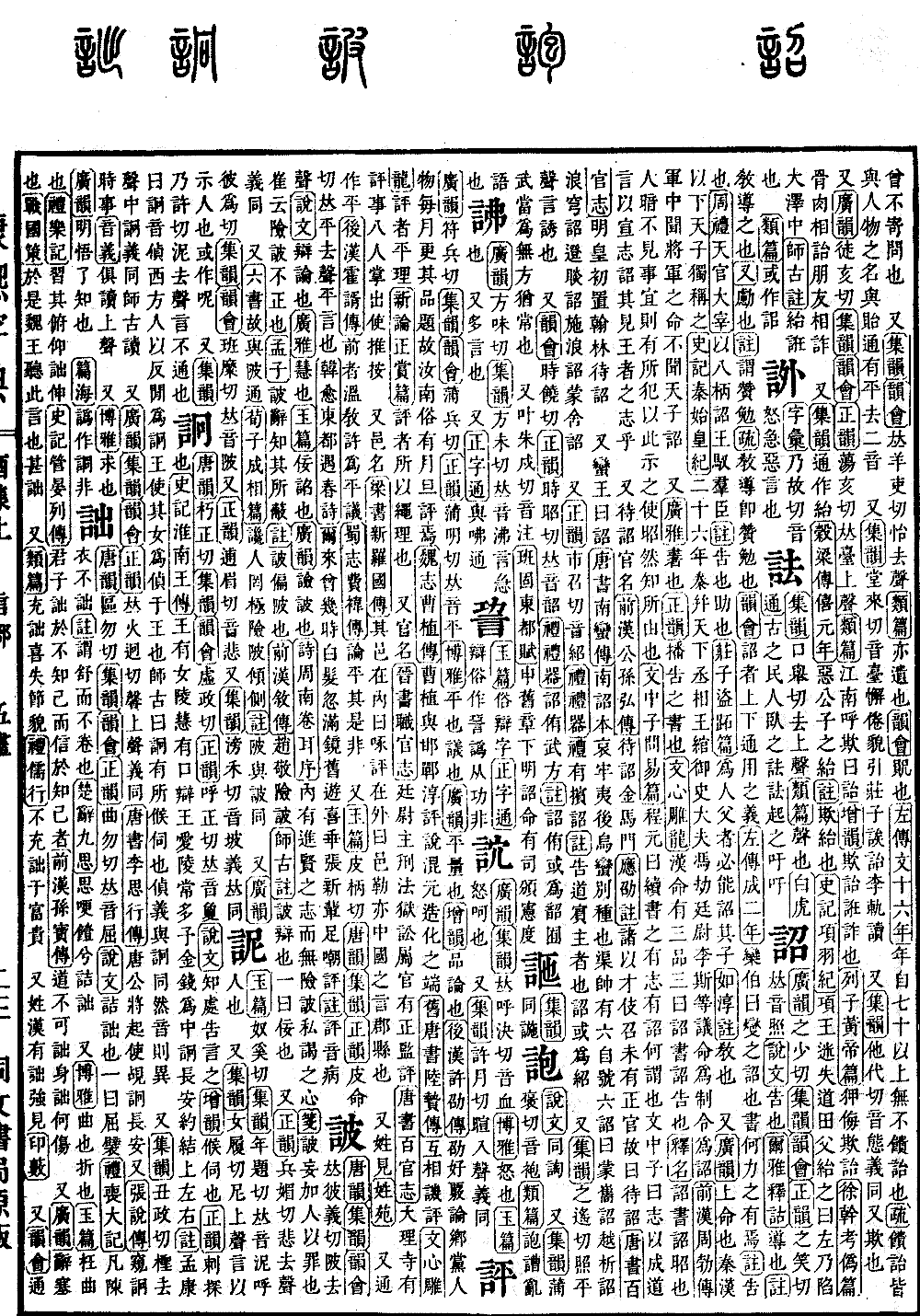
You Collection, Upper Volume
Radical: Speech (yán)
詔
Kangxi strokes: 12
Page 1155, Entry 01
Pronounced zhào.
Shuowen Jiezi: To inform.
Erya, Explanation of Words: To guide. Note: To instruct and guide. Also: To assist. Note: Meaning to praise and encourage. Commentary: Instructing and guiding is the same as praising and encouraging.
Rhyme Collection: The term zhao signifies a meaning used by both superiors and subordinates.
Zuo Zhuan, Second Year of Duke Cheng: Luan Bo said: It is Xie's instruction. What effort does the writing have in it? Note: To inform.
Rites of Zhou, Offices of Heaven, Grand Administrator: Use the eight handles to instruct the king in governing all officials. Note: To inform, to assist.
Zhuangzi, Robber Zhi Chapter: A person who is a father must be able to instruct his son. Ru Chun's Note: To teach.
Also, Broad Rhymes: An order from a superior. From the Qin and Han dynasties onward, the Son of Heaven used this term exclusively.
Records of the Grand Historian, Annals of Qin Shi Huang: In the twenty-sixth year, when Qin unified the world, Chancellor Wang Wan, Grandee Secretary Feng Jie, and Commandant of Justice Li Si and others discussed naming commands as zhi and edicts as zhao.
Book of Han, Biography of Zhou Bo: In the army, one hears the commander's orders, not the Son of Heaven's edict.
Also, Broad Rhymes: To announce. Proper Rhymes: A document of public announcement.
Literary Mind and the Carving of Dragons: Han imperial orders had three grades; the third was the edict (zhaoshu). Zhao means to inform.
Explanation of Names: Edict (zhaoshu). Zhao means to illuminate (zhao). When people are in the dark and cannot see the proper course of affairs, they commit offenses; by using this to show them, they are made to clearly know the path to follow.
Master of Culture, Questions on the Book of Changes: Cheng Yuan said: In the continuation of the documents there are records and there are edicts; what do these mean? The Master of Culture said: Records are used to complete the Dao, words are used to proclaim the records, and edicts are what manifest the king's will.
Also, waiting for an edict, an official title.
Book of Han, Biography of Gongsun Hong: Waiting for an edict at the Golden Horse Gate. Ying Shao's Note: Those who are summoned for their talent or skills but do not yet have a formal office are called waiting for an edict.
Book of Tang, Treatise on Officials: Emperor Ming initially established the Hanlin wait for an edict position.
Also, a king of the barbarians is called a zhao.
Book of Tang, Treatise on Southern Barbarians: The Southern Zhao were originally descendants of the Ailao barbarians and a distinct branch of the Wu barbarians. Their chieftains numbered six and styled themselves the Six Zhao, namely: Mengsui Zhao, Yuexi Zhao, Langqiong Zhao, Dengshan Zhao, Shilang Zhao, and Mengshe Zhao.
Also, Proper Rhymes: Pronounced shào.
Book of Rites, Vessels of Ritual: Ritual has an announcer. Note: One who announces the path for guests and hosts. Zhao is sometimes written as shào.
Also, Collected Rhymes: Pronounced zhào (level tone). Means to entice.
Also, Rhyme Collection: Pronounced sháo. Proper Rhymes: Pronounced sháo.
Book of Rites, Vessels of Ritual: Announcing and assisting in the martial rites. Note: Announcing and assisting is sometimes written as sháoyòu; wu should be wu (none), and fang is equivalent to chang (constantly).
Also, rhyming with the sound zhù.
Ban Gu, Eastern Capital Rhapsody: Renewing old statutes, issuing bright edicts, and ordering the relevant authorities to distribute the regulations.