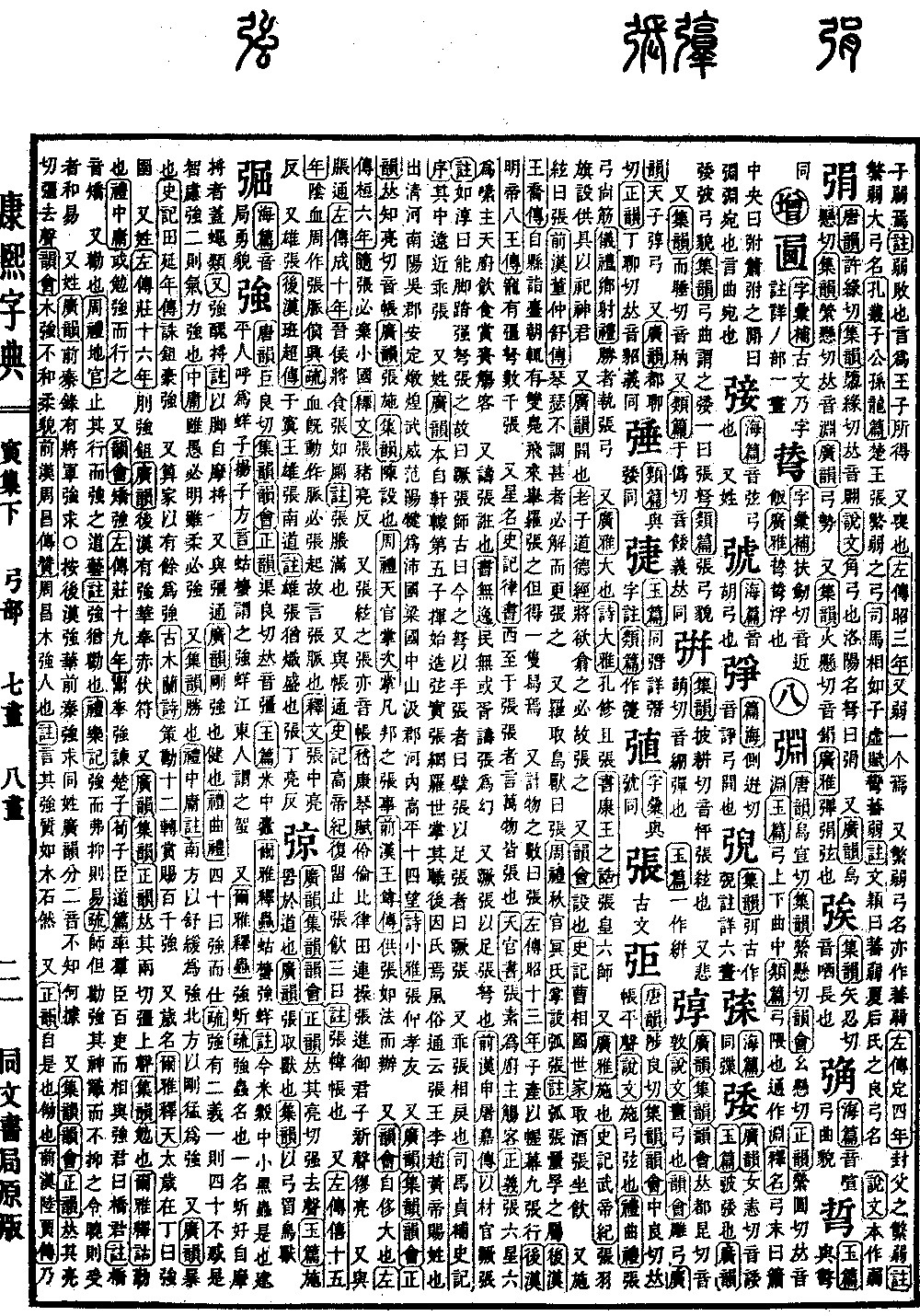
Yin Collection, Lower Volume
Radical: Bow (gōng)
Kangxi Strokes: 11
Page 359, Entry 01
Ancient form is written as (qiáng).
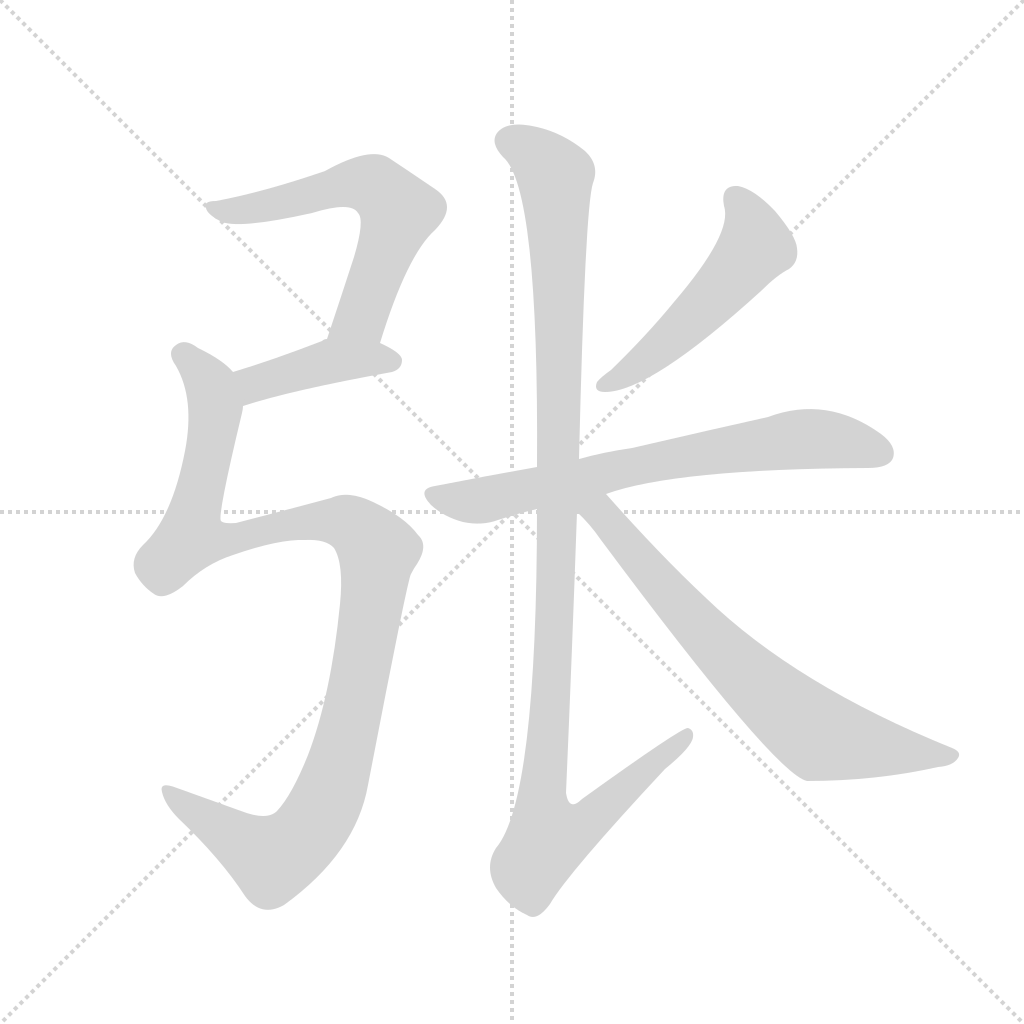
Pronounced zhāng.
Defined in Explaining Graphs and Analysis of Characters (Shuowen Jiezi) as the act of stringing a bow.
Book of Rites (Liji): To draw a bow, one must value the sinew.
Ceremonial Rites (Yili): The victor holds the drawn bow.
Also, in Broad Matters (Guangya), defined as big.
Book of Odes (Shijing): Very long and great.
Book of Documents (Shujing): To expand and awe the six armies.
Also, in Broad Matters (Guangya), defined as to apply.
Records of the Grand Historian (Shiji): Set up feather flags and prepare offerings to sacrifice to the spirit kings.
Also, in Broad Rhymes (Guangyun), defined as to open.
Laozi (Daodejing): If you wish to shrink something, you must first stretch it.
Also, in Collection of Rhymes (Yunhui), defined as to set up.
Records of the Grand Historian (Shiji): Ordered wine to be taken and seats set up for drinking.
Also, applying a string is called zhang.
Book of Han (Hanshu): If the qin and se (traditional zithers) are extremely out of tune, they must be unstrung and restrung.
Also, using nets to capture birds and animals is called zhang.
Rites of Zhou (Zhouli): Responsible for setting up bows and nets. Commentary: Bows and nets are a category of traps and nets.
Book of the Later Han (Houhanshu): Whenever he went from the county to the terrace for an audience, a pair of wild ducks would fly down; he would raise a net to capture them but only obtain a single shoe.
Also, a unit for counting objects is called zhang.
Zuo Tradition (Zuo Zhuan): Zi Chan traveled with nine sets of curtains.
Book of the Later Han (Houhanshu): Chong had several thousand crossbows.
Also, the name of a constellation.
Records of the Grand Historian (Shiji): To the west it reaches Zhang. Zhang means that all things are expanded.
Treatise on the Celestial Offices (Tianguan Shu): The Zhang constellation is a kitchen, presiding over the entertaining of guests. Commentary: Zhang consists of six stars, which act as the gizzard, presiding over the heavenly kitchen and food, as well as rewards and entertaining guests.
Also, zhuu-zhang means to deceive.
Book of Documents (Shujing): May the people not practice deception and create illusions.
Also, jue-zhang refers to using the feet to draw a crossbow.
Book of Han (Hanshu): Using skilled soldiers for foot-drawn crossbows. Commentary: Ru Chun states: Being able to use the feet to step on and draw a strong crossbow is why it is called jue-zhang. Shigu states: Modern crossbows drawn by hand are called bo-zhang, those drawn by feet are called jue-zhang.
Also, guai-zhang means to be contrary or at odds.
Sima Zhen: Among them, the distances are contrary.
Also a surname.
Broad Rhymes (Guangyun): Originally descended from Hui, the fifth son of the Yellow Emperor, who first invented the bowstring and was the first to use nets; the family held this position for generations and later adopted it as their surname. Customs (Fengsu Tong) states: Zhang, Wang, Li, and Zhao were surnames bestowed by the Yellow Emperor. There are fourteen prominent lineages originating from Qinghe, Nanyang, Wujun, Anding, Dunhuang, Wuwei, Fanyang, Jianwei, Peiguo, Lianguo, Zhongshan, Jijun, Henei, and Gaoping.
Book of Odes (Shijing): Zhang Zhong is filial and friendly.
Also pronounced zhàng.
Broad Rhymes (Guangyun): To spread out or apply.
Collection of Rhymes (Yunhui): To set up.
Rites of Zhou (Zhouli): Responsible for all state setup affairs.
Book of Han (Hanshu): The preparations were carried out according to the regulations.
Also, in Collection of Rhymes (Yunhui), refers to being self-indulgent or arrogant.
Zuo Tradition (Zuo Zhuan): If Sui and Zhang are followed, one must abandon small states.
Also, the zhang in stringing a bow is also pronounced zhàng.
Ji Kang (Qin Fu): Ling Lun compared the pitches, fields and strings were arranged, and they were presented to the gentleman with new sounds.
Also interchangeably used with the character for bloating (zhàng).
Zuo Tradition (Zuo Zhuan): The Duke of Jin was about to eat and felt bloated, so he went to the latrine. Commentary: Zhang means to be bloated or full.
Also interchangeably used with the character for tent (zhàng).
Records of the Grand Historian (Shiji): Remained to stop and set up tents to drink for three days. Commentary: Zhang means curtains and tents.
Also, Zuo Tradition (Zuo Zhuan): The evil blood circulated, the pulses swelled and rose. Commentary: Once the blood moves, the pulses must swell and rise, hence it is called zhang.
Also, xiong-zhang.
Book of Later Han (Houhanshu): The King of Yutian was powerful and ambitious in the southern region. Commentary: Xiong-zhang is like saying burning or flourishing.